
Basic Information
Scientific classification
- Chinese name: New Zealand duck
- Scientific name: Brown Duck, Anas chlorotis, Brown Teal
- Classification: Waterfowl
- Family: Anseriformes, Anatidae, Anatidae
Vital signs data
- Body length: Approximately 48 cm
- Weight: 530-700g
- Lifespan: No verification data available.
Significant features
Very timid, mainly active at night.
Distribution and Habitat
It is distributed in the lowlands and freshwater wetlands of several offshore islands in New Zealand, with a population estimated at around 1,000. Small populations also exist on Little Barrier Island, Big Screen Island, Rakitu Island, Chuanyu Island, Moturoa Island, Tiritiri Mataki Island, and Kapiti Island, mainly through captive breeding and reintroduction.
They inhabit a variety of environments on the island, including grasslands, thickets, and coastlines. They are mostly found in coastal swamps, ponds, and lowland forests.
Appearance
The New Zealand duck measures 48 cm in length; males weigh 620–700 grams, and females 530–600 grams. It has dark brown plumage, with males developing a bright green head during the breeding season, and the breast feathers darken to chestnut. The breast and wings are reddish-brown with brown tips. White stripes run along the sides of the body, and some also have a white collar. Non-breeding plumage is almost identical for females, juveniles, and males, with mottled brown feathers edged with lighter colors. The bill is blue. A green frame should be present around the speculum on the wing. This species distinguishes itself from other red-eyed ducks of the same genus by its chestnut-colored eyes with white eye rings.
Detailed introduction
The New Zealand duck (scientific name: Anas chlorotis), also known as the Brown Teal, was once one of the three subspecies of the brown duck, but was reclassified as a separate species in 1993.
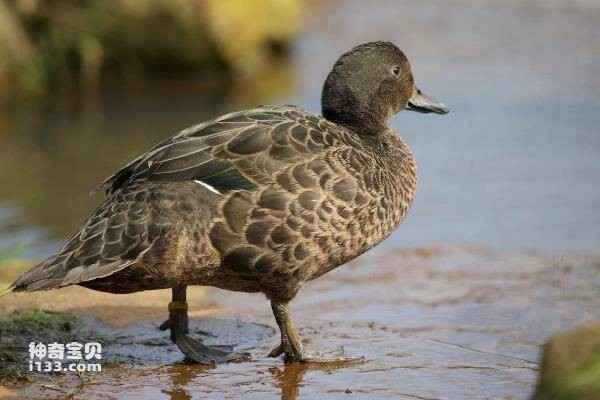
New Zealand ducks are not good fliers and are nocturnal wading ducks, active from dawn to dusk, hiding during the day to avoid predators. They are primarily nocturnal, hiding in grass and hanging plants during the day. They generally live in pairs or small family groups. They never gather in large flocks, and adult male and female ducks live together. They are adept divers, obtaining food underwater. Their toes are webbed, and their tails surface when swimming. They are skilled at foraging, playing, and courtship in the water. Playing in the water helps with feather hygiene and growth.
New Zealand ducks primarily feed on aquatic invertebrates and plant debris in both fresh and brackish water, and also forage in grasslands near water sources. They also feed on worms and insects, and catch small shells at river mouths at night.
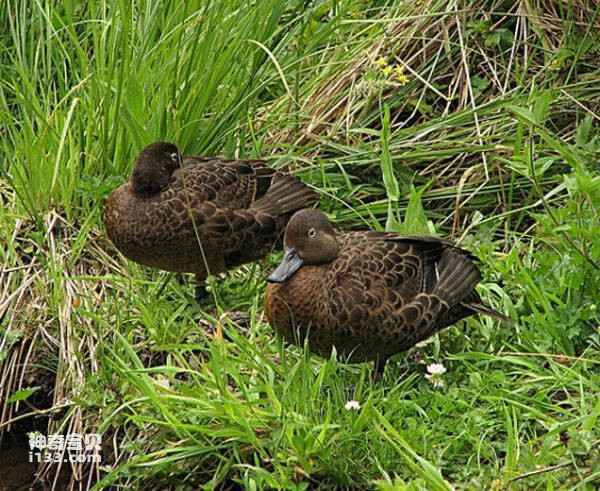
New Zealand ducks nest and breed in dense vegetation along the coastline, 100-200 meters away, from July to November. During this time, they are very territorial, driving away and even killing other ducks that intrude into their territory. The nests are built above nearby water bodies and concealed among aquatic plants. The female typically lays 5-6 eggs. During this period, the ducks are active at night. They incubate their eggs during the day in the riverside vegetation. Incubation takes 27-30 days. The ducklings take about 55 days to fully develop their feathers, but they remain with their families until the next breeding season.
In 2005, BirdLife International surveyed more than 1,100 birds on Daping Island and Beidao Island. The total number in 2012 was estimated at 700 pairs, indicating that the population of this species is c.1,900, which can be considered to include c.1,300 mature individuals, based on the assumption that this accounts for 2/3 of the total.
Listed as Endangered (EN) on the IUCN Red List of Threatened Species 2013 ver 3.1.
Listed as an animal under Appendix I of CITES (Convention on International Trade in Endangered Species of Wild Fauna and Flora).
It is listed in Appendix I of the 2019 edition of the Convention on International Trade in Endangered Species of Wild Fauna and Flora (CITES).
Protect wild animals and ban the consumption of wild game.
Maintaining ecological balance is everyone's responsibility!


