Basic Information
Scientific classification
- Chinese name: Chestnut-breasted duck
- Scientific name: Anas castanea, Chestnut-breasted Teal
- Classification: Waterfowl
- Family: Anseriformes, Anatidae, Anatidae
Vital signs data
- Body length: 38-46 cm
- Weight: 505-766g
- Lifespan: No verification data available.
Significant features
It is one of the most common ducks in Australia
Distribution and Habitat
It is distributed in southwestern and southeastern Australia, Tasmania and its nearby islands.
Inhabiting estuarine wetlands and coastal areas, it is one of several duck species capable of successfully surviving high-salinity waters. It is found in freshwater lakes, reservoirs, and artificially treated wastewater ponds. In coastal areas, it builds its nests in tree cavities or low-grass grasslands.
Appearance
The Chestnut-breasted Duck, measuring 38-46 cm in length and weighing 505-766 grams, is one of the most common ducks in Australia. Males and females differ in plumage; males are more brightly colored, with a chestnut-red breast and abdomen, while females are duller, representing typical female plumage. This duck has a high forehead, and the male's plumage is particularly vibrant during the breeding season, especially the head and neck, which have a glossy blackish-green sheen. The lower chest and wings are mottled dark brown. The tail is black, contrasting sharply with the white on the sides of the abdomen. The wings are mostly brown with slight white bands. Adult females have dark brown plumage with dark centers and pale yellow edges. The throat and foreneck are pale yellow, and the wings are the same as the male's. Juveniles are similar, but the central black feathers are less pronounced.
The iris is bright red, and the beak and legs are bluish-grayish brown.
Detailed introduction
Chestnut-breasted Teal (scientific name: Anas castanea) has no subspecies.
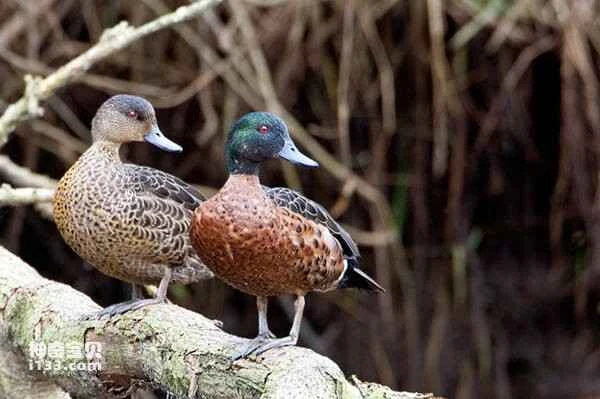
Chestnut-breasted ducks typically live in mixed flocks with other grey ducks, usually in small groups. During the autumn and early winter, they can be seen leaving their small groups to pair off during the egg-laying season. They are adept divers, hunting for prey at the edge of high tide along the coast. In inland lakes, they dive into the water to catch prey. They obtain their food underwater. Their diet consists mainly of plants and seeds, but they also sometimes eat animal matter such as marine mollusks and crustaceans. Their webbed feet allow them to swim and play in the water, keeping their tails above the surface while swimming. They are skilled at foraging, playing, and courtship in the water. Playing in the water helps with feather hygiene and growth.
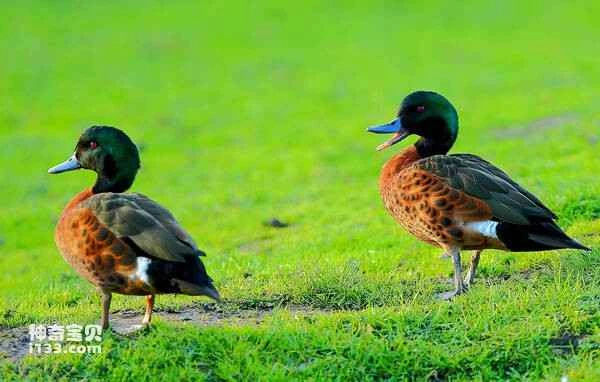
The breeding season for Chestnut-breasted Ducks typically begins in August. They are monogamous, with both partners jointly choosing the nesting site and territorial boundaries. The female incubates the eggs. Nests are usually placed in tree cavities in woodlands, 6 to 8 feet above the water. However, sometimes Chestnut-breasted Ducks will also build nests on the ground near water, slightly higher up. The breeding season is long, usually lasting from August to November (but sometimes from June to December). They build two or three nests, with the female laying 7-13 cream-colored eggs. Incubation lasts 26-28 days. The male does not participate in incubation or care for the newly hatched ducklings. Sometimes, some females will lay their eggs in another female's nest, so their nests will also contain eggs from other females, sometimes up to 17 eggs. Shortly after hatching, the ducklings can swim. After a day or two, they can swim and forage with their mother. Both parents will protect them, and when threatened by hunters and predators, the adult ducks will feign injury to distract the attackers and allow the ducklings to escape.
Listed as Least Concern (LC) on the IUCN Red List of Threatened Species 2013 ver 3.1.
Protect wild animals and ban the consumption of wild game.
Maintaining ecological balance is everyone's responsibility!