Basic Information
Scientific classification
- Chinese name: Blue-crowned Green Gorilla
- Scientific name: Momotus coeruliceps, Blue-crowned Motmot
- Classification: Climbing birds
- Family and genus: Coraciiformes, Sorrowidae, Sorrow
Vital signs data
- Body length: Approximately 40 centimeters
- Weight: No verification information available.
- Lifespan: No verification data available.
Significant features
Distribution and Habitat
It is distributed in Argentina, Belize, Bolivia, Brazil, Colombia, Costa Rica, Ecuador, El Salvador, French Guiana, Guatemala, Guyana, Honduras, Mexico, Nicaragua, Panama, Paraguay, Peru, Suriname, Trinidad and Tobago, and Venezuela.
They inhabit the tropical rainforests, secondary forests, forest edges, shady gardens, and cool coffee farms of Central and South America.
Appearance
The Blue-crowned Blue-crowned Nighthawk is about 40 cm long, with a turquoise crown and a black face. Like all members of the *Motmot* genus, it has a large head, a short, broad, slightly downward-curving beak with serrated edges. Its tarsi are unique, exceptionally short, almost completely fused to the inner toe and the middle toe, which has only one posterior toe. The two forward-facing toes are partially fused at their bases. The tail is long, with the central tail feathers being particularly long, ending in a section with only the shaft remaining near the tip, causing the tip to form a separate, racket-like shape. Sexually dimorphic, this species has plumage in varying shades of green and blue. The iris is red.
Detailed introduction
The Blue-crowned Motmot, scientifically known as *Momotus momota*, has 20 subspecies.

The call of the Blue-crowned Bluebird is similar to that of an owl. It feeds on insects, crickets, mealworms, worms, earthworms, lizards, various invertebrates and small vertebrates, and sometimes also eats fruit. While waiting for prey, it can remain motionless for a long time, then suddenly pounce. On its perch, its tail often swings from side to side or tilts to one side. The Blue-crowned Bluebird stays near water sources for drinking and bathing.

Blue-capped Eurasian Finch burrows into waterside cliffs, embankments, wells, and mines, or digs its nest in sand using its downward-curving beak. The digging season is generally from August to October (during the rainy season when the soil is softer). The nest is tunnel-shaped, 1.5–4 meters long. The breeding season is in March or April of the following year, when they return to their nests. The female lays 3–4 white eggs, and both parents share the responsibility of incubating and raising the chicks.
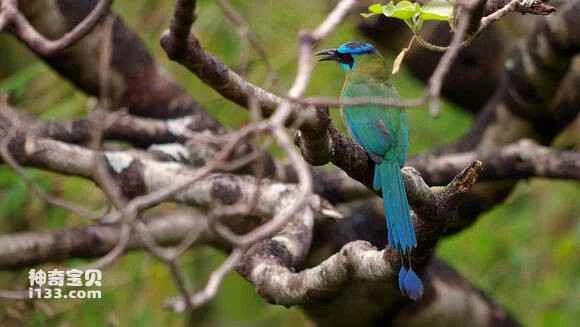
The Blue-capped Bluetail has a wide distribution and a stable population trend, thus it is considered a species of least concern. However, due to the expansion of coffee farms and deforestation, the survival of this beautiful bird remains threatened.
Listed as Least Concern (LC) on the IUCN Red List of Threatened Species 2012 ver 3.1.
Protect wild animals and ban the consumption of wild game.
Maintaining ecological balance is everyone's responsibility!