Basic Information
Scientific classification
- Chinese name: Red-bellied Woodpecker
- Scientific name: Melanerpes carolinus, Red-bellied Woodpecker
- Classification: Climbing birds
- Family and genus: Order Piliformes, Family Pilidae, Genus *Pterygota*
Vital signs data
- Body length: Approximately 24 centimeters
- Weight: 56-90g
- Lifespan: No verification data available.
Significant features
Distribution and Habitat
The Red-bellied Woodpecker is found in southeastern North America, Canada, Mexico, and the United States.
The range extends from the states of Dakota, Minnesota, Wisconsin, Ontario, Massachusetts, along the Missouri River to Pratt, South Dakota, the western Colorado River Valley, and south to Texas and Florida.
The Red-bellied Woodpecker inhabits lowland swamp forests, open wetlands, and mixed deciduous and coniferous plantations with very large walnut trees. It also appears in dense forests, along riverbanks or in the beds of nearby streams, and among oak and elm trees. It frequently visits shady areas and inhabited areas near groves of dead trees. It lives at altitudes around 600 meters above sea level, and locally up to 900 meters on mountain peaks.
Appearance
The Red-bellied Woodpecker is 24 cm long with a wingspan of 33 to 42 cm and weighs 56 to 90 grams. It is a small to medium-sized climbing bird with strong legs and four toes (two forward and two backward), each tipped with a sharp claw, making it adept at climbing trees. Its tail feathers have stiff, thorn-like shafts, which allow it to grip tree trunks, supporting its weight and aiding in climbing. Its beak is strong and chisel-like. Its tongue is long and slender, retractable, and tipped with short hooks. The male has a bright red crown and neck, while the female typically has a grey cap. The wings are covered with strong black and white feathers, and the rump is white. The central tail feathers are mainly white with some black stripes. The outer tail feathers are black and white, with a red patch on the abdomen that is not always visible. In flight, white stripes on the primary flight feathers are clearly visible. The beak is black, and the legs and feet are grey to greyish-green. The iris is dark red to reddish-brown.
Juvenile birds have less distinct upper markings and are whiter than adults. Their breasts have varying dark stripes. Juvenile females often lack red spots on their abdomens, while juvenile males have paler red spots on their abdomens. Young females lack a red neck, and young males have very few red spots on their heads. Juvenile birds have brown irises.
Detailed introduction
The Red-bellied Woodpecker, scientifically known as Melanerepes carolinus, has no subspecies.
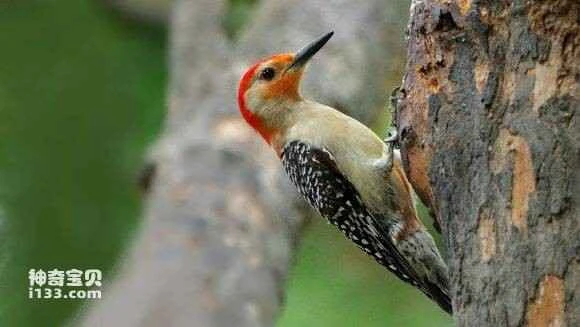
The red-bellied woodpecker prefers to move between different levels of the same tree rather than living on different levels. Its habitat overlaps with that of the money woodpecker; however, while the territories of the two species overlap, they do not necessarily conflict. It maintains a strict separation from the territory of its rival, the European starling, primarily because their diet consists of insects.
When foraging in trees, they tap the branches with their beaks very quickly, at a frequency of 15-16 times per second. Their skulls are extremely strong, with a layer of cotton-like bone surrounding the brain containing fluid, which cushions and absorbs external forces. Muscles around the skull also act as shock absorbers, keeping the beak tip and head in a straight line. Every year, they carve tree cavities to build nests, feeding on insects and grubs under the bark, such as longhorn beetle larvae and jewel beetles, playing an important role in controlling forest pests.
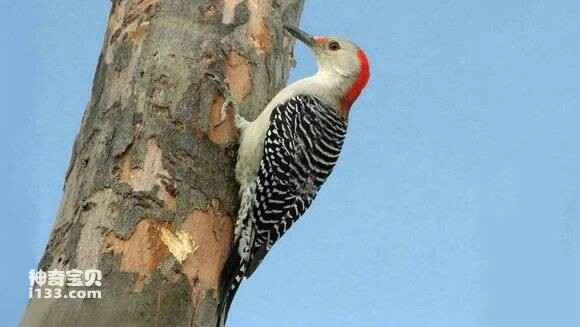
Their diet is diverse, with vegetables making up over 80% of their food intake during spring and winter, and nearly 40% at other times. The most common prey includes insects such as ants, flies, locusts, beetle larvae, and caterpillars. They also hunt spiders and larger prey such as tree frogs, lizards, eggs, and other nesting birds. They also eat fruits (apples, peaches, oranges) and berries (primarily blackberries). Seeds and nuts are the most important part of their winter diet. Their food reserves include nuts, pecans, hazelnuts, and conifer seeds. In some regions…
The breeding season is from March to August. They begin their mating season at the end of March, during which they frequently strike tree trunks with their beaks, producing a continuous "bang, bang, bang..." sound to attract mates. Sometimes, three birds (two males and one female) can be seen fighting for a mate, tangled together, flying up and down, calling out as they fly, until the other male is driven away. They nest in tree cavities, often in the trunks of broad-leaved trees with decayed heartwood, and sometimes in thick side branches. The nest is dug jointly by both parents. They dig a new cavity every year, discarding the old nest. Each cavity takes about 15 days to complete. The cavities are typically 2-18 meters above the ground, sometimes reaching over 10 meters or as low as 2 meters. The entrance is round, with a diameter of 4.5-4.6 cm, the inner diameter is 8.5-10 cm, and the depth is 18-28 cm. The nest contains no lining, only a few wood shavings. Each clutch contains 4-8 eggs, which are white, oval, smooth, and spotless, measuring 22-27 mm × 16-21 mm. Both parents take turns incubating the eggs, with an incubation period of 12 days. The chicks are altricial, hatching completely naked and featherless, with a pinkish-red color. Both parents participate in raising the chicks, and after 20-23 days of feeding, the chicks are ready to leave the nest and fly.
Listed as Least Concern (LC) on the IUCN Red List of Threatened Species 2013 ver 3.1.
Protect wild animals and ban the consumption of wild game.
Maintaining ecological balance is everyone's responsibility!