Basic Information
Scientific classification
- Chinese name: Kansas duck
- Scientific name: New Zealand water duck, Campbell Island duck, Anas nesiotis, Campbell Islands Teal
- Classification: Waterfowl
- Family: Anseriformes, Anatidae, Anatidae
Vital signs data
- Body length: 46-50 cm
- Weight: 500-600g
- Lifespan: No verification data available.
Significant features
Its entire body is covered in dark brown feathers, and during the breeding season, the male duck develops a shiny green head.
Distribution and Habitat
This duck species, endemic to New Zealand, is found in the southernmost part of Fiordland (southwest of the South Island) and some areas of the North Island. It is also found on Hauraki Gulf Island in Tirimataki (in East Auckland).
Kan Island ducks are mostly found in coastal marshes, ponds, and lowland forests.
Appearance
The Kansas duck measures 46-50 cm in length, with males weighing 600g and females 500g. It has dark brown plumage, with the male developing a shiny green head during the breeding season. The breast and wings are reddish-brown with brown tips. White markings are present on the back. The abdomens of females, juveniles, and males are almost uniformly reddish-brown. The bill is blue. A green frame should appear around the speculum on the wing. This species distinguishes itself from other red-eyed ducks of the same genus with chestnut-colored eyes surrounded by white eye rings.
Detailed introduction
The Campbell Islands Teal (scientific name: Anas nesiotis) is a medium-sized waterfowl belonging to the family Anatidae and the genus Anas.
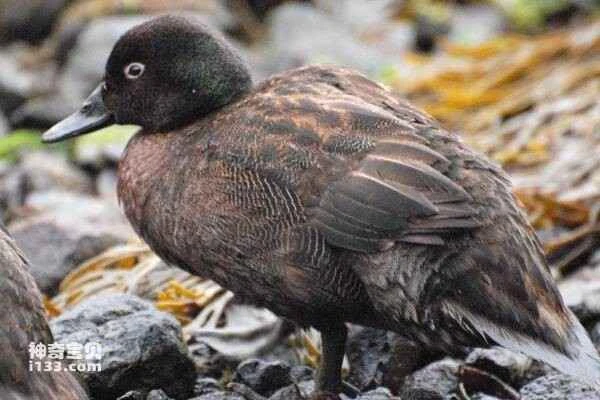
Kansas ducks are timid and primarily nocturnal, living in small flocks of pairs or families, never in large groups. Males and females live in pairs year-round. During the breeding season, they defend their territory. Their diet consists mainly of roots, seeds, leaves, cardamom, and rice from marshes and lakes, but they also eat invertebrates and arthropods.
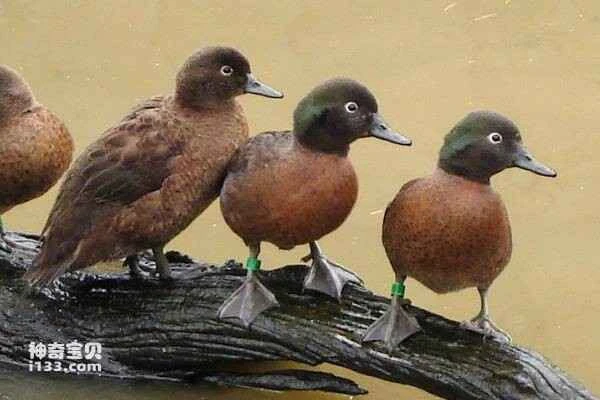
In the wild, the Kan Island duck's nesting and breeding season is the opposite of other bird species, occurring from July to December. The bowl-shaped grass nest is well-hidden, nested far below nearby water plants. The female typically lays six eggs. During this period, the duck is very active at night, foraging among the riverbank vegetation.
Listed as Critically Endangered (CR) in the IUCN Red List of Threatened Species, 2009 version 3.1.
Listed in Appendix I of the Washington Convention.
It is listed in Appendix I of the 2019 edition of the Convention on International Trade in Endangered Species of Wild Fauna and Flora (CITES).
Protect wild animals and ban the consumption of wild game.
Maintaining ecological balance is everyone's responsibility!