Basic Information
Scientific classification
- Chinese name: Velociraptor
- Scientific name: Velociraptor, Velociraptor, Fastraptor
- Order: Carnivora
- Classification: Theropoda, Dromaeosauridae, Sauropsida, Sauropsida
Vital signs data
- Body length: 15 feet
- Weight: 300 pounds
- life:
Significant features
Small in size, resembling a turkey, it is highly aggressive and intelligent, and is known as the "swift robber" due to its agility.
Distribution and Habitat
Inner Mongolia, China; Mongolia
Appearance
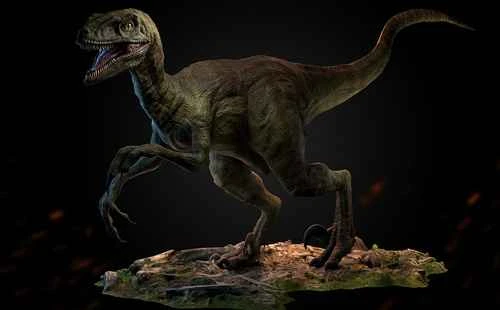
Its body is covered with feathers; it is not large, about the size of a turkey; it has a long head, which is proportionally large to its body; it has a narrow, flat beak; its teeth are sharp with serrated edges; its forelimbs are large and flexible; its hind limbs are strong; it has four toes on its hind feet, with a thick, curved, sickle-shaped claw on the second inner toe; its tail is long, accounting for more than half the length of its body, and its tailbone is horizontally curved in an "S" shape.
Detailed introduction
Chinese scientific name: Velociraptor
Latin name: Velociraptor
Other names: Velociraptor ("Agile Thief"), Swiftosaurus, Fast Thiefosaurus
Period of existence: Late Cretaceous period, 83 to 70 million years ago.
Distribution area: Inner Mongolia, China; Mongolia
Diet: Carnivorous
Aggressiveness: Very high
Length: 15 feet
Height: Approximately 1.6 feet
Weight: 300 pounds
Age: Cretaceous
Velociraptor, also known as Velociraptor, is named after the Latin words "velox" (agility) and "raptor" (thief), meaning "agile thief".
They were small carnivorous dinosaurs with 26 to 28 teeth in their mouths, widely spaced, with distinct serrated edges on the back of the teeth. They were active predators, capable of hunting fast-moving prey. Their diet consisted mainly of small dinosaurs, dinosaur eggs, dinosaur hatchlings, and small mammals.
They were among the most aggressive and intelligent dinosaurs. Their long skulls and wide ears, along with a relatively large brain-to-body weight ratio, indicated that they were a very intelligent dinosaur.
Their bodies resembled those of turkeys. They were covered in feathers, possessed long tails with a horizontally curved "S"-shaped tailbone that accounted for more than half their body length. Velociraptors had large, agile forelimbs and sturdy hind limbs. Their hind feet had four toes, with a 12-centimeter-long claw on the inner third toe. The claws on these toes were thick, curved, and sickle-shaped, serving as crucial weapons for hunting prey. Their forelimbs were slender, with claws on their fingers, and were flexible and adept at grasping. Furthermore, they possessed a unique hunting technique: with one foot on the ground and the other raised with its claws, combined with the forelimb claws, they could easily disembowel their prey, killing them instantly.
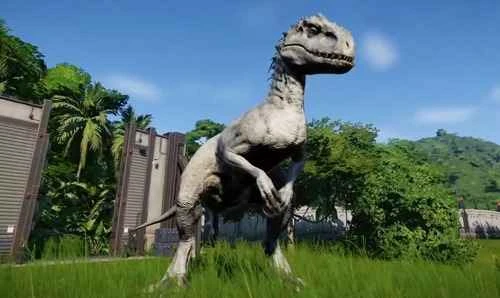
Lifestyle and Habits: Velociraptors were social animals that primarily hunted small dinosaurs, dinosaur eggs, dinosaur hatchlings, and small mammals. They were carnivorous, highly aggressive, and intelligent, and typically hunted in small groups.
Hunting Method: Velociraptors had a very unique and efficient hunting method. They were able to run fast and use the sharp claws on their forelimbs and hindlimbs to catch prey. With one foot on the ground and the other foot raised with its claws, they could easily disembowel their prey and kill it instantly.
Intelligence and Strategy: Velociraptors are considered among the most intelligent dinosaurs, demonstrating high intelligence by hunting larger prey through teamwork. Paleontologists have discovered feather tubercles on the forearms of Velociraptor fossils, indicating that they were also covered in feathers and were known as "swift robbers" due to their agility.
Discovery and Impact: The first Velociraptor fossils were discovered in 1922 in the Gobi Desert of Mongolia. To date, at least 12 Velociraptor skeletons have been found. The vast majority of Velociraptor specimens have been found in the Djadochta Formation, which is distributed across the South Gobi Province of Mongolia and Inner Mongolia of China. The increasing discovery of Velociraptor fossils provides scientists with important evidence for studying the life habits and evolutionary history of Velociraptors. Velociraptors frequently appear in movies, television series, games, and literature, becoming one of the most beloved dinosaurs.
These excavation sites are all located in arid environments, covered with sand dunes and occasionally intermittent streams, while the environment of the Barungoyot Formation is more humid than that of the older Degadocta Formation. In addition to the Protoceratops that Velociraptors preyed on, Velociraptors also coexisted with the following dinosaurs: Andesacerosaurus of the basal ceratopsian infraorders, Hemibarbus ankylosaurs, and several species of oviraptorosaurs, troodontids, and avalazosaurs.
With its small size, feathered appearance, gregarious lifestyle, efficient hunting methods, and high intelligence, the Velociraptor became a unique presence in the dinosaur world and is also one of the most popular dinosaurs.