Basic Information
Scientific classification
- Chinese name: Spinosaurus
- Scientific name: Spinosaurus, Ridgebackosaurus
- Order: Carnivora
- Family and genus: Spinosaurus, Theropoda, Saurischia, Chordata
Vital signs data
- Body length: 10-17 meters
- Weight: 3-10 tons
- life:
Significant features
Its enormous size, the sail-like structure formed by the long spines on its back, and its slender skull
Distribution and Habitat
Most of North Africa
Appearance
The skull is long and narrow, with a narrow mouth and nose area filled with straight, conical teeth.
Detailed introduction
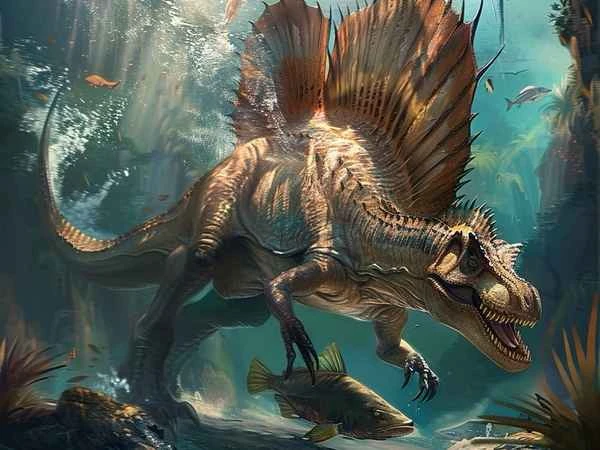
Spinosaurus (meaning "spiny lizard"), also known as the spiny-backed dinosaur, is a theropod dinosaur. The first Spinosaurus fossil was discovered in 1912 in the Bahariya Oasis in western Egypt. In 1915, Strom officially named the giant carnivorous dinosaur he discovered Spinosaurus, meaning "spiny lizard," after its exceptionally long dorsal neural spines. The type species of Spinosaurus was named *Spinosaurus aegyptiacus*, the species name representing Egypt, where the fossils were discovered.
Spinosaurus lived in North Africa during the Cretaceous period, approximately 114 million to 93.5 million years ago. Estimates suggest it was 14 to 15 meters long, 2.1 to 4.8 meters tall, and weighed 6 to 9 metric tons. Spinosaurus is one of the largest known terrestrial carnivorous dinosaurs and also the longest, but its weight was less than that of Tyrannosaurus Rex or other large theropods. Because it walked on four limbs, its hip height was lower than that of other large theropod predators of similar size.
A typical Spinosaurus is 12 meters long and weighs 5 tons. The largest Spinosaurus was 15 meters long and weighed 10 tons.
Spinosaurus was first discovered in Egypt in 1912 by German paleontologist Ernst Stromer. The initial specimen was destroyed by Allied bombing in a Berlin museum during World War II. The time between discovery and destruction was very short. In 2010, fossils of other Spinosaurus body parts, including skulls, claws, arms, tail cones, and crests, were discovered. It is still not entirely certain whether the genus Spinosaurus contains one or two species. The most famous species is *Spinosaurus aegyptiacus*, discovered in Egypt in the 20th century, while the second species is *Spinosaurus marocannus*, discovered in Morocco in the 21st century. The validity of the Moroccan species found in Morocco remains highly questionable.
Its head reached 1.75 meters in length, longer than that of Tyrannosaurus Rex and second only to the 1.92-meter head of Giganotosaurus. More like a crocodile, it had a long, narrow mouth with a distinct gape at the lower edge of the upper jaw. Spinosaurus's eyes were located on the sides of its head, with a slightly enlarged snout and a bony protuberance above each eye, forming a small crest.
Spinosaurus possessed numerous conical teeth in its mouth, slightly curved backwards, surrounded by vertical grooves that formed straight, conical cusps. The teeth lacked serrated edges, similar to other spinosaurs. Each premaxilla had 6 or 7 teeth, and each maxilla had 12 teeth. The second and third teeth of the premaxilla were significantly larger, while the others were slightly smaller. Spinosaurus's teeth were very large, many exceeding 10 centimeters in length, with the largest reaching 22 centimeters. A notch formed between the premaxillary teeth and the large teeth of the maxilla; this notch matched the large teeth of the mandible. From its appearance, Spinosaurus's teeth were more suited for piercing than cutting.
Its enormous size, sharp teeth, and curved claws were all the secrets that allowed Spinosaurus to secure its position as the largest carnivorous dinosaur.
Teeth were an important hunting tool for Spinosaurus, but it also had another formidable weapon: the enormous claws on its forelimbs. Spinosaurus's forelimbs could reach up to 2 meters in length, and the first finger on each hand was a staggering 40 centimeters long. Imagine the damage that would have been inflicted if Spinosaurus's massive claws had struck you.
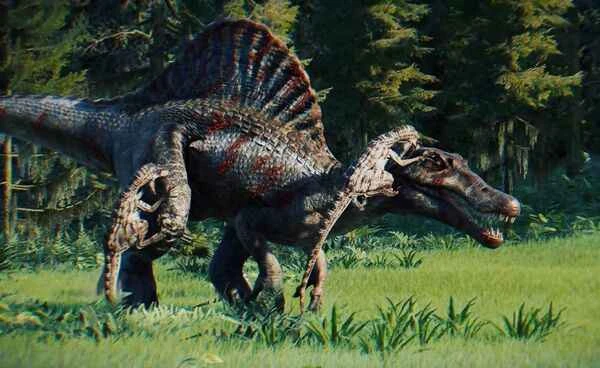
Spinosaurus was named for its tall dorsal sail, a feature characterized by prominent, long spines on its back. These spines, composed of very tall neural spines, are extensions of the neural spines of the vertebrae extending from the back vertebrae. They are approximately 7 to 11 times the length of the vertebrae, reaching up to 2.2 meters in length. The spines are relatively uniform in length from front to back, and it is presumed that skin connects them, forming a large sail-like structure. However, in the early stages of fossil discovery, some scientists believed that these spines were covered by muscles, forming ridges or a spine. Several theories exist regarding the function of this sail, including thermoregulation and visual display. Some researchers have suggested that the dorsal sail was used to attract mates, and that it may have been brightly colored. Other scholars believe that the sail aided in hunting; the shadow cast by the sail in the water would attract fish, allowing the Spinosaurus to attack. The Spinosaurus's skull was long and wide but relatively short, resembling that of pliosaurs. Spinosaurus is believed to have fed on medium-sized ornithischian and sauropod dinosaurs, as well as fish. Studies from 2010 to 2020 have shown that the oxygen isotopes of Spinosaurus teeth are highly hydrophilic, indicating that it was a dinosaur that was very well adapted to aquatic life. Its quadrupedal and flattened tail skeletal structure also shows the morphological evolution Spinosaurus made in response to aquatic life.
Habitat
Their habitats covered most of North Africa, but only parts of the region have been studied. One study of Moroccan dinosaurs suggests that the geographical distribution of Spinosaurus, Carcharodontosaurus, and Deltadromeosaurus during the Cenomanian stage spanned the entirety of North Africa. Spinosaurus inhabited coastal and tidal flat environments in what was then Egypt, with mangrove forests, and coexisted with similar large predators such as Carcharodontosaurus, large titanosaurs like Tidalosaurus, smaller titanosaurs like Aegyptias, 10-meter-long crocodilians like Coelophysis, and coelacanths like Mosen's fish.