Basic Information
Scientific classification
- Chinese name: Pterodactyl
- Scientific name: Flying-finger Pterosaur
- Order: Carnivora
- Genus and family: Pterodactylus, family Pterodactylidae, order Pterosaurs, class Sauromorpha
Vital signs data
- Body length: 0.5 to 14 meters
- Weight: 100.3 to 250 kg
- Lifespan: 30 years
Significant features
With a wingspan reaching 10-12 meters and a massive body, pterosaurs were capable of flight. This enormous wingspan allowed them to glide for extended periods and maneuver rapidly. Their wings were composed of a membrane of skin, also known as the gliding membrane, supported by the arm bones, a large and long fourth digit (wing digit), and wing bones. The pointed tip of the wing was highly advantageous for gliding. Furthermore, the structure of the pterosaur's sternum and shoulder joints facilitated muscle attachment, providing the power support needed for flight. These features enabled pterosaurs to fly slowly like warships, nimbly like seagulls, or even as agile as small birds.
Pterodactyls' physiological structure was also adapted to the needs of flight. Their skeletons were hollow and lightweight, helping to reduce weight while still possessing sufficient strength to support flight. This skeletal structure not only reduced the pterodactyls' weight but also facilitated flight. Furthermore, some pterodactyls were covered in hair-like structures, providing insulation and suggesting they may have been homeothermic animals with a constant internal and body temperature, as well as a high metabolic rate. These characteristics enabled pterodactyls to perform highly efficient energy conversion, thus supporting their prolonged flight activities.
Distribution and Habitat
They are mainly distributed in Europe, Asia, and the Americas, as well as in Africa and Australia.
Appearance
Actively flying vertebrates. Their wings are made of skin, muscles and other soft tissues, forming a wing membrane that extends from the sides of the body to the extremely long fourth finger[2]. The jaws of earlier species were covered with long teeth and had long tails; later species had significantly shortened tails, and some late species lacked teeth. Traces of filamentous structures have been found on the bodies and parts of the wings of some specimens, indicating that pterosaurs may have evolved hair. The skeleton is thin and hollow in the middle, the first finger is particularly long to support the membranous wing, the hind limbs are relatively short, the tail is relatively short, and the head is relatively long. These features enabled pterosaurs to glide in the air and on the sea, only returning to land to lay eggs. Pterosaurs were insectivorous animals with small teeth, feeding on insects, and some also foraging for fish. These features together constitute the unique biological characteristics and ecological niche of pterosaurs.
Detailed introduction
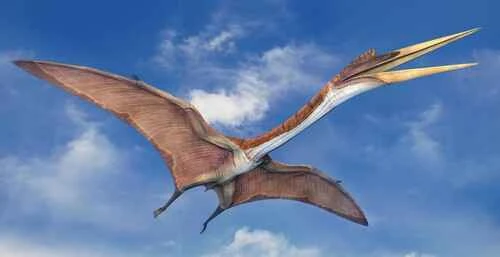
Pterodactylus ( Quetzalcoatlus northropi ) , also known as the Flying-finger Pterosaur, is one of the representative genera of the order Pterosaurs and was the first pterosaur to be named.
Wingspan : The wingspan of the Koko's pterosaur was 50 cm, while that of the giant pterosaur was 2.4 m.
Period of life : Late Jurassic
name
In 1809 , Georges Cuvier named the animal * Ptero-dactyle * . [9] In 1812 , Soemmering named the same specimen * Ornithocephalus antiquus* . Because Cuvier named it earlier, Cuvier's name had priority, so the holotype was named * Ptero-dactyle antiquus *. In 1815 , Constantine Samuel Rafinesque Latinized the name to its current name, *Pterodactylus *.
The first specimen of this famous reptile was discovered in 1784, making it the earliest known pterosaur. The name Pterodactylus means " lizard with winged fingers , " and the English word "Pterodactylus" is often mistakenly used as a general term for the entire order Pterosaurs.
Pterosaurs were an extinct group of flying reptiles and vertebrates. Their forelimbs had evolved into membranous wings, formed by the elongation of the fourth digit and connection to a thin membrane extending from the ventral side. The fifth digit was absent, and the remaining three digits were very small, with claws at the tips. Their skeletons were hollow and lightweight, with a low, flat skull containing many conical teeth, and a well-developed sternum. Although pterosaurs possessed large, membranous wings, the lack of skeletal support prevented them from flying long distances. Males had smaller pelvises and ridges on their skulls, while females had larger pelvises and unridged skulls.
Pterosaurs had a compact body structure, a small thorax, and a short tail, but their wings were long and equipped with three tiny claws. Their necks were highly developed to support their massive heads and beaks, but their beaks lacked crests. More than a dozen species of pterosaurs have been identified, showing little variation in anatomy and size. The largest species preyed on fish, while the smallest likely fed on insects.
These giant pterosaurs were capable of migrating extremely long distances, and their distribution was likely much wider than the few fossils found suggest.
Fossil discoveries have been made in various locations including Europe ( UK, France, Germany ) , Africa ( Tanzania ) , North America, South America, Asia, and Australia. In China, fossils have been found in Xinjiang, Inner Mongolia, Liaoning, Hebei, Gansu, Sichuan, Shandong, and Zhejiang provinces. Globally, pterosaur fossils have been discovered on every continent, including Antarctica. At least 60 genera of pterosaurs have been identified to date, ranging in size from small birds to large pterosaurs with wingspans exceeding 10 meters.
In 1784, Cosimo Alessandro Collini , an Italian scientist who was then the curator of the scientific collection of Elector Karl Theodor of Bavaria, discovered the first fossil of a pterosaur in the Solnhofen limestone in the Electorate of Bavaria (now in Germany).
In 1817, a second pterosaur specimen was discovered, also from the Solnhofen limestone. This small specimen was named * Ornithocephalus brevirostrus* , and after several revisions, it is now classified as an ancient pterosaur. The short snout of this specimen is currently considered a characteristic of juvenile individuals.
A batch of dinosaur fossils forgotten in Brazil for 40 years has been confirmed to be a new species of pterosaur that lived in southern Brazil about 80 million years ago.
The world's first pterosaur embryo fossil was discovered in the Jehol Biota of western Liaoning, China, by paleontologists Dr. Wang Xiaolin and Dr. Zhou Zhonghe . Fossils of unhatched pterosaur fetuses that died before hatching have also been found in China and Argentina. These fossils provide crucial information about pterosaur embryonic development; pterosaurs, like birds and other reptiles, were oviparous (egg-laying) rather than viviparous (live-bearing), especially regarding how they prepared for flight. By comparing these fossils with pre-hatching embryos of birds and crocodiles, scientists have found evidence that pterosaurs could fly at birth. If this discovery is confirmed, it would mean that pterosaurs may be the first vertebrates on Earth to be born capable of flight.
This discovery not only reveals the unique biological characteristics of pterosaurs but also provides a new perspective for understanding the evolution and development of pterosaurs. Features such as the exceptionally long " ring finger " were designed to support the wing membranes, enabling them to fly. This discovery further confirms the evolutionary uniqueness of pterosaurs and their important position in paleontology.
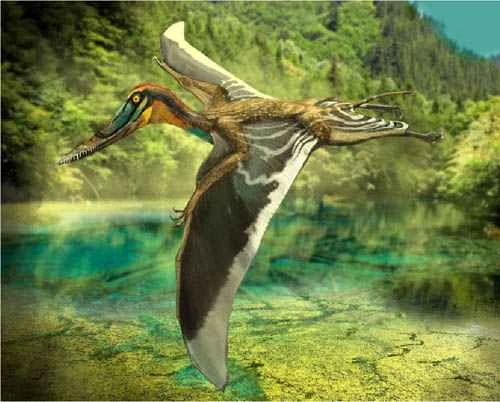
Morphological characteristics
Pterosaurs are an order of ancient reptiles. They represent a branch of reptiles that evolved to fly. Pterosaurs had long heads, long necks, large eyes, and long, pointed snouts. A thin membrane between the fourth digit of their forelimbs and their sides enabled flight. The forelimbs of pterosaurs had evolved into membranous wings, formed by the elongation of the fourth digit and its connection to a membrane extending from the ventral side. The fifth digit disappeared, and the remaining three digits were very small, with claws at the tips. Their skeletons were hollow and light, with a low, flat skull containing many conical teeth, and a well-developed sternum. Pterosaurs possessed only membranous wings; although the wings were large, the lack of skeletal support prevented them from flying long distances. Males had small pelvises and ridges on their skulls, while females had large pelvises and unridged skulls.
The largest pterosaurs had a wingspan of 6 to 8 meters . Two fossil sites have been discovered in China: one in the Karamay region of Junggar, Xinjiang, known as Junggarosaurus, with a wingspan of up to 3.5 meters; and the other in the upper reaches of Linhai, Zhejiang, known as Linhai Pterosaur. Both sites are located in Cretaceous strata ( 137 million to 65 million years ago ) .
Pterodactyls were larger than other pterosaurs and had almost no teeth, unlike the others. A typical pterodactyl had a shorter tail than other pterosaurs and a crest on its head. Some pterosaurs were the size of ordinary birds, while others could grow as large as small airplanes; the largest pterosaur had a wingspan of 39 feet ( 12 meters ).
The wing membrane structure supporting pterosaur flight was completely different from the wing structures of later flying vertebrates such as birds and bats. Pterosaurs formed their wings with a membrane composed of skin, muscles, and other soft tissues, which can be divided into three parts. The first part is the propatagium , connecting the wrist to the shoulder, located at the very front of the wing membrane, and is the part that first encounters the air during flight. Some fossil evidence suggests that the propatagium also connects between the first three fingers. The main part of the wing membrane is the brachiopatagium , extending from the very long fourth finger to the sides of the body (or hind limbs). However, the exact location of the brachiopatagium connecting to the sides of the body, and whether it connects to the hind limbs, remains controversial. In some pterosaurs, a membrane connects between the hind limbs, possibly extending to the tail, called the uropatagium . This membrane appears to be fully adapted for flight and gliding, but less flexible than the membranes of bats or the wings of birds, and is relatively fragile. With a robust body and long, slender hind legs, its structure suggests an inability to move vertically or rest, relying on suspending itself by its hind limbs when at rest. The neck appears to be held upright during flight, forming a right angle with the head and pointing forward. The skull is light and strong, with most bones fused together; it has a slender beak; and large eyes, like those of many birds, with the eyeballs reinforced by a series of bony plates (scleral rings) on its four sides.
Using computed tomography (CT) scanning technology, a three-dimensional image of the pterosaur brain was created based on fossils. The image shows that the pterosaur's cerebellum was remarkably well-developed, accounting for 7.5% of its brain mass , the highest proportion known among vertebrates. In comparison, the cerebellum of birds, which are adept at flight, accounts for only 1% to 2% of their brain mass .
The largest pterosaur was Quetzalcoatl (feathered serpent pterosaur). Its wingspan was 11-15 meters, equivalent to the size of an airplane. The smallest arboreal pterosaur fossil , the Hermit Forest Pterosaur, had a wingspan of only 25 centimeters, roughly the size of a swallow.
Pterosaurs are a very special type of reptile with unique skeletal structure features.
The forelimbs of pterosaurs were highly degenerate. The fourth digit was elongated and thickened to become a flight phalanx, composed of four phalanges. It lacked a claw at the front and, together with the forelimbs, formed the sturdy leading edge of the wing, supporting and connecting the membranes of the sides of the body and the hind limbs, creating a wing membrane similar to that of birds, enabling flight. Pterosaurs developed a unique wing bone extending forward towards the shoulder on their wrist, which supported the wing membrane. The first to third digits grew on the outer side of the wing membrane, becoming small, hook-like claws; the fifth digit degenerated and disappeared.
They have long snouts. Many pterosaurs have mouths covered with needle-like teeth; while some derivative species have no teeth and have long, narrow beaks similar to those of modern birds, such as the Pteranodontidae and the Diplodocidae .[29] The beaks of some specimens have preserved keratin.
Most archosaurs had several openings in front of their eyes; while pterosaurs had nostrils connected to the preorbital fenestra, forming a large opening called the nasoantorbital fenestra. The nasoantorbital fenestra may have served to reduce weight, thus aiding in flight .
crown
Many pterosaurs possessed a crest on their heads. The first pterosaur to be found with a crest was Pteranodon, whose pointed crest faced backward. Some species had uniquely shaped, large crests, composed of bony bifurcations supported by keratinous tissue, such as Palaeosauridae and Nyctaginosaurus.
New fossil discoveries and detailed studies since the 1990s have revealed that pterosaurs generally possessed crests, a departure from previous views. Pterosaur crests were primarily composed of keratinous tissue, sometimes entirely, and therefore rarely preserved during fossilization. Scientists, using ultraviolet imaging, have confirmed that fossils of *Pterodactylus* and other pterosaurs also possess crests, a feature not previously observed. According to previous theories, only derived pterosaurs possessed crests; however, the recent discoveries of *Pterodactylus* and *Australopteratus*, which also exhibit crests, confirm that some rhinoceros-like pterosaurs did possess crests.
hair
While no evidence of feathers has been found in pterosaurs, at least some pterosaurs were covered with hair-like filamentous structures, similar to mammalian fur, but not a result of homologous evolution. Pterosaur fur differed from mammalian fur; it was a unique structure, a consequence of convergent evolution. Although in some studies, fibers on the wing membrane have been mistaken for hair, some fossils do indeed show traces of filamentous structures on the head and body, such as *Sodersaurus* and *Jeholopterus*. Pterosaur fur does not resemble the fur of modern bats, another example of convergent evolution. The evolution of fur in pterosaurs was based on the need for flight, also indicating that pterosaurs were warm-blooded animals.
In his 2009 study of Jehol pterosaurs, paleontologist Alexander Kerner coined a proper noun for pterosaur hairs, “Pycnofibre ,” meaning dense, filamentous structures .
Although they lived in the same era as dinosaurs, pterosaurs were not dinosaurs; they formed a distinct branch on the evolutionary tree. Pterosaurs were reptiles that took to the skies and were sometimes mistakenly considered " flying dinosaurs . " They originated in the Late Triassic period, about 215 million years ago, and went extinct at the end of the Cretaceous period, about 65 million years ago. While dinosaurs dominated the land, pterosaurs controlled the skies.
Pterosaurs varied greatly in size and shape. The largest, such as the pterosaur fossil discovered in Texas, USA in the 1970s, had a wingspan of about 16 meters and a width of about 1.5 meters longer than an F-16 fighter jet . The smallest were as small as sparrows.
flight
The flight patterns, wing locomotion, and takeoff methods of pterosaurs are still debated in paleontology . Paleontologists Mark Witten and Mike Habib have proposed a takeoff hypothesis for pterosaurs: when taking off, pterosaurs would assume a ready-to-fly position, then use the strength of all four limbs to propel themselves forward, thus unfolding their wings and taking flight, similar to a catapult launch. When in flight, pterosaurs could reach speeds of up to 120 kilometers per hour and could travel several kilometers in a single flight.
walk
The pterosaur's pelvic cavity was slightly tilted upwards and to the side, and its femoral head was moderately curved inwards, indicating a semi-upright gait. When flying, its thighs might have been raised parallel to its body, similar to modern gliding lizards. Paleontologists in the past debated whether pterosaurs moved on land in a quadrupedal or bipedal manner. In the 1980s , paleozoologist Kevin Padian pointed out that smaller pterosaurs, such as *Dimorphodon*, had relatively long hind limbs and might have moved bipedally for walking and running, similar to modern roadrunners, in addition to flying. Numerous pterosaur footprints have now been discovered, showing clear four-toed hind limbs and three-toed forelimbs, confirming that pterosaurs moved on land in a quadrupedal manner. Larger pterosaurs had smaller hind limbs and larger forelimbs, and are generally believed to have used four limbs for movement on land.
Footprint fossils show that pterosaurs walked by touching the ground with their feet, similar to humans and bears, and were plantigrade. Footprint fossils of the Shennong pterosaur family show that at least some pterosaurs adopted an upright gait on their hind limbs, rather than a gait that extended to the sides of their hind limbs.
Recent studies have found that some pterosaurs (especially those in the suborder Pterodactylosaurs) were capable of walking and running smoothly. Compared to other pterosaurs, the forelimbs of the genus *Syngonius* and *Ornithopoda* were quite long; the arm bones and metacarpals of *Syngonius* were particularly long, and their forelimb proportions were similar to those of ungulates well-suited for running. Their hind limbs were not suited for high-speed running, but their stride was longer than that of other pterosaurs. While *Syngonius* may not have been able to run, they could walk quickly and efficiently.
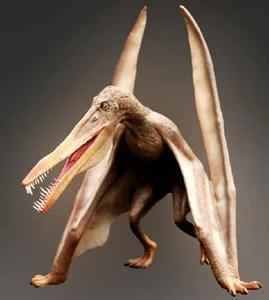
Active time
In 2011 , scientists compared the scleral ring sizes of several pterosaurs, modern birds, and reptiles to infer their daily routines and activity times. Pterodactyls, *Gnaphalosaurus*, and *Gypsys* were diurnal, while *Gnaphalosaurus*, *Australopithecus*, and *Rhabdophis* were nocturnal. *Gnaphalosaurus* exhibited no fixed activity schedule; its foraging and movement were not correlated with day or night, and it only rested briefly. Based on these findings, *Gnaphalosaurus* and *Rhabdophis* may have lived lifestyles similar to modern nocturnal seabirds, hunting fish at night; *Australopithecus* may have lived a lifestyle similar to some anseriformes, filtering small aquatic animals at night. The simultaneous discovery of *Gnaphalosaurus*, *Rhabdophis*, *Gnaphalosaurus*, and *Pterodactylus* in the Solnhofen limestone in Germany suggests they may have occupied different ecological niches, with different lifestyles and food sources.
reproduction
A pterosaur egg has been discovered in a quarry in Liaoning Province, China, the same site where many famous feathered dinosaurs have also been found. The egg was flattened but showed no signs of breakage, indicating it had a leathery shell, similar to that of modern lizards. The embryo's wing membranes were well-developed, suggesting that pterosaurs could fly shortly after hatching .
A 2007 study on the structure and composition of pterosaur eggshells suggested that they might have buried their eggs in the soil, similar to modern crocodiles and turtles. For early pterosaurs, burying eggs in the soil for incubation could reduce the weight of the mother, but it would limit the geographical range in which they could live. Another possibility is that they placed the eggs under their bodies until hatching, similar to some lizards, but most archosaurs did not use this method.
Several recently hatched juvenile individuals have been discovered, including those from the families Pterodactylidae, Rhinocerosauridae, Gnatifidae, and Diplodocidae. The bones of these juveniles are already highly sclerotic, and their wing proportions are approaching those of adults. In early pterosaur research, juveniles and adults were often classified as different species within the same genus. However, the simultaneous discovery of adult and very young individuals, such as those from the genera *Pterodactylus*, *Rhinoceros*, and *Australopithecus* in the Solnhofen limestone in Germany and marine sedimentary layers in Brazil, suggests that these individuals may have fallen and drowned while attempting to fly across the center of the lagoon. This also indicates that these juveniles already possessed the ability to fly .
Once their wings have developed the ability to fly, the young individuals leave the nest. Another possibility is that they survive the first few days after hatching solely on the nutrients they originally received from the yolk, after which they begin to forage for themselves.
Causes of extinction
Some scientific experts believe that frequent volcanic eruptions led to the extinction of pterosaurs, while others believe that pterosaurs may have evolved into warm-blooded animals, but due to the slow pace and varying degrees of evolution, they were ultimately overtaken by birds, which evolved faster and more rapidly.
Traditional theory suggests that competition among early birds led to the extinction of many pterosaurs. By the end of the Cretaceous period, only large pterosaurs had been found; smaller pterosaurs had disappeared, their ecological niches replaced by early birds. However, the lack of small pterosaurs in the fossil record could also be due to their fragile skeletons, making them difficult to preserve, rather than being related to avian biodiversity .