Basic Information
Scientific classification
- Chinese name: Echidna
- Scientific name: Spiny Anteater
- Classification: Monotremes
- Family: Echidnae; Order: Monotremes; Class: Mammalia
Vital signs data
- Body length: 40-60 cm
- Weight: 2.3~10 kg
- Lifespan: 50 years
Significant features
One of the most primitive mammals, and one of only two monotremes in the world.
Distribution and Habitat
The echidna is found only in Australia and New Guinea. Due to habitat destruction, illegal hunting, and invasive species, it has been listed as an endangered species and has received widespread attention and protection from the international community.
Appearance
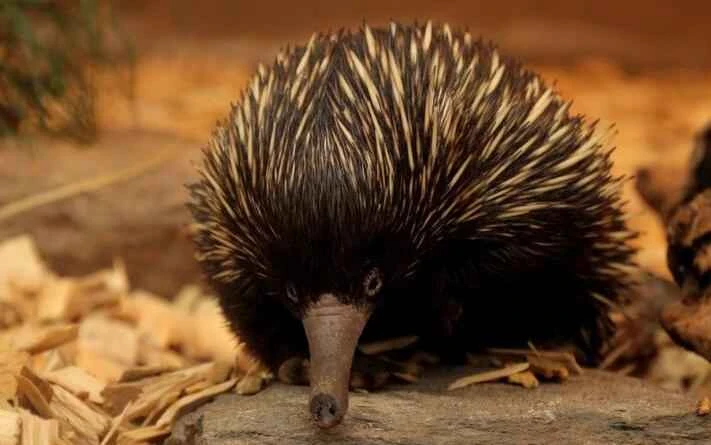
Physical characteristics: Echidna resembles a hedgehog in appearance, with its back and sides covered in hard, detachable, and regenerating spines—specialized hairs composed of keratin. It typically measures 40-60 cm in length, has a very short tail, small eyes and ears, and well-developed external auricles. Its head is grayish-white, with a hard, hairless, cylindrical, downward-curving beak at the front. The nostrils and mouth are located at the tip of the beak; it has no teeth. Its claws are hard and sharp, adapted for digging.
Detailed introduction
Echidnas, belonging to the family Tachyglossidae, are commonly known as spiny anteaters and, along with platypuses, are still extant monotremes. This family comprises three genera and six species; the genus *Giant echidna* is extinct, while the other two genera live in Australia and New Guinea.
Echidnae are warm-blooded animals, with their body temperature fluctuating between 6°C and 8°C throughout the day. They are a fascinating combination of animals with a deceptive appearance, possessing not only the spines of a hedgehog but also a long nose like an anteater and a pouch like a kangaroo.
It is one of the most primitive mammals. There are 2 genera and 4 species. The back and sides are covered with hard spines, beneath which there is hair; the belly is spineless but hairy, with a sparsely haired area in the center where the female's pouch forms; there is a single cloacal opening near the base of the tail. The digestive tract, excretory tract and reproductive tract all open into the cloaca at the rear of the body, making it a primitive, low-level, and strange mammal.
Morphological characteristics
The echidna has a grayish-white head with a long, hard, hairless, tubular snout at the front. The snout contains no teeth, only a small, downward-curving opening. The nostrils and mouth are located at the front of the snout. The tongue is long and sticky, used to feed on termites and ants. Its limbs are strong, with powerful, long, sharp claws on each toe, used for digging and excavating ant nests. The back of its body is covered with hollow, hard spines of varying lengths, giving it a hedgehog-like appearance. The body is also covered with brown or black fur, while the fur on the belly is short, soft, and lighter in color. The eyes and ears are small, but have well-developed external auricles. It has no tail. Its claws are hard and sharp.
The male has spurs on the inside of its hind feet. However, echidnas and hedgehogs are actually very different animals, and are far removed in kinship. Hedgehogs are insectivorous mammals, while echidnas are close relatives of platypuses. Both belong to the monotremes of mammals, and their digestive, excretory, and reproductive tracts all open into the cloaca at the rear of their bodies. Therefore, they are also primitive, low-level, and strange mammals.
The echidna's short, sharp spines serve as its defense, but these spines are not firmly attached to its body. When threatened, the echidna curls into a ball or burrows into loose soil and disappears quickly. Echidnas can dig burrows at astonishing speed to bury themselves. Hedgehogs, on the other hand, have bony, cone-shaped spines that are firmly attached to their bodies. They lack barbs and cannot detach to fly into a predator's body; they can only be removed with pincers after the hedgehog is dead. The echidna's fur is black and soft.
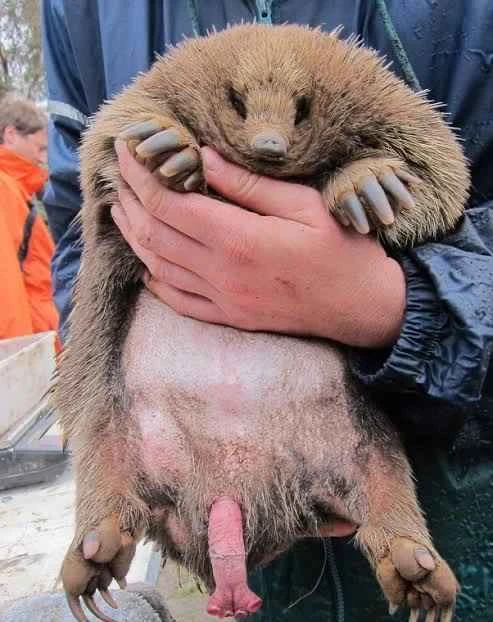
The echidna's reproductive organs are very unique. Their penis is normally hidden inside their body; there are no testes descending into the scrotum, and they don't even have a scrotum. This design makes echidnas very different from other mammals. Their main diet consists of termites and ants, and they sometimes dig up insect eggs and pupae to eat. This reproductive organ structure, combined with the cream-colored spines that can reach up to 5 centimeters in length covering their bodies, allows them to effectively reproduce while protecting themselves. These reproductive organ characteristics, along with their lifestyle, are all results of adaptation to their environment.
Habitat
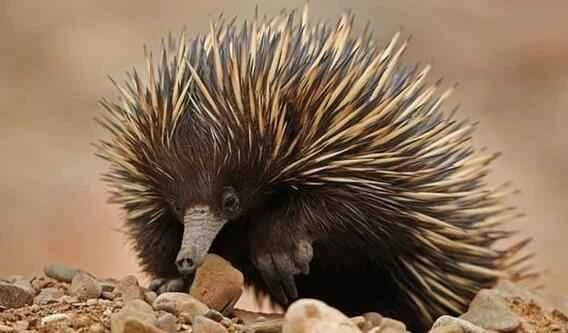
Echidnaes live an ancient lifestyle in Australia's ancient ecosystems. They inhabit scrubland, grassland, sparse forest, and rocky semi-desert areas in the inland desert, hiding in burrows during the day.
Lifestyle
Behavior
Echidnae don't climb trees, but they are exceptionally skilled "engineers." They can dig quickly, even on hard ground, and within ten minutes, they're burrowed into the earth. However, in their natural habitat, echidnas don't build their own nests; instead, they utilize the habitats of other animals. Even when an echidna wants to dig, it only tucks its lower body, leaving its upper body exposed, as it relies on its spines for protection. Furthermore, echidnas can curl into a ball, like a hedgehog. Like hedgehogs, echidnas have difficulty keeping their bristles clean, often harboring parasites, causing them to constantly scratch. Nature has endowed the echidna with a long, curved claw on its second hind toe for grooming and scratching.
Echidnae have poor eyesight, yet they are acutely aware of even the slightest vibrations in the soil. They primarily feed on ants and insects, and their mouths are long and tubular, toothless, with long, flexible tongues. However, given the opportunity, they will not hesitate to change their diet, but they will only eat food that can pass through the small opening in their trunk-like mouths. Unlike their close relatives, the platypus, echidnas can go for extended periods without food or water, sometimes up to a month. It seems they sometimes enter a state similar to hibernation. This is likely an adaptation to their environment. They inhabit Victoria and Tasmania, where winters are relatively cold.
Like the platypus, the echidna is also a skilled swimmer and often grooms itself near the water. Judging from its excellent "dog paddle" swimming style, its ancestors may have been well-adapted to foraging in the water.
prey
Although echidnas have small eyes and poor eyesight, they can keenly detect even the slightest vibrations in the soil. Their mouths are sturdy and long and tubular, without teeth in either the upper or lower jaws. Their tongues are over 30 centimeters long, flexible, and barbed, extending far beyond their mouths. Echidnas typically live in burrows, venturing out in the afternoon and evening. They often insert their hard, pointed mouths into ant nests, then extend their long, sticky tongues to feed on termites and ants. Besides using the sticky substance on their tongues to collect food, they also frequently use the small hooks on their tongues to catch prey. Because they lack teeth, the echidna's diet is limited to animals they can catch with their tongues. Yet, they have tenaciously survived, remaining largely unchanged for at least 80 million years.
There's a reason why echidnas have survived so successfully. Their primary prey is ants, which are among the most successful and widely distributed of all insects. Echidnas focus intently on feeding on ants. Their shovel-like legs are better suited for digging than walking, and this clumsy digging makes them more adaptable to their environment. Echidnas skillfully use their long, hard tongues to probe deep into ant nests.
Echidna spends eighteen hours a day foraging. Equidna possesses an electro-sensory system; through hundreds of electrosensory organs on its nose, it can keenly detect the electrical signals of animals. It uses its nose to locate ants, earthworms, and other invertebrates. Its snout can detect and sense extremely subtle bioelectric signals, finding various insects buried in the soil and nimbly capturing its prey. An echidna can spend up to half an hour eating in an ant nest, consuming thousands of termites. It cannot chew, as it lacks chewing muscles and teeth; it can only crush its food at the back of its tongue. In its search for food, an echidna travels eighteen kilometers a day. It primarily feeds on termites and ants, but sometimes also consumes other insects and worms, among other small invertebrates.
Like miniature four-wheel drive vehicles, they maneuver their short, stubby but agile legs to dart about, using their strong limbs and claws to probe into logs and anthills, then using their long, sticky tongues to hunt their prey. Their tongues are extremely efficient, hence the scientific name "Tachyglossus" for echidna—meaning "fast tongue."
defense
Echidnae resemble hedgehogs in appearance, but their spines are not firmly attached to their bodies. When threatened, these barbed spines shoot out like arrows into the enemy's body. The short, sharp spines on an echidna's body serve as its defense. Echidnae also have two other unique defensive techniques. One is that when startled, they quickly curl into a ball, like a hedgehog, making them appear as a headless, bristly "spiky ball," difficult for the enemy to attack. The other is their short, powerful limbs, with five or three toes tipped with sharp claws, allowing them to quickly dig into the ground, bury themselves, hook onto tree roots, or sink into rock crevices, making them impossible for predators to eat.
Echidnae can dig with all four limbs simultaneously, scooping soil to their sides so they can burrow vertically downwards. Once their unprotected bellies are on the ground, they form a formidable defensive system with their spines to protect themselves from any potential predators. When threatened, the echidna curls into a ball or burrows into loose soil, disappearing quickly. They can dig burrows at astonishing speed to bury themselves. Their spines are extremely sharp and barbed. When encountering a predator, the echidna turns its back to the enemy, and its spines detach from its body, embedding themselves in the attacker. After a period of time, new spines grow from the detached sites.
Distribution range
It is distributed in Australia (Australian Capital Territory, New South Wales, Northern Territory, Queensland, South Australia, Tasmania, Victoria, Western Australia), Indonesia, and Papua New Guinea.
Reproduction methods
May is the echidna's breeding season. During this time, the female develops a kangaroo-like pouch on her abdomen. This crescent-shaped, coarsely hairy pouch, formed by muscle contractions, is a skin fold that appears only during the annual breeding season. It serves as a temporary brood pouch, incubating the eggs for about 10 days and covering the mammary gland area on her abdomen. It also has a suprapubic bone connected to the pelvis, possibly for supporting the eggs or young within the pouch.
The mating of echidnas is truly a spectacular sight. The unique design of the male echidna's reproductive organs is simply breathtaking. Their reproductive organs have four "heads" at the front. This structure is extremely rare in the animal kingdom. During mating, these four "heads" take turns using two at a time to ensure a high success rate. The male echidna adapts to the female's reproductive tract by contracting and expanding to ensure the smooth delivery of sperm and the continuation of life.
When laying eggs, the female echidna bends her body like a caterpillar, aligning her cloaca with her pouch so that the eggs fall directly into the pouch as they flow out. Simultaneously, a sticky fluid flows from the cloaca, attaching the eggs to the fur of the pouch. Most females lay only one egg, occasionally two. Since they have no fixed habitat, the female carries and incubates the eggs after laying them. Echidna eggs are white, containing a very large yolk and no albumen. They are approximately 15 mm long and 13 mm in diameter, similar in size to platypus eggs. The eggshell is rough, like coarse parchment, much like the leathery eggshells of many reptiles.
Echidnae have a peculiar characteristic: they transfer their newly laid eggs into their abdominal pouch, much like kangaroos and other marsupials do, and incubate them there. After several weeks of incubation, the chicks hatch. Newborn chicks, less than 12 millimeters long, remain in the pouch to continue growing. A newborn echidna weighs only 0.4 grams, and their first task is to find milk. Echidnae don't have nipples, but they can still nurse. The mother echidna's pouch has unique milk pores, and the chick can only suckle milk flowing from these pores on the mother's abdomen. When the chick stimulates the skin inside the pouch, milk is secreted from special pores. This milk is very thick and becomes increasingly thick as the chick grows.
Baby echidnas sleep in their pouches, lifting their heads to lick and drink milk. After seven or eight weeks, thorns grow on the backs of the young, and the mother removes them, hiding them in bushes or other secluded places to continue nursing them. Eventually, the mother's temporary pouch disappears naturally.
This unique nursing method is similar to that of the platypus. Platypuses do not have breasts or nipples, but they have small milk pores on both sides of their abdomen for secreting milk. When the baby platypus lies on its mother's belly, it only needs to gently lick to drink the milk secreted from the milk pores, without needing to suckle vigorously.
This unique method of nursing demonstrates the diversity of animal adaptation to the environment. Although they lack traditional breasts and nipples, echidnas and platypuses are still able to effectively nurse their offspring through specially evolved physiological structures.
Echidna chicks, newly hatched from their eggs, are no more than 12 millimeters long. They lick the thick, pale yellow milk flowing from their mother's mammary glands. The young echidnas remain in their pouch until they develop spines on their backs, typically 6-8 weeks, reaching a length of 9-10 centimeters. At this point, the female echidna removes the chick from the pouch and hides it in a secluded place such as bushes to continue nursing it. After fifty days, when the chick's spine has developed, the female pushes it out of the mother's body. Five weeks later, the chick is able to live independently. By one year old, the young echidnas are sexually mature, weighing 2.5-6 kilograms, and their back spines can reach 6 centimeters in length.
Population status
This genus of species has a narrow and limited distribution range and is considered to be experiencing a moderate decline due to habitat loss, reduced rainfall, tourism impacts, and road development, all of which have altered their habitat. They are listed as vulnerable and critically endangered species.
Echidnaes are divided into three genera: *Echidna*, *Protoceratops*, and *Giant Echidna*. Only one species of *Echidna* survives; of the five species in *Protoceratops*, only three remain; and both species in *Giant Echidna* are extinct.
Echidnae
Short-beaked echidna (scientific name: Tachyglossus aculeatus):
Also known as the spiny anteater, it has both fur and spines, a long beak, and feeds on termites and other insects. It is also an excellent digger. Although the echidna is an oviparous monotreme, it also has a pouch into which the eggs are laid to hatch. After hatching, the young continue to live in the pouch for a period of time.
The short-snouted echidna is the most widespread and common monotremes, found throughout mainland Australia, Tasmania, and central and southern New Guinea. The Tasmanian echidna, with its abundant fur, was once considered a separate species.
genus *Echidna*
Attenborough long-beaked echidna (Zaglossus attenboroughi):
It is the smallest member of the original echidna genus, similar in size to the Australian echidna. It has five toes on both its fore and hind limbs, and is covered with dense, short hair.
Human development has impacted forest habitats, leading some to believe these animals are endangered or have disappeared from the region. However, due to incomplete biological research in Papua province, it is possible they still survive in the local mountains. In 2007, nests and tracks of the Attenborough long-beaked echidna were reported, and local residents also claimed to have seen them in 2005.
Long-beaked echidna (Zaglossus bruijni):
Weighing up to 16.5 kg, with a long, downward-pointing snout, its spines are interspersed among long hairs. Almost twice the size of the echidna, it is the largest member of the monotremes, with a long, curved beak, short and sparse spines, and relatively abundant hair. Both its fore and hind limbs have three claws, which are hard and sharp, suitable for digging.
They live in high-altitude forests. Listed as endangered by the International Union for Conservation of Nature (IUCN), their numbers are declining due to habitat loss and hunting. Although hunting of the long-snouted echidna has been banned by the governments of Indonesia and New Guinea, traditional hunting continues. In 2006, Conservation International discovered large numbers of long-snouted echidnas in the Fuya Mountains of Papua province.
Long-beaked echidna (Zaglossus bartoni):
There are four distinct subspecies. Each subspecies is geographically separated, and they differ primarily in size. They have five toes on their forelimbs and four on their hind limbs, all with claws. Weighing 5-10 kg and measuring 60-100 cm in length, they are the largest of the monotremes. They have dense black fur, no tail, and move slowly. When attacked, they curl their bodies in defense.
They are mainly distributed in areas of Papua New Guinea at altitudes of 2000-3000 meters.
Frequently Asked Questions
1. What is an echidna?
Answer : Echidnae are unique monotremes, primarily found in Australia and New Guinea. They are known for their sharp spines covering their bodies and their hedgehog-like appearance. A typical terrestrial mammal, they feed on insects, particularly ants and termites.
2. How do echidnas protect themselves?
Answer : When threatened, echidnas curl their bodies into a tight ball, exposing their sharp spines to defend themselves against predators. Their spines are their strongest defensive weapon, effectively scaring away predators.
3. How do echidnas reproduce?
Answer : Echidnae are oviparous animals. Females lay one or two eggs during the breeding season, which are usually incubated in an underground nest. After hatching, the baby echidnas rely on their mother's milk for growth; although the mother does not have nipples, the milk is secreted through her skin.