Basic Information
Scientific classification
- Chinese name: Anglerfish
- Scientific names: Anglerfish, Toadfish, Sea Toad, Anglerfish, Stuttering Fish, Lanternfish, Ugly Old Woman Fish
- Classification: Medium-sized fish
- Family and Genus:
Vital signs data
- Body length: Females 1-1.2 meters, males 8-16 centimeters
- Weight: 300 to 8000 grams
- Lifespan: 60-100 years
Significant features
The anglerfish, known as the "soft rice king" of the fish world, is a fish that attaches itself to the female and ultimately becomes her "organ." It's also called the "lantern-carrying fish" and is infamous for its "ugliness."
Distribution and Habitat
Distributed in the Indian Ocean, Pacific Ocean, and Atlantic Ocean, and also found in the Arctic Ocean and along the coast of China.
Appearance
The body is flat and soft. The head is large, broad, and flat. The trunk is relatively short. The mouth is large and anteriorly positioned. The lower jaw protrudes, and both jaws, vomer, and palatine bones all have canine teeth or sharp teeth of varying sizes, which can fold inward. The gill openings are large, and the body is naked and scaleless. The periphery of the head has well-developed dermal tentacle-like projections. (A type of fish known as a lanternfish)
Detailed introduction
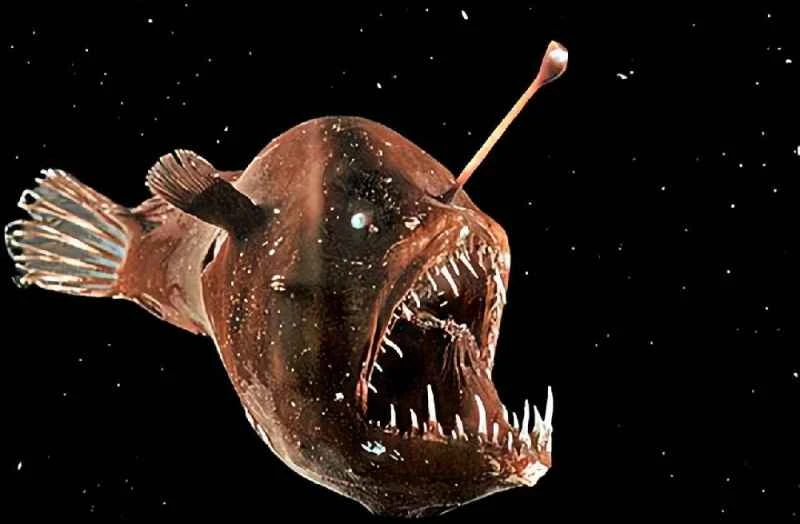
Anglerfish (scientific name: *Lophiiformes*), also known as monkfish, is a bony fish. It lives in waters 3 to 3600 meters deep, and is a carnivorous fish that lurk on the seabed. Female anglerfish can reach 1-1.2 meters in length, while males are only 8-16 centimeters long. They exhibit significant size variation, with large, unusual bodies, large heads, and round, plump bodies. They have large eyes and a large mouth, though their eyes are largely unused. They are not good swimmers and rely primarily on their pelvic fins for locomotion. Their mouths contain sharp, inward-sloping teeth, making it virtually impossible for prey to escape once bitten. They also possess a flexible stomach, allowing some species to consume fish larger than themselves. The body is naked and scaleless, with dermal protrusions of varying sizes above the head and along the sides. A distinctive feature is the female's luminous lure, evolved from her dorsal fin. This lure, formed by the gradual upward extension of the anglerfish's first dorsal fin, is biologically termed a lure. Millions of bioluminescent bacteria, resembling small fish, reside at the tip of this lure. Their bioluminescence is due to glandular cells within the lantern that secrete luciferin. This luciferin, catalyzed by luciferase, undergoes slow chemical oxidation with oxygen, emitting light to attract small organisms as food. The anglerfish derives its name from this bioluminescence.
The body is flat and soft. The head is large, broad, and flat. The trunk is relatively short. The mouth is wide and anteriorly positioned. The lower jaw protrudes, and both jaws, vomer, and palatine bones all have canine teeth or sharp teeth of varying sizes, which can be folded inward. The gill openings are large, and the body is naked and scaleless. The periphery of the head has well-developed dermal tentacle-like projections. The spines of the first dorsal fin are separate, with the first spine located on the snout and ending in a dermal tassel-like rostrum tentacle. The second dorsal fin and anal fin are both located at the tail. The pectoral fins are well-developed and have a long muscular stalk. The pelvic fins are located at the throat. Due to its extremely ugly appearance, it is known as the "ugly fish" in Shandong. Because its cry sounds like an old man's cough, it is also called the "old man fish" along the coast of Hebei.
Skilled at hiding but not adept at swimming, anglerfish employ a "wait-and-see" hunting strategy on the seabed. The "lantern" atop its head is its key to this ambush; simply put, the lantern is the lure used by the anglerfish to catch prey. Whenever a small fish swims near the glowing spot, the anglerfish shakes its hook to lure it in. It then uses the pressure in its throat to create a current, drawing the prey into its mouth – a skill unique to anglerfish and demonstrating high feeding efficiency.
Distribution range
Anglerfish live on the bottom of nearshore waters and are widely distributed in the Indian Ocean, Pacific Ocean, and Atlantic Ocean. They are also found in the Arctic Ocean and along the coast of China.
External features
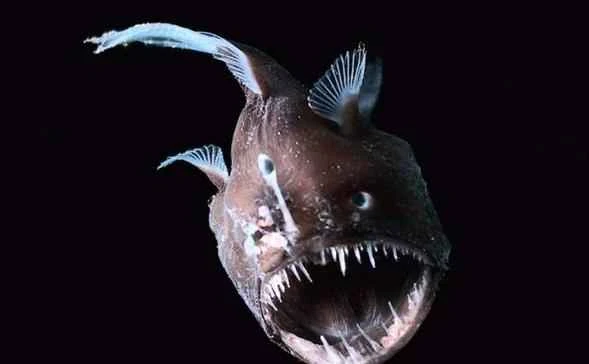
The ugliest of fish, with its wide mouth, fine, sharp teeth, rough body, and dark, gooey fins, is the anglerfish.
Reproduction
During winter, the male anglerfish begins to develop its gonads and lays eggs in spring. During the reproductive process, the male anglerfish will attach itself to the female to ensure its survival and reproduction. Once this attachment is established, the male anglerfish becomes part of the female's body, achieving a unique reproductive strategy of taking advantage of her to the extreme.
During reproduction, the male anglerfish bites the female's gill cover, and their skin tissues gradually fuse together, even connecting blood vessels. Afterward, their blood vessels and muscles slowly intertwine, and the small male becomes inseparable from the large female, becoming part of her body. The saying "love lasts forever" perfectly describes this animal. This amazing mating method, however, comes at the cost of immune system damage, making the male anglerfish completely dependent on the female for nutrients.
During mating, the female anglerfish provides the male with nutrients and hormones, stimulating him to release sperm simultaneously with his own ovulation, thus completing mating. Simply put, the male acts as a sperm-producing machine, and some female anglerfish can even have multiple sperm-producing fish at the same time.
After mating with the female, the male anglerfish undergoes changes—except for the spermatophore, other parts of its body gradually degenerate and disappear. To maintain this bond, the male anglerfish continuously provides the female with reproductive cells, eventually becoming a "tumor" on the female's body. At this point, the male can no longer be considered an individual, but rather merely a sex organ of the female. This unique reproductive strategy ensures that the female anglerfish receives sufficient nutrition while also guaranteeing the transmission of its genes.
The anglerfish's reproductive strategy is a marvel of nature, showcasing the unique adaptations that organisms have evolved for survival and reproduction. The male anglerfish's attachment behavior is not only a form of protection for the female but also an optimization of its own survival strategy, which is particularly unique and effective in deep-sea environments. When spawning, they migrate to shallower waters.
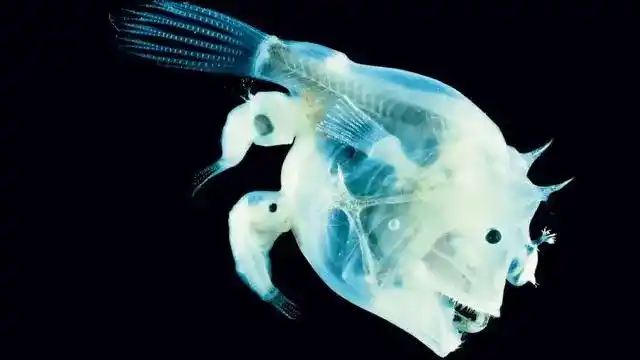
Yellow anglerfish fry, hatched from gelatinous eggs, are translucent with slender tips on their dorsal and pectoral fins, exhibiting a graceful and captivating appearance. As they grow, their color deepens, their caudal and pectoral fins become very large, and their dorsal fin spines become prominent, giving them a somewhat warrior-like appearance. The fry continue to grow and gradually swim towards the deeper sea, with the "fishing rod" on their heads becoming faintly visible. They grow relatively slowly, generally taking 10-20 years to reach adulthood, and can live for 60-100 years.
The starfish anglerfish engages in lifelong, one-on-one parasitism, while the dense-spined anglerfish, the spiny-headed anglerfish, and the kingfisher are multi-paired parasites, meaning a single female can have multiple "grooms." The others are fish species that do not exhibit sexual parasitism and can mate normally.
Main varieties
There are 25 species in 4 genera of anglerfish worldwide. In 1987, the global catch reached 94,200 tons. The anglerfish (Lophius piscatorius) was the most abundant, with 56,500 tons, distributed in the Northeast Atlantic, primarily produced by France, Spain, the former Soviet Union, and the United Kingdom. The American anglerfish (L. american) had a catch of 11,100 tons, mainly caught in the United States. The South African anglerfish (L. upsicephalus) had a catch of 8,958 tons, mainly produced in South Africa. China has only three species.
1. Yellow Anglerfish (L. litulon): 1-2 rows of teeth in the lower jaw, 8-11 rays in the anal fin, 6 spines in the first dorsal fin, black anal fin, yellow in front of the bottom of the mouth, distributed in the Yellow Sea, Bohai Sea and northern East China Sea.
2. Black Anglerfish (Lophiomus setigerus): 3 rows of teeth in the lower jaw, 6-7 rays in the anal fin, 5 spines in the first dorsal fin, white anal fin, black and white cross-shaped interior bottom of the mouth, distributed in the East China Sea and South China Sea.
3. The Anglerfish with the Acquired Spines (Lophiodes abditus pinus): It has 3 spines on its first dorsal fin and well-developed humeral spines. It is found only in the deep sea areas above 600 meters in the South China Sea.
Known as the "Eastern Paradise, Western Paradise," monkfish boasts meat as firm and elastic as lobster, surpassing most fish in flavor and rich in collagen. Its liver contains abundant oil rich in vitamins A and D, making it a highly valuable tonic and significant for scientific research. The liver's exceptionally delicious flavor has earned it the nickname "foie gras of the sea."