Basic Information
Scientific classification
- Chinese name: Black Fox Bat
- Scientific name: Pteropus alecto
- Order: Chiroptera
- Family and genus: Pteropodidae, Pteropoda
Vital signs data
- Body length: Adults typically have a head and body length of about 23–29 cm and a wingspan of about 1–1.5 meters.
- Weight: Adult individuals typically weigh between 500 and 1000 grams, with some large males weighing slightly over 1 kilogram.
- Lifespan: Estimated lifespan in the wild is about 8–12 years, and may be longer under captive conditions.
Significant features
Large fruit bats, entirely black or dark brown, inhabit "bat camps" such as riverbank forests and urban green spaces in groups, and are important pollinators and seed dispersers in northern Australia and New Guinea.
Distribution and Habitat
They are mainly distributed in the tropical and subtropical regions of northern and eastern coastal Australia, New Guinea and nearby islands. They are commonly found in coastal wetlands, mangroves, riparian forests, seasonal floodplains, and near urban parks and orchards. During the day, they roost in groups in tall trees and fly to a range of tens of kilometers around at night to forage.
Appearance
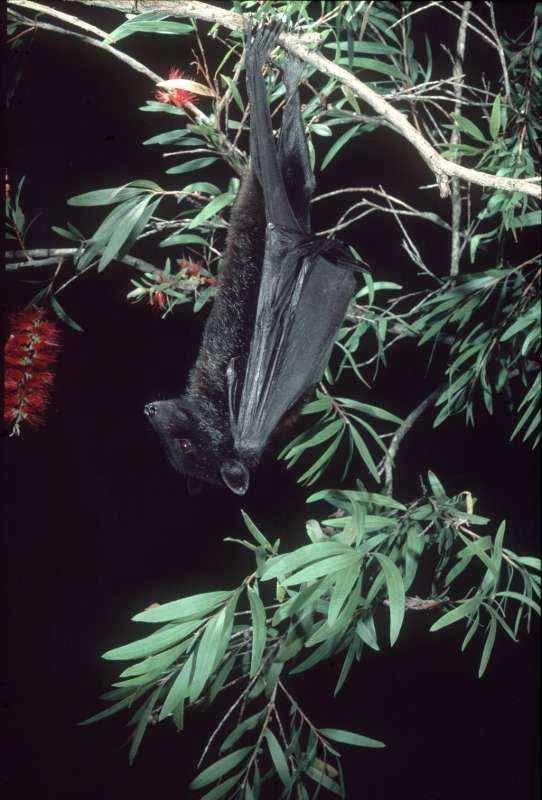
They are relatively large, with heads resembling those of a small dog or fox, large eyes, and medium-sized, slightly pointed ears. Their fur is mostly black or dark brown, with some individuals having a slightly yellowish-brown or grayish-brown tinge on their neck and chest. Their wings are made of dark membranes and supported by elongated phalanges. Compared to insectivorous bats, they have longer faces and thicker snouts, making them look more like "flying foxes."
Detailed introduction
The black flying fox ( Pteropus alecto ) is a large fruit bat belonging to the genus Pteropus in the family Pteropodidae. It is one of the most common and representative flying foxes in northern Australia and New Guinea. Known for their entirely black or dark brown fur, enormous wingspan, and the large "bat camps" of thousands, they are important pollinators and seed dispersers in the region, playing a crucial role in the forest ecosystem.
Classification and nomenclature
The black flying fox belongs to the class Mammalia, order Chiroptera, family Pteropodidae, and genus Pteropus . The genus Pteropus includes many large fruit bat species, collectively known as "flying foxes." The black flying fox, along with the grey-headed flying fox ( Pteropus poliocephalus ) and the little red flying fox ( Pteropus scapulatus ), are some of the most common flying foxes in Australia. Its English name, Black Flying-fox, comes directly from its almost entirely black plumage.
Appearance features
The black flying fox is one of the larger fruit bats. Adults typically have a head-body length of 23–29 cm, a forearm length of 14–18 cm, and a wingspan of 1–1.5 meters. They mostly weigh between 500–1000 grams, with some large males possibly exceeding 1 kg. Like most flying foxes, their heads resemble those of a small dog or fox, hence the name "flying fox."
The black flying fox's plumage is predominantly black or dark brown, with some individuals showing slightly lighter brownish-yellow or grayish-brown areas on their shoulders, neck, or chest. Its face has short, fine hairs, and its large, bright eyes are advantageous for movement in low-light conditions; its ears are medium-sized and slightly pointed. The wings are composed of elongated phalanges and membranes, and are mostly black or dark brown. Unlike small insectivorous bats that rely on echolocation, the black flying fox primarily uses its well-developed vision and sense of smell for navigation and foraging.
Distribution range and habitat
Black flying foxes are mainly distributed in the tropical and subtropical regions of northern and eastern Australia, including the northern and eastern coasts of Queensland, the northern tip of the Northern Territory, and the northernmost part of Western Australia, extending to New Guinea and some neighboring islands. They typically live in coastal wetlands, mangroves, estuaries, coastal woodlands, seasonal floodplains, and near urban and rural woodlands, parks, and orchards.
During the day, black flying foxes gather in thousands at their "camps," which are often located in tall trees in riparian forests, mangroves, or urban green spaces. After nightfall, they fly out in flocks and disperse to forests, farmlands, and urban gardens within a radius of tens of kilometers to forage for food. The location of the camps sometimes changes depending on the season, food availability, and drought conditions.
Lifestyle Habits and Behaviors
Black flying foxes are primarily nocturnal, leaving their camps in flocks at dusk to forage and returning to their roosts at dawn. They possess exceptional flying abilities and the capacity for long-distance migration, capable of flying tens of kilometers in a single night in search of nectar or fruit. During the day, when roosting, large groups of individuals hang densely, either upside down or upright, on tree branches, maintaining a complex social structure through calls, scents, and physical contact.
In hot weather, large numbers of black flying foxes huddled in trees are prone to heat stress events: when temperatures are extremely high and there is a lack of shade and water, some individuals, especially juveniles, may die from heatstroke. Such events have increased in recent years during extreme heat waves and have drawn attention from researchers and the public.
feeding habits
Black flying foxes are typical fruit-eating and nectar-eating animals. They primarily feed on a variety of wild and cultivated fruits, nectar, and pollen, including flowers of native tree species such as eucalyptus and bottlebrush, fig plants, tropical fruits such as mango, banana, and papaya, as well as other berries and juicy fruits. While feeding, they chew the pulp, swallow the juice, and simultaneously spit out or excrete seeds, which helps in the long-distance dispersal of plants.
In eucalyptus forests and other flowering forest ecosystems, black flying foxes are important nocturnal pollinators and seed dispersers, playing a positive role in maintaining forest structure and species diversity. However, in agricultural areas, they may also prey on crop fruits, thus creating conflict with fruit farmers.
Reproduction and life cycle
The breeding patterns of black flying foxes vary slightly depending on geographical region, but they generally breed once a year. The peak breeding season often coincides with the season when food supply is better. Females usually give birth to one offspring per litter, with a gestation period of about 5 months. The young are born with their eyes closed, clinging tightly to the mother's nipples on her abdomen or chest, and are partially wrapped and protected by the mother's wings.
In the first few weeks, the young fly with their mother. As they gain weight, the mother bat will leave the young on a branch at the camp and go out to forage for food, returning to nurse them. After several months, the young begin to try eating fruit, gradually weaning and becoming independent. The natural lifespan of the black flying fox is estimated to be 8–12 years in the wild, and may be even longer under captivity.
Relationship with humans
The relationship between black flying foxes and humans is complex. On the one hand, they are important pollinators and seed dispersers, playing an irreplaceable ecological role in natural forests and regenerating vegetation; on the other hand, their large colonies in urban and agricultural areas often cause problems such as noise, odor, and fecal pollution, and may also eat fruit in orchards, leading to economic losses.
Black flying foxes also hold a place in public health discussions because some species are linked to zoonotic diseases such as bat rabies in Australia. While the risk of direct human infection is low, officials generally advise the public not to handle live or injured flying foxes with bare hands, and any rescue efforts should be carried out by professionally trained wildlife rescuers.
Protecting the status quo and threats
The black flying fox is currently classified as "Least Concern" (LC) on the IUCN Red List, primarily due to its wide distribution and the continued existence of large regional populations. However, local populations are affected by habitat loss, urban expansion, eviction by fruit growers, and deforestation of their habitats, leading to the gradual shrinking or disappearance of some traditional campsites.
The frequent extreme heat events and heat waves in recent years have caused a large number of black flying foxes to die from heatstroke, and are considered a major potential threat to the species from climate change. Key measures to protect black flying foxes include preserving and restoring important habitats such as riverine forests and mangroves, retaining key "bat camp" trees in urban planning, reducing conflict through non-lethal methods such as orchard protective netting, and strengthening public education to raise awareness of their important ecological value in pollination and seed dispersal.
Frequently Asked Questions
Q1: What are the differences between the black fox bat and other "flying foxes"?
The black flying fox is mainly black or dark brown and is one of the large flying foxes commonly found in northern Australia and New Guinea. The grey-headed flying fox and brown fruit bat are more grey or brownish-yellow in head and body color, and their distribution range and habits also vary slightly.
Q2: Will black fox bats affect human health?
Some flying fox species are associated with pathogens such as the Australian bat rabies virus, theoretically posing a small risk of zoonotic diseases. Therefore, officials generally advise the public not to handle live or injured flying foxes with bare hands, and to contact professional wildlife rescue organizations if rescue is needed.
Q3: Are black flying foxes considered "pests" by farmers?
In fruit-growing areas, black flying foxes can indeed prey on fruits such as mangoes and bananas, causing some economic losses and leading to conflicts with fruit farmers in some regions. However, from an ecological perspective, they are also important pollinators and seed dispersers, playing a crucial role in the restoration of natural vegetation and forests.
Q4: What measures can be taken to protect black flying foxes?
Key measures include protecting and restoring key habitats such as riverside forests and mangroves, and avoiding the indiscriminate felling of large perch trees; using non-lethal methods such as protective netting in orchards to reduce losses; and raising public awareness of the ecological value of flying foxes through public education, while also paying attention to the impact of extreme heat events on their populations.