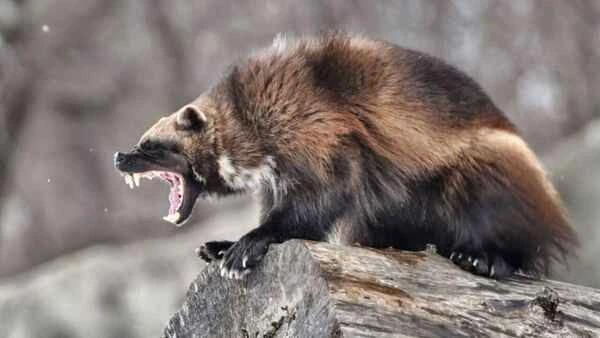
Scientific name: Honey Badger, North American Honey Badger
Order: Carnivora
Family and genus: Wolverine
Vital signs data
Body length: 60-100cm
Weight: 10-25 kg
Lifespan: 16 years
Significant features
One of the most powerful predators
Distribution and Habitat
North America: Wolverines are mainly distributed in the northern part of North America, including Alaska, northern Canada, and parts of the mountainous regions of the United States, such as the Rocky Mountains. Europe and Asia: In Europe, wolverines are mainly distributed in the Nordic countries of Finland, Sweden, and Norway. They are also found in large numbers in Siberia, Russia. They are adapted to these cold, harsh environments, especially in coniferous forests and tundra regions.
Appearance
Wolverines resemble small bears in appearance, with short, thick limbs, a broad head, and dense, dark brown fur. Their backs have light-colored stripes, and their thick, oily fur provides protection against cold weather.
Detailed introduction
What kind of animal is a wolverine?
The wolverine (scientific name: *Gulo gulo* ), also known as the bully or North American honey badger , is a member of the mustelid family. It is a large animal, renowned for its fierce temperament and exceptional survival skills. Despite its relatively small size, the wolverine is extremely aggressive and capable of fighting off prey much larger than itself. Found in cold regions of North America, Europe, and Asia, wolverines have adapted to harsh environments and are impressive predators.
1. Characteristics of a wolverine
Size : Wolverines are relatively stocky, typically weighing between 10 and 25 kilograms and measuring 60 to 100 centimeters in length. Despite their small size, they are strong and have sturdy bones.
Appearance : Wolverines resemble small bears, with short, thick limbs, a broad head, and dense, dark brown fur. Their backs have light-colored stripes, and their thick, oily fur provides protection against cold weather.
Teeth and claws : Wolverines have very sharp teeth and claws, particularly well-suited for tearing the flesh and bones of their prey. They can easily crush thick bones, making them highly efficient scavengers.
Sense of smell : Wolverines have a highly developed sense of smell, which allows them to detect hidden prey even when covered in snow.
2. Wolverine Reproduction
Mating season : The mating season for wolverines is typically between May and August in the summer. Female wolverines give birth to cubs every two to three years.
Delayed implantation : Wolverines have a unique reproductive strategy called delayed implantation . The fertilized egg can be implanted into the uterine wall several months later, ensuring that the cubs are born in the most favorable season (late winter or early spring).
Gestation and Cubs : The gestation period for wolverines is approximately 30-50 days, with each litter typically containing 1-3 cubs. The cubs are born lightly weighted and rely on their mother's care. Over the next few months, the mother wolverine will raise the cubs until they are capable of foraging for food independently.
3. Habits of Wolverines
Solitary nature : Wolverines are solitary animals, only interacting with other individuals during the breeding season. They have a very strong sense of territory; a single wolverine's range typically covers hundreds of square kilometers, marking its territory to warn other individuals.
Diet : Wolverines are omnivorous, preferring meat but also consuming plants. They primarily hunt small mammals, birds, and insects, but also prey on larger animals such as reindeer and elk. Furthermore, they are scavengers, using their sense of smell to locate animal carcasses, especially in winter when they can bite through thick snow to find food.
Powerful fighting ability : Despite their small size, wolverines are known for their extremely fierce nature. They will not hesitate to attack animals much larger than themselves, such as bears or wolves, and will even drive these predators away to steal their prey.
4. Distribution of wolverines
North America : Wolverines are mainly distributed in the northern part of North America, including Alaska, northern Canada, and parts of the mountainous regions of the United States, such as the Rocky Mountains.
Europe and Asia : In Europe, wolverines are mainly distributed in the Nordic countries of Finland, Sweden, and Norway. They are also found in large numbers in Siberia, Russia. They are adapted to these cold, harsh environments, especially in coniferous forests and tundra regions.
5. Other interesting facts
Other names : The English name "Wolverine" comes from its tough personality and fierce hunting skills. They are sometimes called "bullies" or "North American honey badger," names that highlight their fearless nature.
Rare Species : Due to habitat destruction and human disturbance, wolverine populations have declined in some areas, particularly in parts of Europe and the United States. They are listed as endangered or threatened species, and conservation measures are being implemented.
Winter adaptability : Wolverines are highly adapted to cold climates. Their thick fur not only provides warmth but also protects them from cold winds and moisture. They are adept at moving through snow and can dig burrows in the snow to live in.
in conclusion
Wolverines are among the most formidable predators on Earth. Despite their small size, they possess astonishing strength, intelligent foraging skills, and the ability to adapt to extreme environments. Their unique habits and exceptional survival skills make them an indispensable force in nature.
As a species vital to ecosystems, the wolverine's survival and reproduction in cold regions play a crucial role in the healthy development of the natural environment. By understanding and protecting this mysterious animal, we can better maintain the ecological balance in these harsh environments.
The relationship and differences between wolverines and honey badgers
Although wolverines and honey badgers share similar names and are both known for their strength and fearlessness, they differ significantly in biological classification, habitat, and behavioral habits. The following is a detailed introduction to their relationship and key differences:
1. Biological classification
The wolverine (Gulo gulo) and the honey badger (Mellivora capensis) both belong to the order Carnivora , but differ in family and genus:
Wolverines belong to the Mustelidae family and are closely related to animals such as weasels, badgers, and minks.
Honey badgers belong to the subfamily Melinae of the family Mustelidae and are more closely related to other badger species.
Although they all belong to the Mustelidae family, they are not directly related and belong to different evolutionary branches.
2. Habitat and Distribution
Wolverines primarily inhabit the cold Northern Hemisphere , found in Canada and Alaska in North America , the Nordic countries of Europe , and Siberia in Asia . These regions are typically characterized by coniferous forests, tundra, and mountainous environments, with cold and harsh climates.
Honey badgers are found in warm regions of Africa and South Asia , especially in most of sub-Saharan Africa, as well as in grasslands, forests, and deserts in countries such as India, Pakistan, and Iran.
3. Body shape and appearance
Wolverines are large animals, typically weighing between 10 and 25 kilograms. They have a robust body, resemble small bears, and have thick, dark brown or black fur with light-colored stripes on their backs.
Honey badgers are relatively small, typically weighing between 7 and 14 kilograms. They have a more slender appearance, with a distinctive black and white stripe on their backs, and white stripes extending from the top of their heads to their tails.
4. Personality and behavioral habits
Wolverines are primarily solitary animals, fierce and highly aggressive, especially when competing for food. They are scavengers, often using their sense of smell to locate animal carcasses, and are willing to confront predators larger than themselves, such as bears or wolves, even daring to steal their prey.
Honey badgers are known for their aggressiveness and fearlessness . They are incredibly brave and often fight off dangerous animals such as lions and venomous snakes. Their thick, loose skin allows them to easily turn and fight back when attacked. They can also withstand snake venom and possess remarkable regenerative abilities.
5. Diet and Predation Methods
Wolverines are omnivorous , but lean more towards carnivorous diets . They prey on small mammals such as rabbits and rodents, and occasionally hunt larger animals such as reindeer and elk, even gnawing on animal bones. Their teeth and jaws are very strong, allowing them to easily tear apart hard chunks of meat and bones.
Honey badgershave a diverse diet , including insects, amphibians, small mammals, and birds, and are particularly adept at hunting venomous snakes. They also have a strong affinity for honey, sometimes even entering beehives to steal it, hence their name. They also cooperate with honeyguides , who guide the honey badgers to the beehives, where the badgers then destroy the hives and share the food.
6. Reproduction and Living Habits
Wolverines have a reproductive characteristic that includes delayed implantation , meaning that fertilized eggs are implanted in the uterus a period of time later than intended to ensure that the pups are born in the right season (usually in late winter or early spring).
Honey badgers have a relatively normal breeding cycle. Female honey badgers usually give birth to 1-2 cubs at a time. The cubs live with their mother and depend on her for hunting and protection until they are able to live independently.
7. Defense and Survivability
Wolverines are extremely aggressive when facing predators, using their strong bodies and tough fur for effective defense and attack. They often choose to fight predators, especially when competing for food.
Honey badgers, with their thick, loose skin, can flexibly defend themselves against enemy attacks. Furthermore, they can withstand extreme venom and possess extremely rapid healing abilities, recovering quickly even from snake bites.
Summary: The relationship and differences between wolverines and honey badgers
Although wolverines and honey badgers both belong to the Mustelidae family of the order Carnivora and are known for their bravery and aggression, they differ significantly in habitat, size, appearance, diet, and lifestyle. Wolverines primarily inhabit the cold Northern Hemisphere, feeding mainly on scavenging and hunting, while honey badgers live in the warmer regions of Africa and South Asia, known for hunting snakes and consuming honey. Wolverines prioritize strength and fighting skills, while honey badgers rely on their protective skin and courageous nature for survival.
Both exhibited remarkable adaptability and a tenacious survival instinct, making them unique and powerful entities in their respective habitats.
Distribution and Population of Wolverines in Various Countries
The following table shows the distribution and approximate numbers of wolverines in various countries:
Country/Region
Distribution area
Approximate quantity (estimated)
Protection status
Canada
Alaska border, Yukon Territory, Northern Canada
Approximately 15,000-20,000
The quantity is relatively stable
USA
Alaska, the Rocky Mountains, and other regions
Approximately 250-300 (Rocky Mountain region)
Endangered/threatened species
Russia
Siberia, Ural Mountains
Approximately 20,000-30,000
Stable quantity
Finland
Northern forests and tundra
Approximately 150-200
Rare/protected species
Sweden
Forests in the northern and central regions
Approximately 500-600
Protected species
Norway
Northern region
Approximately 300-400
Protected species
Estonia
Forest and swamp areas
Approximately 100-200
Rare
Latvia
Northern Forest Zone
Approximately 100-150
rare
Poland
Northeast Forest Zone
Very few
endangered
Mongolia
Altai Mountains region
unknown
rare
Kazakhstan
Northern mountainous and forested areas
unknown
rare
illustrate:
Population estimates : Due to the wide range and strong elusiveness of wolverines, it is difficult to accurately count the number of wolverines in different regions. The above data are estimates.
Conservation status : The conservation status of wolverines varies in different regions. Some areas in North America and Northern Europe list them as endangered or threatened species and implement corresponding conservation measures.
That country uses wolverines as food.
Wolverines are not widely used as food, primarily because their meat is coarse and has a strong odor, making them difficult to cook. Furthermore, wolverines are a protected species in many areas, making hunting and consumption illegal. However, in some remote areas, particularly among indigenous peoples near the Arctic Circle or nomadic tribes in extremely cold regions , wolverines may be hunted for sustenance when food resources are extremely scarce.
The main food source is wolverines:
Native American peoples (such as the Inuit) :
In extreme climatic conditions, Inuit peoples and other Arctic indigenous groups sometimes hunt wolverines. Wolverine meat serves as a survival option in these situations, especially during winter when food supplies are scarce.
However, this practice is relatively rare, because wolverine meat is not considered a high-quality food, and their fur is more often used to make cold-weather clothing.
Ethnic minorities in Siberia :
In some remote areas of Siberia, Russia, such as the Yakuts or Chukchi , people occasionally hunt wolverines for food, especially during the long, cold winter.
However, wolverine meat is not a primary food source in these cultures; it is more of a choice made in emergency situations or to meet survival needs.
In general, the consumption of wolverines is extremely rare. Wolverines are more often seen as mysterious and powerful animals than as a common food source.