Basic Information
Scientific classification
- Chinese name: Yellow-fronted Toucan
- Scientific name: Yellow-browed Toucanet (Aulacorhynchus huallagae)
- Classification: Climbing birds
- Family and genus: Order Toucanidae, family Toucanidae, genus *Green Toucan*
Vital signs data
- Body length: No verification information available.
- Weight: No verification information available.
- Lifespan: No verification data available.
Significant features
Distribution and Habitat
The Yellow-fronted Toucan is distributed in South America (including Colombia, Venezuela, Guyana, Suriname, Ecuador, Peru, Bolivia, Paraguay, Brazil, Chile, Argentina, Uruguay, and the Falkland Islands).
Appearance
The Yellow-fronted Toucan somewhat resembles a hornbill in appearance. Its plumage is predominantly green. It has an extremely large beak, yet it is relatively lightweight, weighing less than 30 grams despite its size. The beak bone has a unique structure; it is not a dense solid but rather has a thin outer shell with extremely fine fibers running through it. This porous, sponge-like tissue, filled with air, allows it to feel no pressure whatsoever.
Detailed introduction
The Yellow-browed Toucan, scientifically known as Aulacorhynchus huallagae, is a small to medium-sized climbing bird.
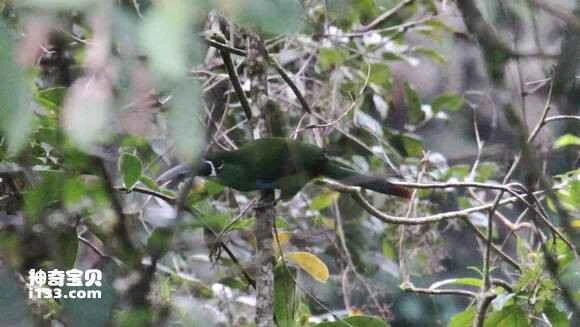
The Yellow-fronted Toucan's call is typically a long, off-key guttural sound, similar to frog croaks and dog barks, as well as a dry, clicking sound; it is also one of the noisiest forest birds. It inhabits mountain forests at altitudes of 1,000–3,600 meters, preferring to perch in the treetops. When eating, it first pecks at its food with the tip of its beak, then tilts its neck back, tosses the food upwards, and then opens its large beak to accurately swallow the food, avoiding the time spent "swallowing" through its long beak. It is omnivorous, feeding on fruits, seeds, and insects, and sometimes raids the nests of small birds, eating the eggs and chicks.
The Yellow-fronted Toucan burrows into decaying trees, building its nest high inside the hollow. Both parents care for the chicks, but there's no clear responsibility for night watch. Large droppings and debris are pecked out of the nest with their beaks, keeping it quite tidy. They lay 2-4 eggs at a time. The smooth, white eggs are placed in the unlined burrow and incubate for about 16 days. The hatchlings are completely naked and take at least three weeks to open their eyes. They begin living independently about 45 days after hatching.
Protect wild animals and ban the consumption of wild game.
Maintaining ecological balance is everyone's responsibility!