Basic Information
Scientific classification
- Chinese name: Red-billed Shovel
- Scientific name: Red Shoveler, Spatula platalea
- Classification: Waterfowl
- Family: Anseriformes, Anatidae, Anatidae
Vital signs data
- Body length: 45-56 cm
- Weight: 523-608g
- Lifespan: No verification data available.
Significant features
Its most striking feature is its very large beak.
Distribution and Habitat
They are distributed in South America, including Colombia, Venezuela, Guyana, Suriname, Ecuador, Peru, Bolivia, Paraguay, Brazil, Chile, Argentina, Uruguay, and the Falkland Islands (also known as the Malvinas Islands).
Appearance
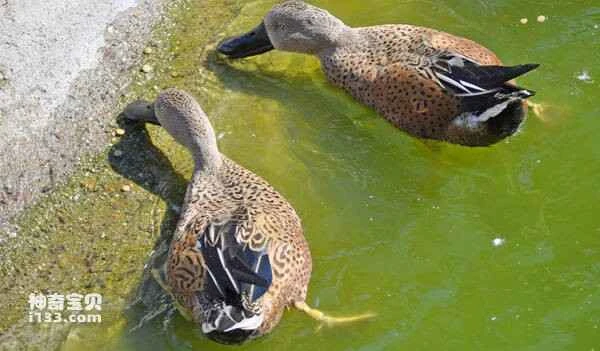
The Red-billed Shoveler measures 45-56 cm in length and weighs 523-608 g. The male's main plumage is cinnamon-colored, with a common greyish-brown head, neck, breast, and wings. It has white eye-rings and lacks a prominent speculum. The female is generally grey and has a plain appearance with dark brown eyes. The most distinctive feature of this duck is its very large beak.
Detailed introduction
The Red Shoveler (scientific name: *Spatula platalea*) is a medium-sized waterfowl belonging to the genus *Spatula* in the family Anatidae.
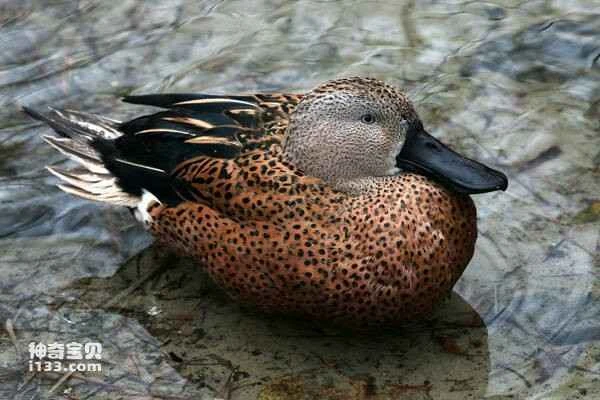
The Red-billed Shovelful (Spotted Shovelful) has a unique bill shape and bright plumage, making it valuable for its ornamental purposes. It primarily inhabits open areas such as lakes, rivers, coastal lagoons, ponds, mangroves, and marshes. It mostly forages in shallow water, using its spoon-shaped beak to dig through the mud and sand for food, including crustaceans, fish eggs, frogs, and small fish. Sometimes it also digs up plants in the mud. Its diet mainly consists of roots, seeds, leaves, fruit, and rice from marshes and lakes, but it also eats invertebrates and arthropods.
The Red-billed Shoveler nests in reeds and marshes using grass as its building material. The breeding season is from May to July, with each clutch containing 7-8 eggs, which are pale yellow or light grayish-green. Incubation takes 25-26 days. The male duck spends a significant amount of time and activity guarding the nest and territory. Ducklings can fly after 40-45 days.
Listed in the International Union for Conservation of Nature (IUCN) Red List of Birds, 2009 ver 3.1.
Protect wild animals and ban the consumption of wild game.
Maintaining ecological balance is everyone's responsibility!