Basic Information
Scientific classification
- Chinese name: Black-capped Shovel
- Scientific name: Anas rhynchotis, Spatula rhynchotis, Australasian Shoveler
- Classification: Waterfowl
- Family: Anseriformes, Anatidae, Anatidae
Vital signs data
- Body length: 46-53 cm
- Weight: 665-667g
- Lifespan: No verification data available.
Significant features
The sexes are very different, and their plumage color varies with the seasons.
Distribution and Habitat
It is found in Australia and New Zealand, including Tasmania and its nearby islands.
This duck is found in almost all lowland swamps and freshwater lakes, as well as seasonal shallows. It inhabits wetlands, but clearly prefers overgrown marshes and occasionally visits coastal lagoons. It is endemic to Australia and New Zealand.
Appearance
The Black-capped Shovel measures 46-53 cm in length and weighs 665-667 grams. There is significant sexual dimorphism, with plumage coloration varying seasonally. During the breeding season, the male's plumage has a greenish sheen, with a black cap-like crown and a white crescent-shaped marking of varying sizes between the beak and eyes, varying among individuals. The neck is grey. The tail, back, and rump feathers are centrally black. The coverts and large, pale blue wings are edged entirely in white. The primary flight feathers are dark brown, while the secondary flight feathers are metallic green. The breast feathers are brown with fine black and white borders. The rest of the underparts are reddish-brown with black crescent-shaped markings. Fine white streaks adorn the sides of the abdomen. The underside is white and brown feathers.
The female duck has a yellow head and neck with dark brown stripes. It has a black crown and black eye stripes. The entire body is light brown, with a brown tail with yellow outer tail feathers. The top and bottom wings resemble those of the male duck, while juveniles resemble the female.
Another subspecies found in New Zealand (Anas rhynchotis variegata) shows less pronounced plumage color changes in males during the breeding season, with an increase in pure white on the face and lower abdomen. The crown is light brown.
Detailed introduction
The Black-capped Shoveler (scientific name: *Spatula rhynchotis*), also known as the Australasian Shoveler, has two subspecies and is a medium-sized waterfowl belonging to the family Anatidae and the genus *Spatula*.
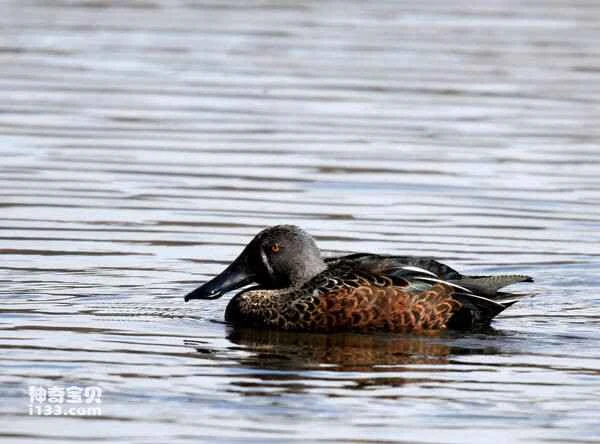
Black-capped Shovels are timid and cautious, generally living in small groups; however, during the dry season, they can congregate in large flocks of hundreds of other bird species. They have a flat, paddle-like bill that they use to forage in the water. Their main diet consists of plants and insects.
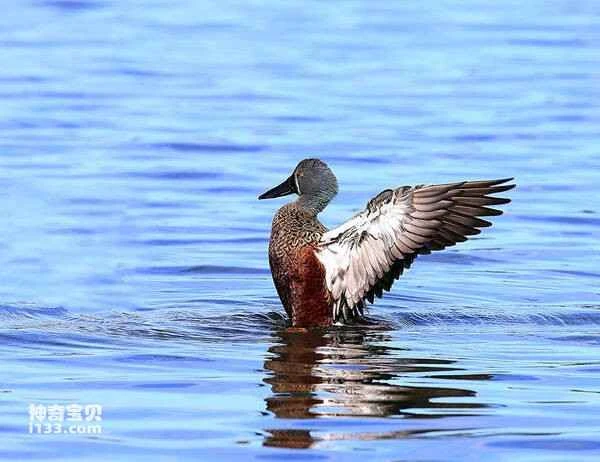
Black-capped Shovels generally breed in arid regions, building their nests near the coast. The egg-laying season is primarily from August to December. Nests are usually built in densely vegetated areas, but are sometimes placed on a tree stump or in a tree cavity. Each nest contains 9 to 11 eggs, which the female incubates alone for 25 days. The female is solely responsible for all subsequent care, including feeding and swimming training.
Listed as Least Concern (LC) on the IUCN Red List of Threatened Species 2012 ver 3.1.
Protect wild animals and ban the consumption of wild game.
Maintaining ecological balance is everyone's responsibility!