
Basic Information
Scientific classification
- Chinese name: North American Black Duck
- Scientific name: Green-billed Black Duck, Black Duck, Anas rubripes, American Black Duck, Black Duck
- Classification: Waterfowl
- Family: Anseriformes, Anatidae, Anatidae
Vital signs data
- Body length: 48-56 cm
- Weight: No verification information available.
- Lifespan: No verification data available.
Significant features
The upper body, tail, and wings are dark brown.
Distribution and Habitat
It is distributed in North America, including the United States, Canada, Greenland, Bermuda, Saint Pierre and Miquelon, and the transitional zone between North and Central America in Mexico.
The American Black Duck prefers forested environments, and its breeding season includes alkaline wetlands, marshes, lakes, ponds, bays, and estuaries. Its favorite habitat is bays and estuaries that are extensively adjacent to farmland. It normally lives in large, open lagoons and coastal waters.
Appearance
The North American Black Duck is a large duck, measuring 48-56 cm in length and with a wingspan of 92 cm. Its upper body, including the tail and wings, is dark brown. The inner edges of its feathers are blackish-brown with red and pale yellow edges. The face is yellow with a dark brown cap and eye stripe. The breast, abdomen, back, and wings are dark brown, and the secondary flight feathers are a shimmering bluish-purple with a purple speculum. Adult males have a yellowish-green bill and bright red legs. The iris is brown. Adult females have a green bill with black spots. Their legs are a similar reddish-orange to the males.
It has bright silver speculum. Similar to juvenile ducks.
Detailed introduction
The American Black Duck (scientific name: Anas rubripes), also known as the Black Duck, is a medium-sized waterfowl belonging to the genus Anas in the family Anatidae.
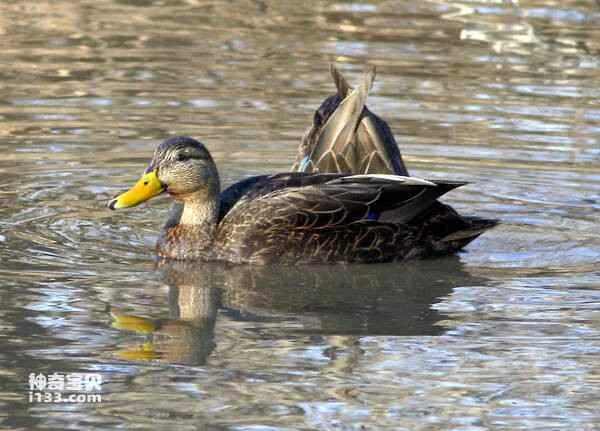
The American Black Duck feeds on seeds, aquatic plants, and crops, and also consumes a significant proportion of invertebrates, including insects, mollusks, and crustaceans in spring and summer. It forages in shallow waters and occasionally dives. In autumn and winter, American Black Ducks are highly gregarious, potentially forming flocks of thousands. As the breeding season approaches, they move in pairs or small groups.
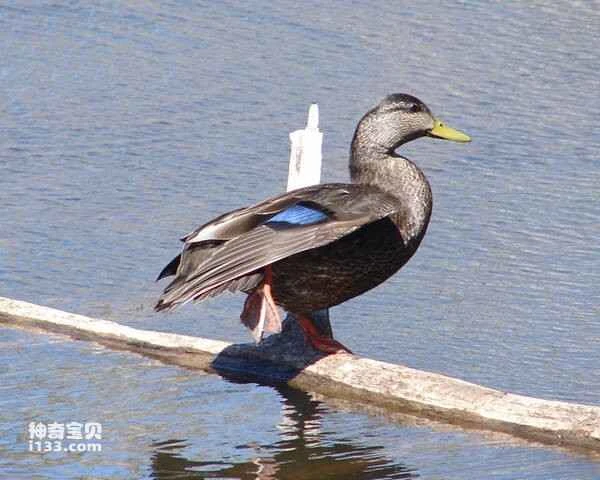
The breeding season for North American Black Ducks begins in March and April. Almost all females typically return to their nesting sites from previous years, often using old nesting sites, or at least building one not far from them. Nests are hidden in vegetation, sometimes in tree cavities, and each nest contains 9 to 10 eggs. The female incubates the eggs alone, with an incubation period of approximately 27 days. The peak hatching period is generally in early May and early June. Ducklings can follow their mothers within 1-3 hours of hatching, and the mother continues to train the ducklings for 6-7 weeks.
Listed as Least Concern (LC) on the IUCN Red List of Threatened Species 2020 ver 3.1.
Protect wild animals and ban the consumption of wild game.
Maintaining ecological balance is everyone's responsibility!


