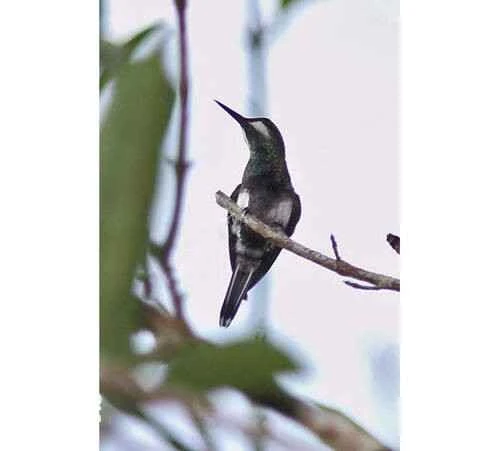
Basic Information
Scientific classification
- Chinese name: Black and white-breasted duck
- Scientific name: Chiloe Wigeon, Anas sibilatrix
- Classification: Waterfowl
- Family: Anseriformes, Anatidae, Anatidae
Vital signs data
- Body length: 43-54 cm
- Weight: 830-940g
- Lifespan: Approximately 20 years
Significant features
The chest has distinct black and white stripes, the sides of the chest and abdomen are orange-brown, and it has a slightly curved black duckbill.
Distribution and Habitat
Distributed across Eurasia and North Africa, including all of Europe, Africa north of the Tropic of Cancer, the Arabian Peninsula, and Asia north of the Himalayas-Hengduan Mountains-Minshan Mountains-Qinling Mountains-Huai River. Also found in the Indochina Peninsula and southeastern coastal regions of China, including Myanmar, Vietnam, Laos, Cambodia, Thailand, as well as Hong Kong and Hainan Island.
They typically inhabit freshwater lakeshores, and also live in groups in rivers, lakes, reservoirs, bays, and coastal salt flats.
Appearance
The Black-and-Spotted Breasted Duck measures 43-54 cm in length. Males weigh 940 g, and females weigh 830 g, with a lifespan of 20 years. The male has an iridescent crest, a large bright sapphire blue stripe extending from behind the eyes to the neck, a white forehead and cheeks, black feathers on the gills, and white spots under the ear coverts. The breast has distinct black and white stripes, orange-brown sides of the chest and abdomen, and a slightly curved black bill. The female is largely similar to the male, but her plumage is slightly darker, and her green crest is not as vibrant as the male's.
Detailed introduction
The Black-and-White-breasted Duck (scientific name: Anas sibilatrix), also known as the Chiloe Wigeon, is a medium-sized waterfowl belonging to the genus Anas in the family Anatidae.
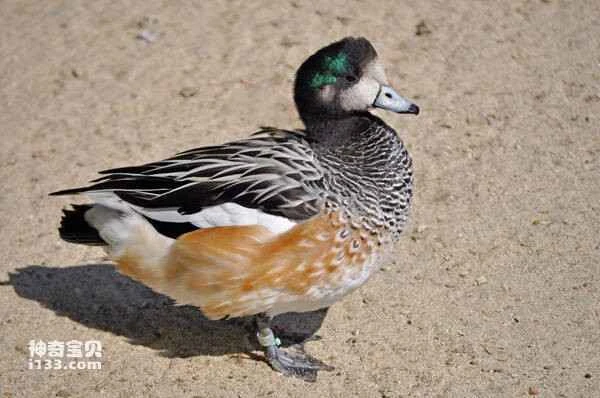
Black-spotted ducks prefer to live in flocks during winter, mostly inhabiting the grassy areas of marshy regions near water. They primarily float on the water's surface, foraging underwater, mainly feeding on plants, but sometimes also consuming animal matter. Their toes are webbed, but they rarely dive; when swimming, their tails remain above water. They are adept at foraging, playing, and courtship in the water. They are clean animals, frequently preening their feathers both in the water and on land. When sleeping or resting, they look after each other. Their diet mainly consists of roots, seeds, leaves, cardamom, and rice from marshy and lake areas, but they also eat invertebrates and arthropods.
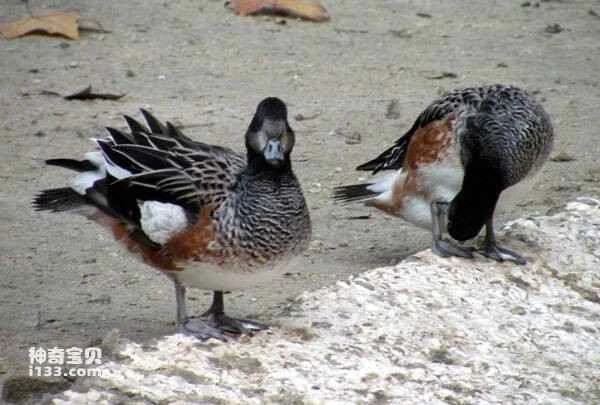
The breeding season for the Black-and-Spotted Breasted Duck is from April to June. They build a bowl-shaped nest using plant stems, placing it above nearby water and concealing it among aquatic plants. Each nest contains 4 to 12 eggs, with incubation lasting 21 to 25 days. The chicks leave the nest at 49 days old and are usually incubated solely by the female. After hatching, the female continues to care for the chicks, who follow her as they forage.
Listed in the International Union for Conservation of Nature (IUCN) Red List of Birds, 2009 ver 3.1.
Protect wild animals and ban the consumption of wild game.
Maintaining ecological balance is everyone's responsibility!