Basic Information
Scientific classification
- Chinese name: Passenger Pigeon
- Scientific name: Passenger pigeon, wandering pigeon, migratory pigeon, travel pigeon
- Classification: Landfowl
- Family and genus: Columbidae, Columbidae, Columba
Vital signs data
- Body length: 32-41 cm
- Weight: 250-340g
- Lifespan: Approximately 30 years
Significant features
It is two to three times larger than a mourning pigeon and resembles a spotted dove.
Distribution and Habitat
Originally distributed south of the forest belt in northeastern North America, extending west to the Rocky Mountains and reaching Pennsylvania. In autumn, they migrate southeast to Florida, Louisiana, and Mexico. Passenger pigeons breed primarily in southern New England, New York, the Mid-Atlantic states including Pennsylvania, as far as the Great Lakes region of western Minnesota, and the Upper Mississippi Valley in southern Kentucky.
They inhabit broad-leaved and mixed forests in the plains, valleys and hilly areas of North America, and often bask in the sunlight on the dead branches at the top of large trees in the morning and evening.
Appearance
The passenger pigeon is a medium-sized pigeon. It measures 32-41 cm in length, has a wingspan of 65 cm, and weighs approximately 250-340 grams. It is two to three times larger than the mourning pigeon and resembles a turtledove. The passenger pigeon has an elongated oval body, propelled by a long, feathered tail and well-designed wings. Its muscles are strong and powerful for its size. When it flies through the sky, its flight path is almost impossible to track with the naked eye; by the time one searches in vain, the bird has already vanished.
Male: The beak is straight, of average length, relatively slender, with a wide base and a rough, fleshy covering; the upper lower mandible droops slightly at the tip, with deformed edges. The head is small, the neck slender, and the body relatively full. The legs are short and strong, scaly at the front, with slightly webbed toes at the base and short, blunt claws. The feathers are mixed on the lower neck and compact on the back. The wings are long, with the secondary flight feathers being the longest. The tail has twelve conical feathers. The beak is black. The iris is bright red. The claws are carmine-purple. The head and sides are pale blue. The throat, foreneck, chest, and sides are light brownish-red, the rest white. The lower neck, along the sides, turns golden, emerald green, and deep red. The upper body feathers are generally greyish-blue, with some black spots on the wing coverts. The wings are dark black, with the primary upper coverts blue and larger whitish areas at the tips. The two middle tail feathers are black, the rest pale blue at the base, fading to white.
Female: The plumage is slightly lighter in color than the male, although the color distribution is the same. The breast is light greyish-brown, the upper half light reddish-brown with blue tinges. There are varied spots on the neck, but not many. The eyes are somewhat dark red, as are the feet.
Detailed introduction
The Passenger Pigeon (scientific name: Ectopistes migratorius), also known as the Passenger Pigeon, has no subspecies and, as the name suggests, is a type of pigeon that particularly enjoys traveling.
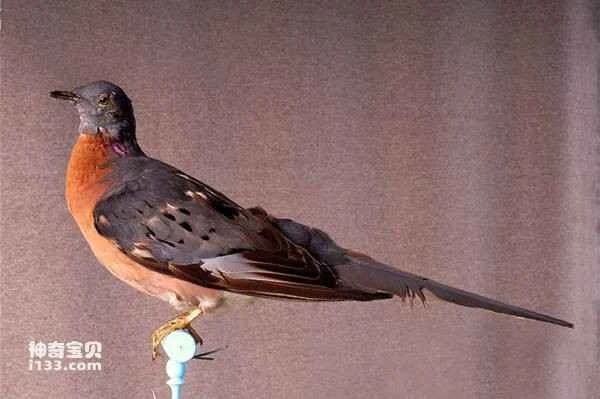
The passenger pigeon is a social bird that lives in large flocks in forests, forming vast colonies covering hundreds of square kilometers, with often a hundred nests in a single tree. It is a typical gregarious species, with each flock exceeding 100 million birds. The passenger pigeon is also a migratory bird unique to North America, spending its summers in a wide area from central and western Canada to the United States, while migrating to Mexico and Cuba in the winter. During migration, flocks of passenger pigeons can reach 1.6 kilometers wide and 500 kilometers long. These enormous flocks contain astronomical numbers of passenger pigeons, sometimes exceeding 2 billion.
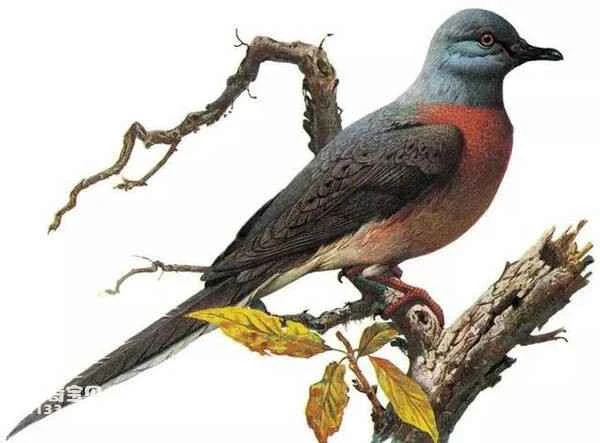
Passenger pigeons primarily feed on seasonal crops and fruits such as berries, nuts, acorns, chestnuts, grapes, cherries, dogwood, and blackberries, as well as insects and invertebrates. Unfortunately, their diet also includes cultivated grains such as wheat, barley, rye, and oats. As they passed through fields cultivated by European settlers, they devoured large quantities of crops, which is one of the reasons why this species was hunted by humans.
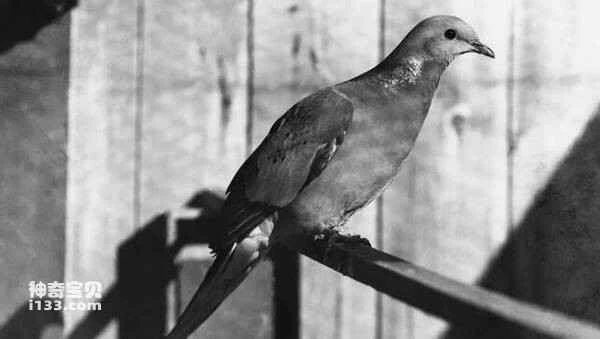
Passenger pigeons nest in flocks of hundreds of thousands, their nests stretching for kilometers and covering several square kilometers of forest. The breeding season is from March to September. They nest in clusters in trees, constructing nests from twigs. Each clutch contains one egg. Both parents incubate the egg for 12-13 days. The chicks feed on pigeon milk secreted by both parents during their first week. They can live up to 30 years.
The last wild passenger pigeon was killed in 1900. On the afternoon of September 1, 1914, the last captive female passenger pigeon, named "Martha," died at the Cincinnati Zoo in Ohio, marking the end of the passenger pigeon's existence on Earth. The exact cause of its extinction is difficult to determine, but widespread deforestation by humans clearing away the broadleaf trees that provided it with its main food source, along with the extensive expansion of railroad and telegraph networks, the destruction of breeding grounds, and the transport of chicks to markets, are likely two of the most significant factors. Other important factors include overhunting, the spread of new diseases, and the collapse of their social structures in their final years.
Listed as Extinct (EX) on the IUCN Red List of Threatened Species 2016 ver 3.1.
Protect wild animals and ban the consumption of wild game.
Maintaining ecological balance is everyone's responsibility!