Basic Information
Scientific classification
- Chinese name: Tasmanian devil
- Scientific name: Sarcophilus harrisii
- Classification: Mammals
- Family and genus: Tasmanian devil (family Mustelidae)
Vital signs data
- Body length: head and body length 57–65 cm; tail length 23–30 cm
- Weight: Males 6–8 kg; Females 4–6 kg (seasonal fluctuation)
- Lifespan: 5–6 years in the wild; longer in captivity.
Significant features
Carnivorous marsupials; strong bite force; ecological scavengers; nocturnal; significant DFTD impact.
Distribution and Habitat
Tasmania’s wet sclerophyllous forests, shrublands, coastal landscapes and agroforestry mosaic.
Appearance
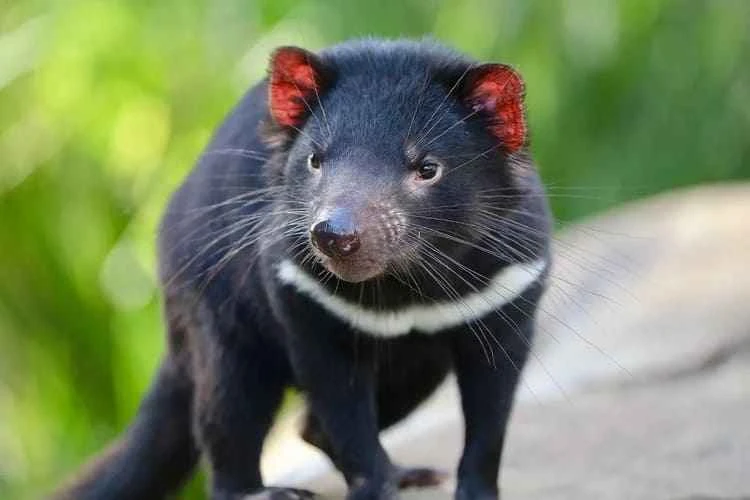
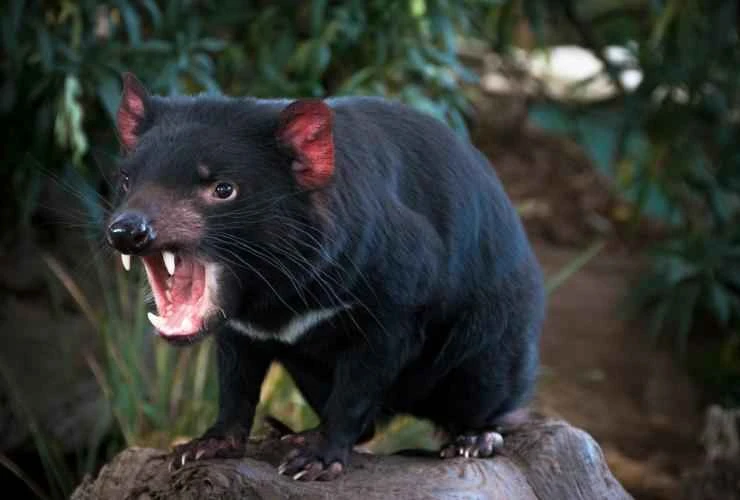
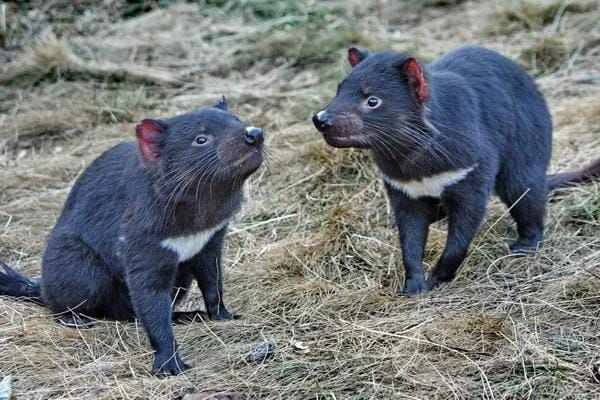
Black fur, often with white spots on the chest/rump; broad head, short and thick tail; short and strong limbs.
Detailed introduction
The Tasmanian devil ( Sarcophilus harrisii ) is one of the largest extant carnivorous marsupials, native to Tasmania . It is known for its powerful bite and its ecological role in scavenging carrion. Since the mid-1990s, the emergence of contagious facial tumor disease (DFTD) has led to a significant decline in its population, and it is assessed as endangered (EN) by the IUCN.
Ecology and Behavior
Nocturnal and primarily solitary; feeds on carrion, reptiles, birds, and insects. Competition for food is accompanied by screams and growls, forming brief hierarchical interactions. Breeding occurs in the Australian autumn; females produce many offspring with few teats (usually four), and early competition among the young is intense.
Morphology and Recognition
It is short and stocky with short limbs, mostly black in color, and often has white stripes on its chest and rump; it has a large head and wide jaw, and a short, thick tail that can store fat.
Threats and Protection
DFTD tumors significantly reduce survival and reproduction.
Road-related deaths : Carrion prey are more likely to be active near roads at night.
Habitat alteration and canine threats are impacting local populations.
The measures taken include: disease-free "insured" populations for captivity and rewilding, disease surveillance, gene management, road speed reduction and clearing, and community programs to reduce the impact of dogs.
Frequently Asked Questions
Q1: Will Tasmanian devils attack people on their own initiative?
Generally not, but remain vigilant towards people; conflicts mostly occur in food-related situations. Never feed or provoke them.
Q2: Can DFTD be cured?
Some wild individuals have shown signs of resistance, but overall, comprehensive conservation measures such as isolation, breeding, and release are still needed.
Q3: Is the distribution limited to Tasmania?
Yes. Historically, the Australian continent has become extinct; its current original range consists only of Tasmania and its surrounding islands.