Basic Information
Scientific classification
- Chinese name: Reedy Quetzal
- Scientific name: Quetzal, also known as the Green Quetzal or Common Quetzal, *Pharomachrus mocinno*, Resplendent Quetzal
- Classification: Climbing birds
- Family and genus: Quetzalcoatlus, order Quetzalidae, family Quetzalcoatlu
Vital signs data
- Body length: 38-41 cm
- Weight: 180-210g
- Lifespan: No verification data available.
Significant features
It is the national bird of Guatemala.
Distribution and Habitat
It is distributed in Costa Rica, El Salvador, Guatemala, Honduras, Mexico, Nicaragua, and Panama.
They inhabit the tropical rainforests of southern Mexico and Central America, including pristine, humid mountain cloud forests, densely vegetated ravines and cliffs, forest edges, and pastures, at altitudes between 900 and 3200 meters. In Costa Rica, there are records of them migrating to lower altitudes during the non-breeding season.
Appearance
The Resplendent Quetzal is the largest of the trogons, measuring 38-41 cm in body length. Including its tail feathers, it can reach 70 cm in length. It weighs 180-210 grams. Its toes are different from other birds; its first and second toes point backward, while its third and fourth toes point forward, exhibiting heterodactylization.
The Resplendent Quetzal has an extremely gorgeous appearance, with green feathers and a narrow crescent-shaped white ring on its red breast. The feathers are a vibrant copper-green and red, and can be seen from different angles ranging from metallic green to bluish-purple, usually with bright feathers that shimmer with a metallic sheen. Under normal circumstances, the feathers of the first flight wing cover the tail feathers, and only during the breeding season do the males show their long tail feathers.
The male has a helmet-like crest. Adult males have yellow beaks, while females have black beaks. Male green quetzals have smooth, long tail coverts, resembling those of a phoenix. Juvenile resplendent green quetzals retain a pair of primitive claws, like those of Archaeopteryx or pterosaurs, which disappear in adulthood.
Detailed introduction
The Resplendent Quetzal (scientific name: Pharomachrus mocinno) has two subspecies.
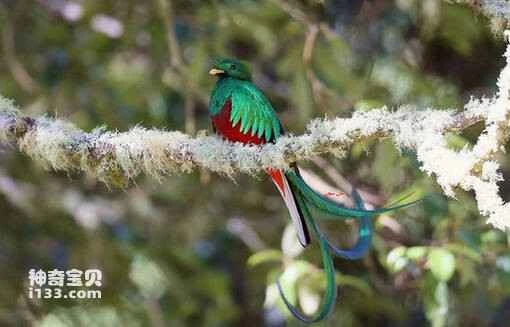
The Recurve Quetzal is a fast flier, renowned for its exceptionally beautiful plumage, and is one of the most beautiful birds in the Americas, holding an important place in Mesoamerican mythology. It is omnivorous, feeding on jungle insects, fruits, and frogs.
The breeding season for the Resplendent Quetzal is from February to July each year. To attract females, males perform a courtship dance, leaping through the air and singing loudly. Both parents build the nest, usually in a tree cavity 20-30 meters above the ground, but occasionally choosing an old woodpecker burrow. After mating, the female lays one or two pale blue eggs in the nest, which are incubated by both parents for 17 to 18 days. Once hatched, the chicks are fed by both parents for 23 to 31 days until they are fully plumped and leave the nest. Newborn chicks retain a pair of primitive claws on their wings, which disappear in adulthood, similar to the hoatzin, indicating that it is also a primitive bird.
The Resplendent Quetzal, also known as the "Aztec Bird," is a beautiful bird that lives in the tropical rainforests of Central and South America. In ancient Mayan and Aztec cultures, the Resplendent Quetzal was considered an incarnation of the feathered serpent god (Quecharia) and enjoyed a sacred status.
In ancient Mayan culture, the Recurve Quetzal was considered an incarnation of the feathered serpent god Quetzal and enjoyed a sacred status. It is the national bird of Guatemala.
Listed as Near Threatened (NT) in the IUCN Red List of Threatened Species 2016 ver 3.1.
It is listed in Appendix I of the 2019 edition of the Convention on International Trade in Endangered Species of Wild Fauna and Flora (CITES).
Protect wild animals and ban the consumption of wild game.
Maintaining ecological balance is everyone's responsibility!