Basic Information
Scientific classification
- Chinese name: Curly-leaved garden spider
- Scientific name: Araneidae (typical genus Phonognatha spp., etc.)
- Classification: Arthropoda
- Family: Araneidae; Genus: *Araneus*
Vital signs data
- Body length: Female spiders are approximately 8–15 mm in length, while males are significantly smaller.
- Weight: Relatively light, mostly in the tens of milligrams range, varying depending on the species and individual.
- Lifespan: Generally about 1 year, some individuals can overwinter and reproduce the following year.
Significant features
They roll up leaves in a spiral web to use as a hiding place; they feed on small flying insects; they are often found in shrubs and garden environments.
Distribution and Habitat
It is mainly distributed in low vegetation zones such as shrublands, forest edges, roadside hedges, and family gardens in warm to subtropical regions.
Appearance
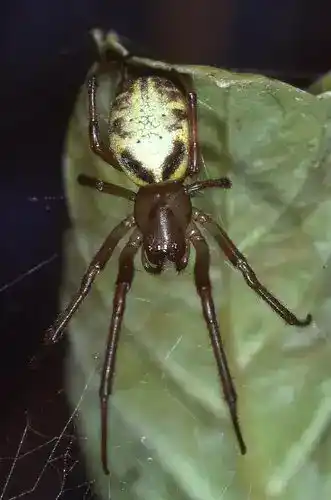
They are small in size and mostly brown or yellowish-brown in color, often with stripes or spots, which provide good camouflage against the leaves and branches.
Detailed introduction
Leaf-curling spiders are a type of web-weaving spider that rolls up leaves and secures them in their webs. They are commonly found in the genus * Phonognatha * within the family Araneidae . They weave whorled webs between shrubs, branches, or fences, rolling up a dry or fresh leaf into a "small tent" as a "resting place" for hiding during the day and ambush prey at night.
Basic Information
Scientific name (general term): Araneidae – leaf-curling spiders (typical genus such as Phonognatha spp.)
Size: Mostly small to medium-sized spiders, with females measuring about 8–15 mm in length and males even smaller.
Lifespan: Usually about 1 year, some individuals can overwinter and reproduce the following year.
Web weaving and leaf curling behavior
The distinctive feature of the leaf-rolling orb spider is that it gathers, curls, and secures a leaf (usually a dry leaf) to the center or side of its web using silk, forming a hollow "small tube." During the day, the spider mostly hides inside the rolled leaf, only extending its legs or silken tentacles to sense prey; from dusk to night, it emerges and waits near the opening of the rolled leaf. Once a flying insect hits the spiral web, it quickly rushes out to subdue its prey.
Ecology and Habits
They primarily prey on small flying insects, such as mosquitoes, small moths, fruit flies, and small beetles, and play a certain role in regulating insect populations in gardens and shrubbery. They are often found in bushes, forest edges, roadside hedges, and around family yards, and people often find these "curled-leaf tents" hanging from low branches or railings.
Toxicity and Effects on Humans
Like most common web-weaving spiders, the Orb-weaver spider possesses venom glands to paralyze its prey. However, for healthy humans, occasional bites usually cause only mild and localized pain, redness, or itching , and are not considered a medically significant danger. They are small in size and secretive in nature, and generally do not bite unless handled with bare hands.
Ecological role
Ornamental leaf-rolling spiders act as a natural pest control mechanism in shrubbery and garden ecosystems by preying on various small flying insects. Protecting diverse vegetation, preserving adequate amounts of fallen leaves and shrubs, and reducing pesticide use are beneficial for these web-weaving spiders to establish stable web sites and also contribute to overall biodiversity.
Frequently Asked Questions
Q1: Why do leaf-rolling spiders roll up their leaves?
The rolled-up leaves can serve as hiding places, helping spiders avoid predators, shield them from sunlight and wind and rain, and also act as concealed strongholds for ambushing prey.
Q2: Did you cut the leaves yourself?
Generally, the existing leaves are used, and spider silk is used to pull and entwine them to make them curl up, rather than actually "cutting off the leaves".
Q3: Are leaf-curling spiders dangerous to humans?
It usually poses no serious danger to healthy adults; bites are extremely rare and mostly cause mild local discomfort.
Q4: Do I need to remove the spiderwebs with curled leaves that I find in my yard?
If they don't interfere with daily activities, they can be kept, as they help reduce small flying insects; if pruning is necessary, move the entire branch aside first, allowing the spiders to migrate naturally.