Basic Information
Scientific classification
- Chinese name: Jumping spider
- Scientific name: Salticidae (typical genus Phidippus spp., etc.)
- Classification: Arthropoda
- Family: Jumping Spiders; Genus: Jumping Spider
Vital signs data
- Body length: mostly 3–15 mm, small to medium-sized spiders
- Weight: Usually in the range of a few milligrams to more than ten milligrams, depending on the species and individual.
- Lifespan: Generally about 1 year, some species can live 1-2 years.
Significant features
They have excellent vision; they are good at jumping; they actively track and pounce on prey; some species exhibit mimicry behavior.
Distribution and Habitat
They are found almost all over the world, in various environments from forests and grasslands to the surfaces of urban buildings and family gardens.
Appearance
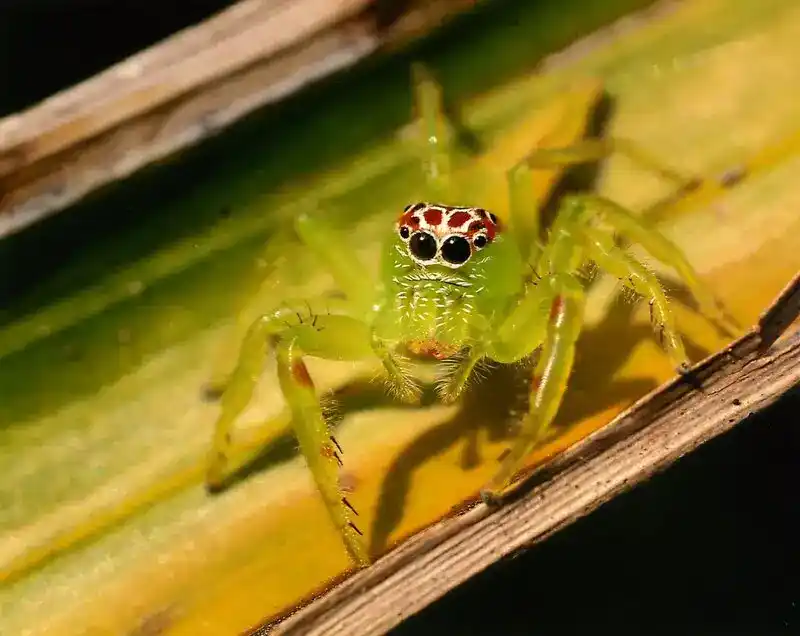
They have a compact body and a pair of prominent large eyes at the front; their body colors are diverse, with some species having bright colors or a metallic sheen.
Detailed introduction
Jumping spiders are a large group of spiders known for their agile jumping and excellent vision, mainly belonging to the family Salticidae . They do not rely on large webs, but hunt by actively tracking and leaping to catch their prey , making them a very important group of "visual hunters" in terrestrial ecosystems.
Basic Information
Scientific name (general term): Salticidae – jumping spiders (typical genus such as Phidippus spp.)
Size: Most are small to medium-sized spiders, about 3–15 mm in length, with a few tropical species being slightly larger.
Lifespan: Usually around 1 year, some species can live up to 1–2 years.
Vision and Behavior
The most distinctive feature of jumping spiders is the row of large eyes on the front of their cephalothorax, especially the anterior median eyes (anteromedian anti-eyes), which give them one of the highest resolution visions among arachnids. They often raise their heads and turn left and right, as if "surveying" their surroundings, enabling them to accurately judge distances and complete jumps several times their own body length.
Most are diurnal , moving among leaves, walls, rocks, and branches in the sunlight, slowly approaching their prey before suddenly leaping to strike, simultaneously releasing a safety thread as a "safety rope." Some species mimic the appearance and behavior of ants or beetles for camouflage or to approach prey.
Ecological habits
They primarily feed on small insects and other arthropods, including aphids, small flies, and ant larvae, and play a role in controlling pests in farmland and gardens. They typically only weave short silk nests for resting, molting, or laying eggs, rather than large predatory webs.
Toxicity and Effects on Humans
Jumping spiders possess venom glands to paralyze their prey, but due to their small size, bites to healthy humans are extremely rare and usually only amount to minor insect bites , manifesting as temporary localized redness or mild itching, generally without serious medical consequences. Most jumping spiders are docile and will retreat or hide when encountering humans.
Frequently Asked Questions
Q1: Do jumping spiders jump onto people and bite them?
Jumping is primarily used for hunting and escaping; animals generally do not attack humans unprovoked. Approaching out of curiosity is usually for "observation," not an aggressive behavior.
Q2: Are jumping spiders poisonous?
The venom glands are used to paralyze prey, but they are very weakly toxic to healthy humans, with serious cases being rare.
Q3: Why do my eyes look so big?
The highly developed anterior and middle eyes are capable of forming relatively clear images, and together with other small eyes, they provide a wide field of vision, which is the basis for the jumping spider's precise jumping and complex courtship behavior.
Q4: Can jumping spiders be kept as pets?
Some brightly colored jumping spiders (such as certain Phidippus species) are kept as miniature pets by a small number of enthusiasts, but their wild nature should still be respected, and they should not be released into non-native habitats.


