
Basic Information
Scientific classification
- Chinese name: Oil Owl
- Scientific name: Steatornis caripensis, Oilbird, guacharo
- Classification: Climbing birds
- Family and genus: Nocturnal order, Oleidae family, Oleidae
Vital signs data
- Body length: 30-40 cm
- Weight: No verification information available.
- Lifespan: No verification data available.
Significant features
It is the only fruit-eating member of the order Noctua and the bird with the highest oil content.
Distribution and Habitat
Oil owls are found in the tropical forests of the Andean foothills from Bolivia to Venezuela, and also in Panama and Trinidad.
Appearance
It is about 30 cm (12 inches) long. The tail is fan-shaped, the wings are long and wide, dark reddish-brown with black horizontal bars and white spots. The beak is strong, hooked at the end, with a wide gape and long barbels around it. The eyes are large and black.
Detailed introduction
In the coastal mountains of Colombia, Ecuador, and Peru lives the oil owl, a close relative of the nightjar. Larger than the nightjar and similar in color, the oil owl is more closely related to owls than the nightjar, and both are nocturnal birds. However, the oil owl differs significantly from its relatives in diet, feeding primarily on oil palm fruits. Its yellow, hooked beak is well-suited for catching fleshy fruits. At dusk, large flocks of oil owls flit through the forests, pecking at oil palm fruits in the palm canopy. Because they consume a lot of oily fruits, they accumulate a thick layer of yellow fat under their skin, hence their name. The oil owl's main food sources are avocados, oil palm fruits, and olives, abundant in South America. Avocados have recently been hailed as the king of fruits in terms of nutrition, their main component being oil. An avocado contains 20% to 30% oil, and the oil palm fruit is known as the "king of oils in the world," and like olives, it is a major source of plant oil for humans.
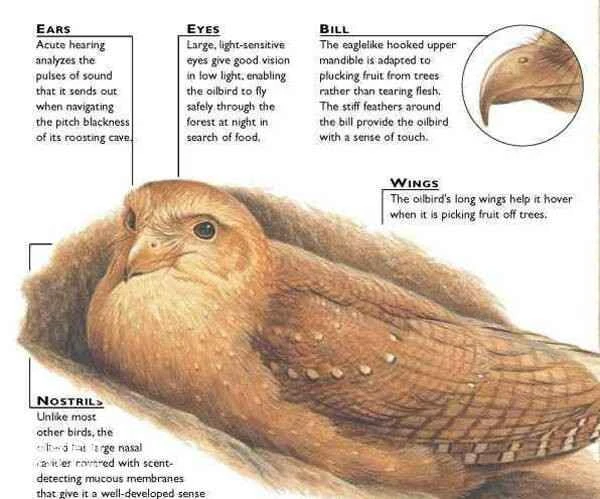
During the breeding season, oil owls build nests in the hollows of rock walls within caves. They secrete a sticky substance from their beaks to bind semi-digested fruit together to form the nest walls. Oil owl chicks are flightless and mostly stay in the cave waiting to be fed. Because birds expend enormous amounts of energy during flight—data from the Chinese Academy of Sciences' ornithological research shows it's about 3 to 15 times the energy expended by terrestrial animals running—adult oil owls ingest a lot of oil, but some is burned off during nighttime flight. The chicks' sedentary nature leads to them becoming excessively large, resembling a ball of flesh. During their approximately 120-day incubation period, these baby oil owls can grow to 1.5 times their adult weight! Because they are richer in oil than adults and easier to catch, resource-scarce Native Americans have relied on them for oil for thousands of years. Every year, when the oil owl's breeding season arrives, Native Americans gather at the entrance of the caves where the owls nest, and hold a unique ceremony. Then they set up a large pot, build a roaring fire, and throw thousands of collected oil owl chicks into the pot to render oil. This oil is said to be transparent and odorless, and will not spoil even after long storage. Native Americans use this oil for lighting and for food.
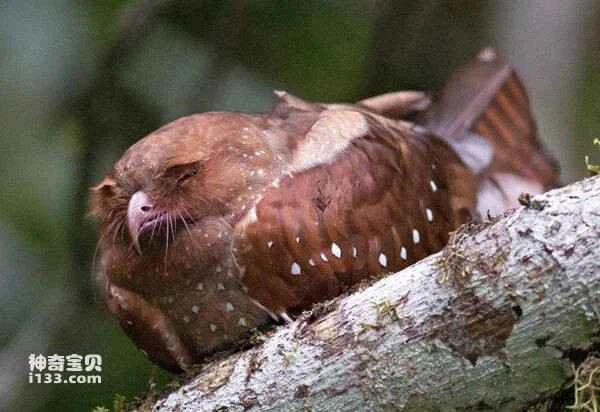
At night, oil owls emit a sharp cry as they fly, creating a loud echo in the mountains and fields. They use these echoes to locate food, companions, and obstacles. If their ear canals are plugged, oil owls can only fly in light, similar to bats. However, unlike bats, the sound waves emitted by oil owls are within the range of human hearing, while the ultrasonic waves emitted by bats are inaudible to humans. Furthermore, the frequency of the oil owl's general cry is below 7000 Hz, but in dark places or when encountering obstacles, their cry becomes much sharper, and the closer they are to the obstacle, the sharper the cry becomes. Griffin determined that the frequency of this scream is above 7000 Hz.

In 1958, the Venezuelan government established a national park at the Capri Caves and installed sophisticated electronic lighting inside. Since then, thousands of tourists have flocked to the caves to witness this unique "radar-equipped bird."
Protect wild animals and ban the consumption of wild game.
Maintaining ecological balance is everyone's responsibility!


