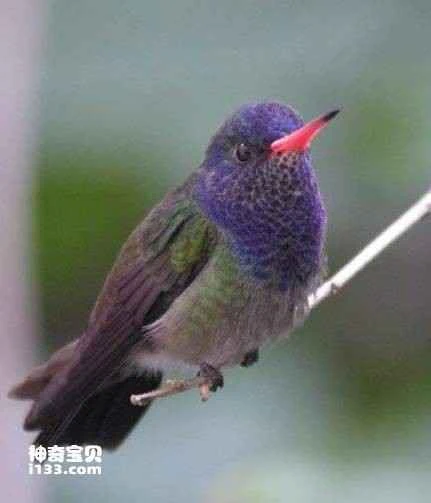
Basic Information
Scientific classification
- Chinese name: Lin Feicui
- Scientific name: Todirhamphus macleayii, Forest Kingfisher
- Classification: Climbing birds
- Genus and species: Order Coraciiformes, Family Kingfisher, Genus Aldebaran
Vital signs data
- Body length: Approximately 20 centimeters
- Weight: 29-42g
- Lifespan: No verification data available.
Significant features
Very noisy and has a strong sense of territory.
Distribution and Habitat
It is distributed in Australia, Indonesia, Papua New Guinea, and the Solomon Islands. In Australia, its distribution extends to northeastern New South Wales, particularly east of the mountains, to the Cape York Peninsula and northern regions, from Melville Island, Darwin, the Victoria River, and Groot Island. It is also found east of Star Bay in Papua New Guinea, extending to the western Bismarck Archipelago.
They typically inhabit wooded areas, forests, and riverbanks; in Australia, they are found in nearby forest swamps, savannas at forest edges, farmland, grasslands, swamps, woodland streams, wooded bays, and also in eucalyptus forests and mangroves. In New Guinea, their habitat extends up to 1600 meters.
Appearance
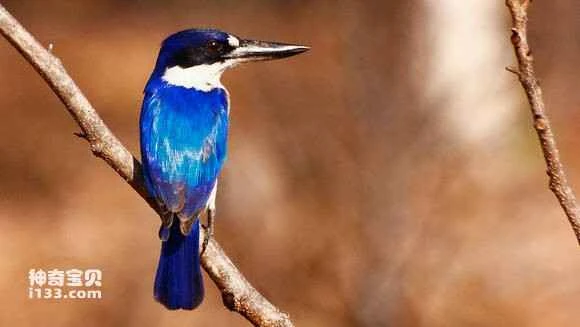
The forest kingfisher is 20 cm long and weighs 29-42 g. The male has a bluish-purple crown and wings. There is a large white spot on the base of the beak. The lores are black and the back of the neck is white. The upper body coverts are turquoise blue and the tail is cobalt blue. The tertiaries and tail feathers have a bluish-purple hue, and the sides of the neck, chin, throat, chest, wings, lower abdomen and tail are largely white. The inside of the wings is white. The upper jaw is dark brown. The iris is dark brown and the legs are grayish-black. [1]
The female differs from the male in that the nape, cap, and wattle (lacking a white collar) are all deep blue. Juveniles differ from adult males; their blue is slightly darker, and their outer plumage and wing coverts are antelope-skin yellow. The breast has dark stripes, the sides and abdomen are pale yellow, and the back is grey, blue, or black.
The beak is thick and long, resembling a chisel, with a relatively wide base, a straight beak peak, a rounded ridge, and no nasal grooves on either side; the wings are rounded, with the first primary flight feather being the same length as or slightly shorter than the seventh primary flight feather, and the second, third, and fourth primary flight feathers being nearly the same length; the base of the primary flight feathers has white spots; the tail is rounded.
Detailed introduction
The scientific name of the Forest Kingfisher is Todirhamphus macleayii, Forest Kingfisher. There are three subspecies (Forest Kingfisher Papua subspecies, Forest Kingfisher nominate subspecies, and Forest Kingfisher Cape York subspecies).
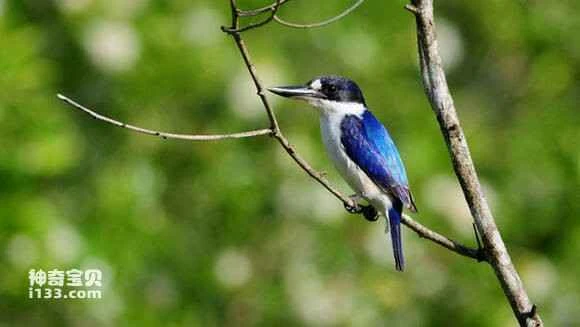
Wood kingfishers migrate to some areas, returning to the same regions each year. In New South Wales, they leave in March and April, returning in September and October. They winter in the Tanimbar Islands, Indonesia, and southern Papua New Guinea. Subspecies living in New Britain, New Ireland, and Elizabeth are non-migratory and resident birds.
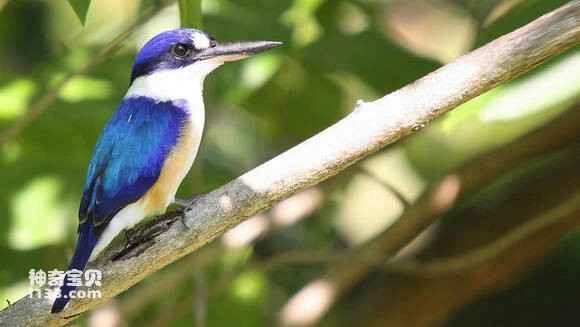
Forest kingfishers typically hunt alone or in pairs. Like most forest kingfishers, they are entirely carnivorous. They are very noisy and have a strong sense of territory. As migratory birds, they migrate twice a year, in summer and winter, and at this time of year, the forest kingfisher pair faithfully returns to the same territory. This kingfisher is a keen hunter, seeking out bare branches or telephone poles. Once it finds prey, it pecks at its legs and chest, sometimes holding it in its beak and swinging it back and forth or striking it forcefully until the prey dies before swallowing it.
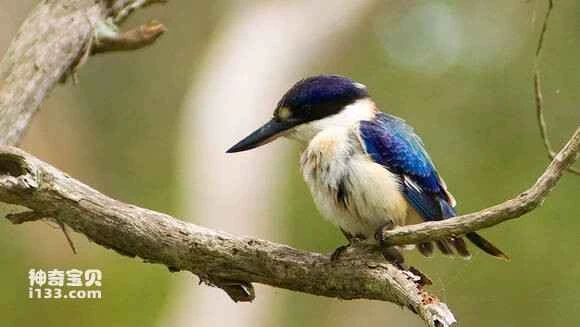
The forest eagle's main diet consists of invertebrates such as crickets, spiders, scorpions, and snails. It also eats small vertebrates such as small fish, small snakes, and lizards.
The laying season for the Wood Kingfisher varies depending on the region: October to December in New South Wales, Australia; August to December in Queensland; September to November in the Northern Territory; and January in New Guinea. Both males and females typically work together to dig a nest in a termite-eroded tree trunk. Their nest resembles a slightly curved, short tunnel, approximately 23 cm deep. The female lays 3-6 eggs per clutch.
Listed as Least Concern (LC) on the IUCN Red List of Threatened Species 2013 ver 3.1.
Protect wild animals and ban the consumption of wild game.
Maintaining ecological balance is everyone's responsibility!