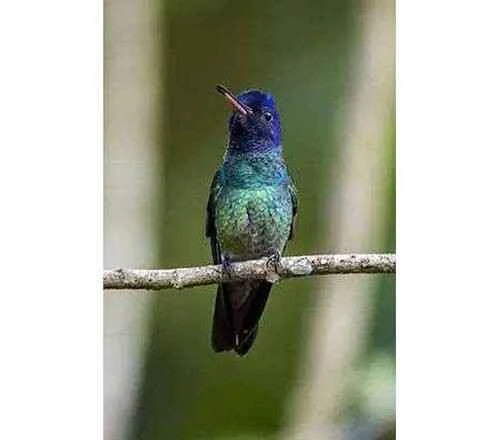
Basic Information
Scientific classification
- Chinese name: Red Forest Jade
- Scientific name: Halcyon senegaloides, Mangrove Kingfisher
- Classification: Climbing birds
- Family and Genus: Order Coraciiformes, Family Kingfisher, Genus Kingfisher
Vital signs data
- Body length: Approximately 22 centimeters
- Weight: 57-66g
- Lifespan: No verification data available.
Significant features
Distribution and Habitat
Redwoods are found in south-central Africa (including the southern Arabian Peninsula and the entire African continent south of the Sahara Desert (Tropic of Cancer)).
Redwood kingfishers do not only live in mangrove forests. They are active in open woodland areas near forests and along rivers, frequently appearing in estuarine woodlands and mangroves. They are also found near wooded coastlines, fields, thickets, evergreen forests, urban parks, gardens, and farms. Their distribution ranges from plains to elevations of 300 meters.
Appearance
The Red-crowned Kingfisher measures 22cm in length and weighs 57-66g. Its forehead, neck, crest, and nape are greyish-brown. A slightly curved white line runs from the nostril to the eye. The lores are black, and the cheeks and sides of the neck are greyish-brown. The abdomen and sides are greyish-white without any impurities. The primary flight feathers are black. The tips of the scapula and secondary flight feathers are blue, the rest being a mixture of black, grey, and white. The bill is red, and the iris is dark brown. The legs are greyish-brown. Juveniles are slightly darker blue than adults. The abdomen and sides are tinged with yellow. The bill is blackish-brown.
The beak is thick and long, resembling a chisel, with a relatively wide base, a straight beak peak, a rounded ridge, and no nasal grooves on either side; the wings are rounded, with the first primary flight feather being the same length as or slightly shorter than the seventh primary flight feather, and the second, third, and fourth primary flight feathers being nearly the same length; the base of the primary flight feathers has white spots; the tail is rounded.
Detailed introduction
The Mangrove Kingfisher, scientifically known as Halcyon senegaloides, is a bird belonging to the genus Halcyon in the family Kingfisheridae of the order Coraciiformes.
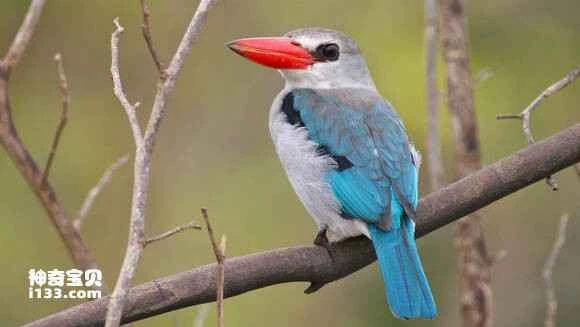
Mangrove kingfishers are migratory birds. In late September and early October each year, they leave the forests and coastal mangroves to nest inland, 5 or 10 miles from the sea. In February and March, the birds make the exact opposite journey, returning to the coast to find mates.
Like most forest kingfishers, the redwood kingfisher is entirely carnivorous. It typically hunts for prey in leaves or soil. Its main diet consists of invertebrates such as crickets, spiders, scorpions, and snails. It also eats small vertebrates such as small fish, snakes, and lizards.
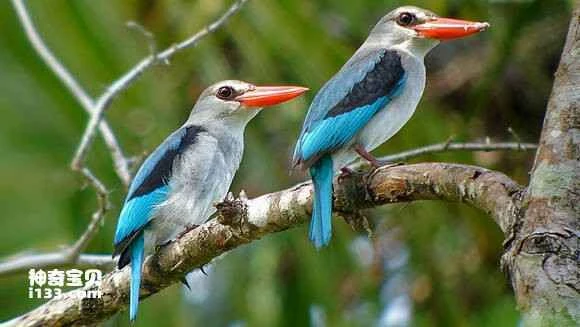
The spawning season of the mangrove kingfisher varies with latitude: October in Kenya, December in Tanzania and Pemba Island, November to December in the Cape Province, August to January in East Africa, and September to April in South Africa. They nest on earthen cliffs or riverbanks, digging tunnel-like burrows with their beaks, 60 cm deep, 20 cm wide, and 10 cm high, oval in shape. These burrows are generally unlined. Eggs are laid directly on the ground inside the nest. Some also burrow into tree trunks to make nests. The eggs are nearly round and pure white.
Listed as Least Concern (LC) on the IUCN Red List.
Protect wild animals and ban the consumption of wild game.
Maintaining ecological balance is everyone's responsibility!