
Basic Information
Scientific classification
- Chinese name: Woodland Emerald
- Scientific name: Woodland Kingfisher, Senegal Kingfisher, Halcyon senegalensis, Woodland Kingfisher
- Classification: Climbing birds
- Family and Genus: Order Coraciiformes, Family Kingfisher, Genus Kingfisher
Vital signs data
- Body length: Approximately 21 centimeters
- Weight: No verification information available.
- Lifespan: No verification data available.
Significant features
Distribution and Habitat
Woodland emeralds are found in south-central Africa (including the southern Arabian Peninsula and the entire African continent south of the Sahara Desert (Tropic of Cancer)).
Woodland emeralds typically inhabit dense forests and riverbanks near water, on the edges of tropical savanna woodlands, in rivers, lakes, or mangroves.
Appearance
The Woodland Kingfisher is a medium-sized kingfisher, measuring 21 cm in length. Its head and neck are greyish-blue. The scapula and primary flight feathers are black, forming a dividing line. The tail feathers are blue. Unlike other African species, its upper body is grey, with a small patch of black and white on its tail. The beak is red on the upper part and black on the lower jaw. The legs are greyish-brown, and the iris is brown. The eye stripe is black.
The beak is thick and long, resembling a chisel, with a relatively wide base, a straight beak peak, a rounded ridge, and no nasal grooves on either side; the wings are rounded, with the first primary flight feather being the same length as or slightly shorter than the seventh primary flight feather, and the second, third, and fourth primary flight feathers being nearly the same length; the base of the primary flight feathers has white spots; the tail is rounded.
Detailed introduction
Woodland Kingfisher, scientifically known as *Halcyon senegalensis*, has three subspecies: 1. *Halcyon senegalensis* senegalensis, distributed in Kenya, Tanzania, Rwanda, Burundi, and Ethiopia; 2. *Halcyon senegalensis fuscopilea*, distributed in Nigeria, the Congo Basin, and Sierra Leone; and 3. *Halcyon senegalensis cyanoleuca*, distributed in Angola, Botswana, South Africa, and Tanzania.

Woodland kingfishers stand motionless among the trees when exposed to direct sunlight, but become quite active in damp weather and on cloudy days. This is a unique bird that often emits a rapid, repetitive trill during the breeding season. Woodland kingfishers are migratory in Africa. This species is located north and south of the equator, varying seasonally. Migration generally occurs at night, with birds flying alone or in small flocks.
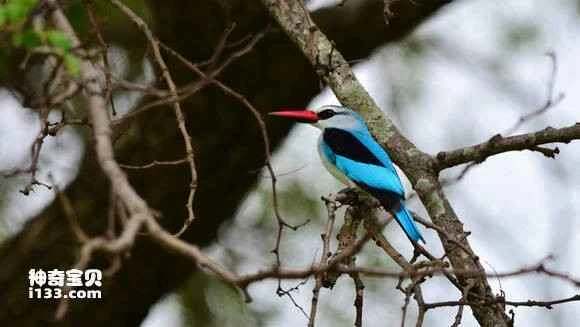
Woodland kingfishers typically hunt alone or in pairs. Like most forest kingfishers, they are entirely carnivorous, often searching for prey in leaves or soil. Their main diet consists of invertebrates such as crickets, spiders, scorpions, and snails. They also eat small vertebrates such as small fish, snakes, and lizards.
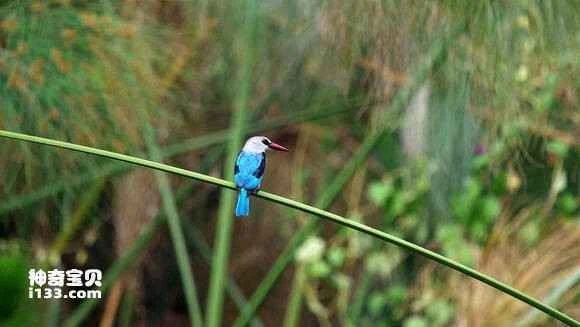
The woodland kingfisher's nesting season in Northern Rhodesia is from October to January, and in Transvaal it extends to November to February. They nest on earthen cliffs or riverbanks, digging tunnel-like burrows with their beaks. These burrows are 60 cm deep, 20 cm wide, and 10 cm high, and are oval in shape. These burrows are generally unlined. The eggs are laid directly on the ground inside the nest. The female lays 3-4 eggs at a time. The eggs are nearly round and pure white.
Listed as Least Concern (LC) on the IUCN Red List.
Protect wild animals and ban the consumption of wild game.
Maintaining ecological balance is everyone's responsibility!


