Basic Information
Scientific classification
- Chinese name: Blue-breasted Jade
- Scientific name: Halcyon malimbica, Blue-breasted Kingfisher
- Classification: Climbing birds
- Family and Genus: Order Coraciiformes, Family Kingfisher, Genus Kingfisher
Vital signs data
- Body length: Approximately 25 centimeters
- Weight: 66-94g
- Lifespan: No verification data available.
Significant features
The adult bird has a white-grey-brown forehead and is the largest kingfisher in Africa.
Distribution and Habitat
Blue-breasted eagles are found in south-central Africa (including the southern Arabian Peninsula and the entire African continent south of the Sahara Desert (Tropic of Cancer)).
The blue-breasted kingfisher inhabits a variety of forest environments: secondary forests, mangroves, rainforests, riparian forests, and lush tropical grasslands. Its range extends from sea level to approximately 1800 meters above sea level. Its territory and range cover almost the entire equator in Africa.
Appearance
The Blue-breasted Kingfisher is 25 cm long, with males weighing 66-94g and females weighing 70-93g. Adults have a white-grey-brown forehead.
A white line marks the boundary between the crown and eye stripe. The crown is dark brown. There is a black triangle on the lores and behind the eyes. The neck, upper hood, cheeks, and sides of the neck are blue. The lower hood, upper back, shoulders, and forewings are black. The lower back and tail are bright sky blue, with a dark blue tail. The chin and throat have small white squares, interspersed with blue-green on the chest. The sides of the abdomen are greyish-white along the tail. The underside of the wings is white, and the tail is shiny black. The upper jaw has a beautiful bright red, the iris is dark brown, and the legs are dark red. Juveniles differ from adults; their crown is blue-green. There is a green stripe under the blue head. The chin and abdomen are pale yellow instead of white. The legs and claws are red.
The beak is thick and long, resembling a chisel, with a relatively wide base, a straight beak peak, a rounded ridge, and no nasal grooves on either side; the wings are rounded, with the first primary flight feather being the same length as or slightly shorter than the seventh primary flight feather, and the second, third, and fourth primary flight feathers being nearly the same length; the base of the primary flight feathers has white spots; the tail is rounded.
Detailed introduction
The Blue-breasted Kingfisher, scientifically known as *Halcyon malimbica*, has four subspecies: (1. *Halcyon malimbica torquata*, distributed in Mali and Senegal; 2. *Halcyon malimbica forbesi*, distributed in Nigeria and Cameroon; 3. *Halcyon malimbica dryas*, distributed in São Tomé and Príncipe; 4. *Halcyon malimbica malimbica*, distributed in Sudan, Uganda, Tanzania, Cameroon, Angola, Zambia, and Ethiopia).
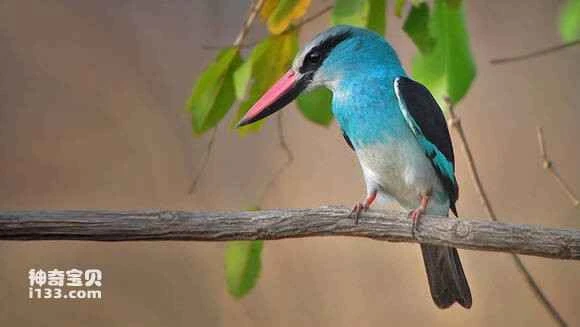
Like most kingfishers, the blue-breasted kingfisher hunts, but it is not entirely carnivorous. It consumes some vegetables and fruits, such as oil palms. In addition, its diet consists mainly of invertebrates: cockroaches, crickets, termites, wasps, beetles, spiders, scorpions, crabs, and mollusks. It also eats small vertebrates, frogs, toads, lizards, and mice.
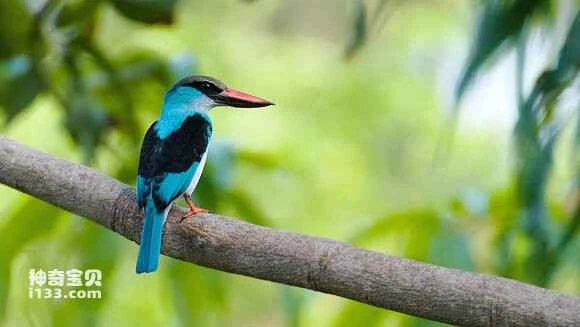
Blue-breasted kingfishers burrow into tree trunks to build their nests, 6 to 10 meters above the ground. They typically lay two eggs. The egg-laying season varies by region: August to September in Guinea-Bissau, March to April in Ghana, January to June in Nigeria, August to June in Cameroon and Gabon, October to December in the island nation of São Tomé and Príncipe, and April in Uganda.
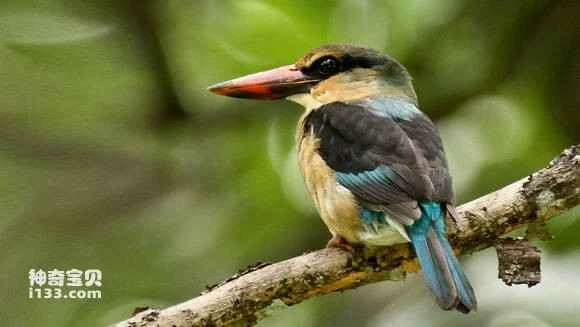
Listed as Least Concern (LC) on the IUCN Red List.
Protect wild animals and ban the consumption of wild game.
Maintaining ecological balance is everyone's responsibility!