
Basic Information
Scientific classification
- Chinese name: Bermuda Roundtail
- Scientific name: Bermuda petrel, Pterodroma cahow, Bermuda Petrel, Cahow, Fardela de Bermudas, Petrel cahow
- Classification: Waterfowl
- Family and genus: Procellariiformes, Procellariiidae, *Rhynchus*
Vital signs data
- Body length: Approximately 38 centimeters
- Weight: 257-455g
- Lifespan: Approximately 30 years
Significant features
It is a medium-sized petrel with brown, grey, and white plumage.
Distribution and Habitat
It is found in Bermuda and the United States.
Wandering: Bahamas, Portugal (Azores), Portugal (Azores).
Seasonal uncertainty: Canada.
Outside of the breeding season, they may move northward into the Atlantic Ocean along the warm waters of the western edge of the Gulf Stream. Confirmed records exist along the coasts of North Carolina, Virginia, and Massachusetts in the United States.
Bermuda roundtails are mostly found in warm and tropical regions, particularly the South Pacific, and occasionally undertake long-distance voyages, even flying along the Gulf Stream and the Carolina Current. This species used to nest in soil burrows, but lacking such habitats on breeding islands, they nest in less desirable locations such as naturally eroded limestone fissures and man-made burrows.
Appearance
The Bermuda Roundtail is 38 cm in length, with a wingspan of 85-92 cm and a weight of 257-455 g. It is a medium-sized petrel with brown, grey, and white plumage, a greyish-black crest extending to the eye and interrupted at the pale eyebrow. A brown nape extends upwards to form part of the collar. It has long wings; the wing coverts and tail are dark grey, with a narrow white band of white upper tail coverts and white underwing coverts edged in black. The underparts and abdomen are entirely white. The underwings are white with a narrow black trailing edge and a black tip, narrowly extending to the leading edge. It has a short, robust black beak, a tubular beak, pink legs and feet, and two-thirds of its back is banded with black feathers.
The beak is stout and laterally flattened, covered by multiple horny plates, with a hook at the end. The nostrils open into horny tubes with pores to expel salt from the seawater they ingest. The foretoes are webbed, while the hindtoes are vestigial. The wings are long and pointed, allowing for excellent flight over the sea. The skull has a cleft palate.
Detailed introduction
The Bermuda petrel (scientific name: Pterodroma cahow), also known as the Fardela de Bermudas, has no subspecies.
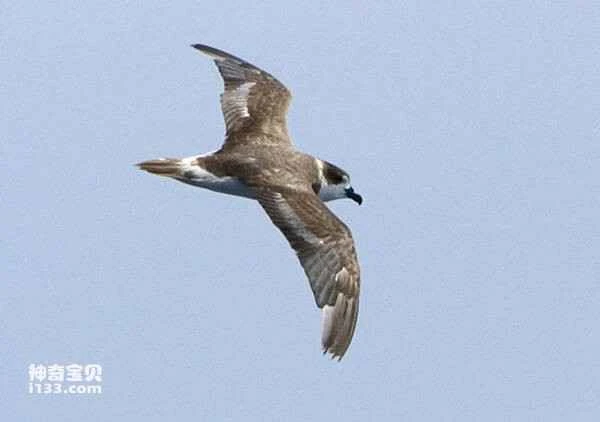
The Bermuda Roundtail is an excellent flier, spending almost all of its adult life flying over the sea. It flies slowly, moving at a leisurely pace, and is a nocturnal seabird that feeds on fish, cuttlefish, jellyfish, and other marine animals.
The Bermuda Roundtail Shearling's breeding season occurs from January to June. Generally, the male builds the nest and attracts the female, who lays the egg on the ground or in a burrow on the desert island. Each clutch contains one white egg, and they breed in groups. Both sexes incubate the eggs, which takes approximately 80-100 days. The chicks are covered in grey down after hatching but require several weeks of care from the parents. The breeding success rate is approximately 50%. Bermuda Roundtail Shearlings typically reach sexual maturity at 4 to 5 years of age before beginning to breed. A single pair may remain together for nearly 30 years. This species first returns to breed 4 years after molting. From mid-June to mid-October, the birds do not visit their breeding grounds, and adults return from mid-October.
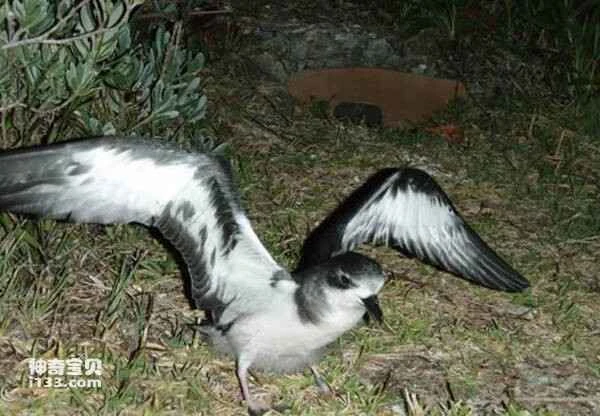
In 2005, the Bermuda Roundtail population was estimated to include 71 breeding pairs. By 2011, the population had reached 98 pairs. Trend analysis: The population had increased from 18 pairs in 1951 to 71 pairs in 2005. Considering the species' long lifespan, this equates to an increase of over 79% over three generations. Records of 40 chicks hatching in 2008 and 35 chicks hatching in 2009 indicate continued population growth, reaching 98 nesting pairs by 2011.
Listed as Endangered (EN) in the IUCN Red List of Threatened Species 2018 ver3.1.
Protect wild animals and ban the consumption of wild game.
Maintaining ecological balance is everyone's responsibility!


