Basic Information
Scientific classification
- Chinese name: Scarlet Hummingbird
- Scientific name: Calypte anna, Anna's Hummingbird
- Classification: Climbing birds
- Family and genus: Apodiformes, Hummingbird family, Lisbeak genus
Vital signs data
- Body length: Approximately 11 centimeters
- Weight: 3-5g
- Lifespan: Approximately 8.5 years
Significant features
The city bird of Vancouver, British Columbia, Canada, can change its appearance.
Distribution and Habitat
The Scarlet Hummingbird breeds along the west coast of North America. Its breeding range extends from British Columbia, Canada, to Arizona, and then to the western edge of New Mexico. However, its non-breeding range is expanding, stretching from the coast of Alaska to northern Mexico.
Including: observed in the United States (Alabama, Alaska, Arizona, Arkansas, California, Colorado, Florida, Georgia, Idaho, Kansas, Louisiana, Mississippi, Missouri, Montana, Nevada, New Mexico, Oregon, Pennsylvania, Tennessee, Texas, Utah, Washington) and Canada (residing on Vancouver Island).
They inhabit open woodlands, scrublands, gardens, and parks. During the breeding season, they are confined to California, USA, and establish habitat segregation between males and females. During this period, males typically migrate to more open habitats, including canyon sides and hillsides. Females, on the other hand, live in woodlands, including evergreen and oak forests. The scarlet hummingbird also experiences different habitats with the seasons. In summer, they move to higher elevations, while in winter they move to lower elevations, reaching a maximum altitude of 1,800 meters.
Appearance
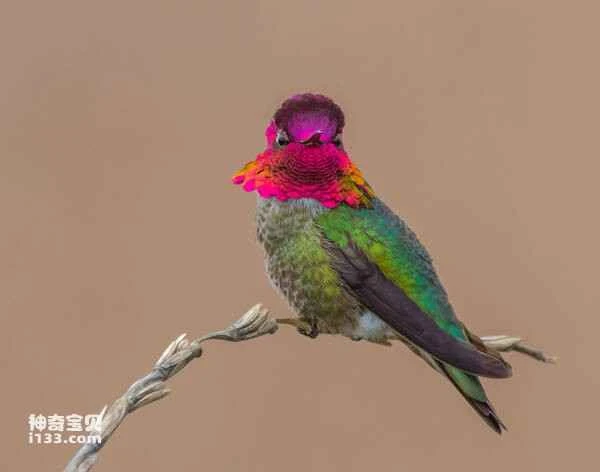
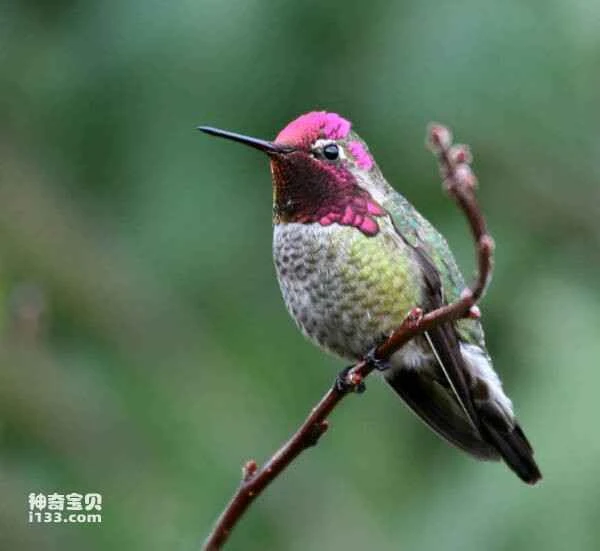
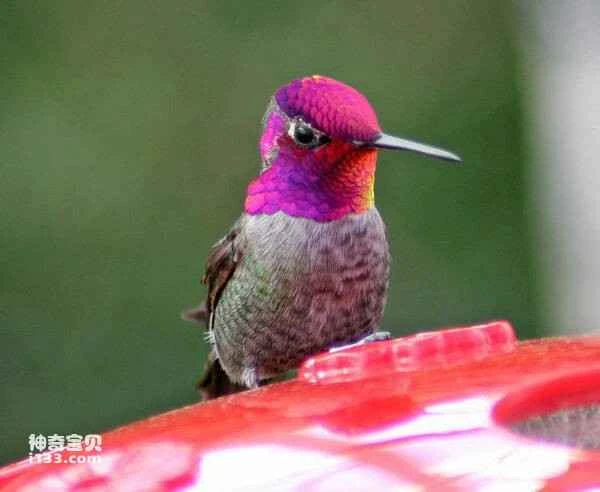
The Scarlet Hummingbird measures 11 cm in length, has a wingspan of 11-12 cm, and weighs 3-5 grams. It is a medium-sized, slightly stocky hummingbird. It exhibits sexual dimorphism, with significant differences between males and females. Both males and females have a bronze-green back area that is glossy, while the abdomen is duller. They have a medium-length beak and a broad tail. The male's head and throat area are brightly colored, displaying a vivid purplish-red hue. The structural colors of the head feathers in adult males change with the angle of light. This species is the only North American hummingbird with a pink crown on its head. The female has a green head, but may have a patch of metallic red or purple feathers in the center of the throat area. The upper tail is white, the center is metallic green, and the outer tail feathers darken to black.
Juvenile birds resemble adult females, but there are some subtle differences. Immature males have bright plumage on their throats and crowns, and their tails are less rounded, while young females are pale brown and lack metallic plumage on their throats.
The male and female scarlet hummingbirds exhibit significant sexual dimorphism. The male displays a vibrant purplish-red color from its head to its throat, while the female has a green head and a grayish-white throat. Bird feather colors can be broadly categorized into two types based on their origin: pigmentary colors and structural colors. Pigmentary colors are formed by natural pigments such as melanin and carotenoids found in bird feathers. Many bird feathers appear blue, purple, or green when viewed from certain angles, but change to other colors or lose their metallic sheen when viewed from different angles; these are structural colors. These feather colors are produced by the scattering and refraction of light. The male scarlet hummingbird displays this ability to "change its appearance" only when attracting the attention of a female. In short, the scarlet hummingbird's vibrant colors are due to structural colors; the different angles of light result in different colors.
Detailed introduction
The Scarlet Hummingbird (scientific name: *Calypte anna*), also known as Anna's Hummingbird, has no subspecies. Its Latin name is derived from Anna Messena.
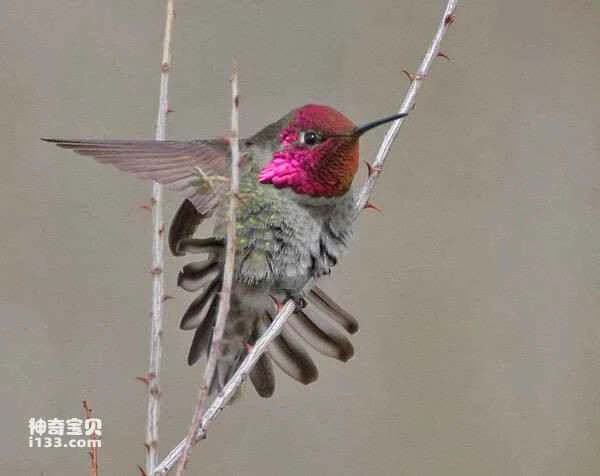
Scarlet hummingbirds are not social birds; they are territorial, entering their territories at any time regardless of size. These birds migrate between summer and winter. They are active during the day and rest at night to conserve energy. In flight, they flap their wings rapidly, powerfully, and persistently, reaching frequencies exceeding 50 times per second. They are adept at hovering and "pausing" among flowers for extended periods, and sometimes even fly backwards. During circling flight, scarlet hummingbirds maintain a high-frequency wingspan pattern through various flight maneuvers, enabling rapid dives and ascents, achieved through their powerful pectoral muscles. The pectoral muscles that power hummingbird flight are entirely composed of rapidly glycolytic fibers, which are quick-responding and fatigue-resistant.
The scarlet hummingbird is the northernmost of all hummingbirds, gradually gaining weight during the cold season as it converts sugar into fat. Furthermore, hummingbirds with insufficient body fat storage or insufficient plumage can survive the freezing weather by slowing their metabolism and entering a state of semi-hibernation.
The scarlet hummingbird can shake its body 55 times per second to remove pollen or dust from its feathers during flight or in dry weather. Each twist lasts one-fortieth of a second and applies 34 times the force of gravity to the bird's head. These birds use their long, extendable tongues to feed on nectar. They also catch small insects and other arthropods in flight or gather them from vegetation. A PBS documentary showed how scarlet hummingbirds eat flying insects: they target flying insects and then open their beaks to capture their prey. While collecting nectar, they also help pollinate plants. The species sometimes feeds on tree sap. The male has a hoarse, metallic call and perches atop trees and bushes. They are commonly seen in backyards and parks.
Unlike most northern temperate hummingbirds, the male Scarlet Hummingbird sings during courtship. This song is thin and piercing, a mix of buzzing and hissing, lasting over 10 seconds. During the breeding season, males can be observed performing aerial displays over their territory. The male also uses its wings to scare away other males and even large insects such as bumblebees and hawk-moths that attempt to forage there. When the female flies to the male's territory, it soars about 40 meters before leaping over the receiver. As it dives down, the male's average speed is 27 meters per second, or 385 body lengths per second. Upon reaching the bottom, the male travels at 23 meters per second, emitting a loud, explosive squeak.
The scarlet hummingbird's four main food sources are nectar from flowers, sap from trees, a mixture of sugary liquids secreted from plant leaves, and very small insects and spiders. They have narrow, bird-like bodies adapted for hovering over flowers. These two features allow them to easily extract nectar. As the bird hovers over a flower, it extends its tongue and inserts it into the flower. Scarlet hummingbirds particularly favor long, tubular flowers in shades of red, orange, or purple. Some common flowering plants eaten by hummingbirds include: sweet rhododendron (Rhododendron arborescens), fuchsia (Fuchsia arborescens), red morning glory, honeysuckle, and impatiens. However, the most frequently foraged plants include: *Ribes malvaceum*, *Ribes speciosum*, *Arctostaphylos glauca*, *Diplacus longiforus*, *Salvia spathacea*, *California sage*, *Aquilegia formosa*, and *Pedicularis densiflora*. Besides flowers, scarlet hummingbirds also forage in the air, catching flying insects or eating insects caught in spider webs. They also extract sap from holes in trees.
The breeding season for the Scarlet Hummingbird begins in November and December, lasting until sometime between April and May. Seasonal mating begins as winter rains start, during which the male enters the breeding area while the female builds the nest. The nest is made of spiderwebs and lined with soft materials such as plants, feathers, or down. The outside of the nest is covered with bark, dead leaves, lichen, or wood shavings for camouflage. The actual mating ritual begins when the female enters the male's territory. After the male spots the female, he performs a series of descents in the air and begins to chase her. During the chase, the female leads the male to her nesting area and roosts. During mating, the female spreads her tail, bending it slightly downwards to one side. To facilitate fertilization, the male must sit back. During this time, he may bite the female's crest feathers with his beak and wriggle his abdomen, with his tail drooping downwards. Mating lasts 3 to 5 seconds.
The Scarlet Hummingbird lays an average of two white, oval eggs per clutch, one every other day. The female incubates and feeds the chicks. She incubates the eggs for 14-19 days, and the chicks then remain in the nest for another 18-23 days. The chicks are very small, almost unlike adult juveniles. They open their eyes on the fifth day after hatching and are completely covered in down by six days old. After the brooding period, the chicks still rely on their mother for a few days, but become completely independent within 1-2 weeks. Premature Scarlet Hummingbirds begin to exhibit territorial behavior from a very young age. After leaving the nest, they tend to live in pairs, usually siblings. However, in autumn, most young Scarlet Hummingbirds separate and maintain their own territories. Their average lifespan is 8.5 years.
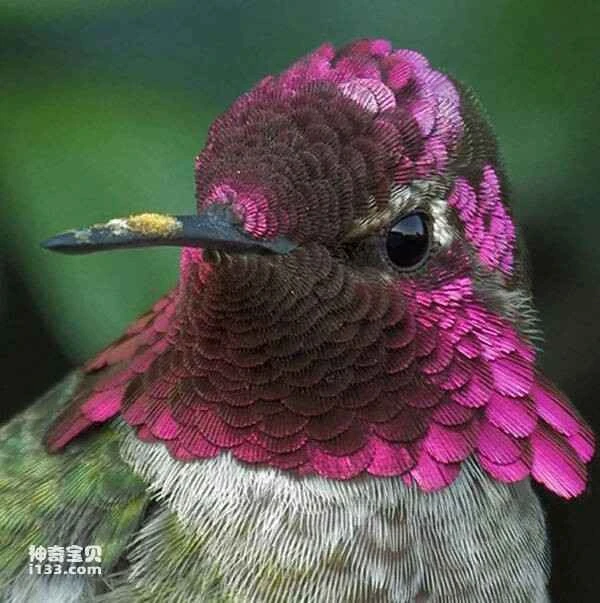
With its emerald green plumage and shimmering rose-pink throat, the Scarlet Hummingbird is more like a flying jewel than a bird, yet it is also a fierce defender, tenaciously guarding its territory. In 2017, the Scarlet Hummingbird was named the city bird of Vancouver, British Columbia, Canada, where it spends the entire winter.
Trend Analysis: Statistically, this species has experienced a significant increase in North America over the past 40 years (up to 2017), growing by 180% in 40 years, equivalent to a 29.3% increase per decade. The Scarlet Hummingbird population is estimated at 1.5 million and appears stable, therefore it is not considered an endangered species. Scarlet Hummingbird populations have been spreading and growing since the 1950s. They have expanded northward and eastward from their original habitat. Flowers and feeders in suburban gardens have enabled them to extend into these diverse areas. Scarlet Hummingbirds are common in most of their range; therefore, there are regular sightings. Furthermore, they are well adapted to suburban environments.
Listed as Least Concern (LC) in the IUCN Red List of Threatened Species 2020 ver3.1.
Protect wild animals and ban the consumption of wild game.
Maintaining ecological balance is everyone's responsibility!