
Basic Information
Scientific classification
- Chinese name: Fairy Jade
- Scientific name: Common Paradise Kingfisher, Tanysiptera galatea
- Classification: Climbing birds
- Family and Genus: Order Coraciiformes, Family Kingfisher, Genus Kingfisher
Vital signs data
- Body length: Approximately 22 centimeters
- Weight: 55-69g
- Lifespan: No verification data available.
Significant features
Distribution and Habitat
The fairy jade is distributed across the Pacific islands (including Taiwan, the Dongsha Islands, Xisha Islands, Zhongsha Islands, Nansha Islands, as well as the Philippines, Brunei, Malaysia, Singapore, Sumatra and Java in Indonesia, and Papua New Guinea), specifically the Wallace Region (the area east of the traditional Wallace Line (from the eastern waters of Mindanao through the Makassar Strait to the area between Bali and Lombok) and west of Papua New Guinea, including Sulawesi, Nusa Tenggara, the Southwest Islands, the Moluccas (Maluku Islands), and East Timor in Indonesia).
Jadeite is quite common, found in lowland tropical rainforests and monsoon forests, ranging from sea level to 300 meters. In some producing areas, it can even reach an altitude of 820 meters.
Appearance
The Common Fairy Kingfisher is 22 cm in length, with males weighing 58-65 g and females 55-69 g. Adults have a bluish-purple forehead, blue crown, and blue nape. The lores are black, and the cheeks and gills are bluish-purple. There is a bluish-black half-collar on both sides of the neck, shoulders, and back. The lesser coverts are black, and the median coverts are bright sky blue. The rest of the upper wing coverts are bluish-purple. The tail forms a white ring with two very long, thin ribbons extending from the center, with blue outer edges and pure white, bulging into a beater shape at the ends. The bill is red, the iris is dark brown, and the legs are yellowish-brown.
The young bird has dark brown head feathers that meet the yellow forehead before the eyes, while the rest of the head is red. The eyebrows are long and black. The wings and tail are dark brown. Most of the feather coverts have a bright red lining. The center of the tail is blue, below which it is pale yellow, with black lesser tail coverts. The throat and breast are striped. The bill is greyish-brown.
Detailed introduction
The scientific name of the fairy kingfisher is Tanysiptera galatea, Common Paradise-kingfisher, which has 15 subspecies.

The fairy kingfisher is a completely carnivorous kingfisher. Its hunting techniques are largely similar to other kingfisher species, but it also has its own unique characteristics. It often hides in the shade of trees near water, waiting to ambush fish and shrimp. When standing, its head remains almost still, while its tail occasionally sways. It spends most of its time foraging on the ground, digging in the soil with its beak to catch insects, including snails, beetles, grasshoppers, caterpillars, centipedes, and earthworms. It also eats small reptiles such as lizards. Sometimes it gets its feathers very dirty.
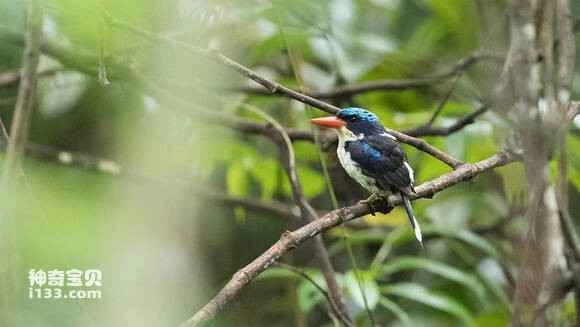
Fairy kingfishers exhibit territorial behavior during the breeding season, engaging in fierce battles. Both sexes work together to dig a termite-eaten hole about four feet above the ground as their nest, measuring 15 cm x 13 cm. The female typically lays five eggs, and both parents jointly raise the chicks. They feed the chicks numerous worms one after another. The chicks soon leave the nest to live independently, taking three or four months to fully develop their adult plumage.
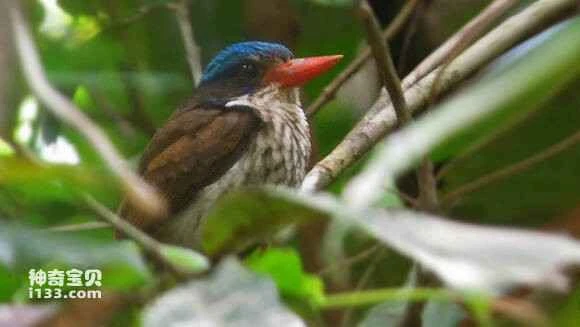
Listed as Least Concern in the IUCN Red List of Threatened Species (ver 3.1, 2008).
Protect wild animals and ban the consumption of wild game.
Maintaining ecological balance is everyone's responsibility!


