
Basic Information
Scientific classification
- Chinese name: Blue-breasted Buddhist monk
- Scientific name: Coracias garrulus, European Roller
- Classification: Climbing birds
- Classification and Genus: Order Coraciiformes, Family Coraciiformes, Genus Coraciiformes
Vital signs data
- Body length: 30-35.2 cm
- Weight: Approximately 183g
- Lifespan: No verification data available.
Significant features
Distribution and Habitat
Country of Origin: Afghanistan, Albania, Algeria, Angola, Armenia, Austria, Azerbaijan, Bahrain, Belarus, Benin, Botswana, Bulgaria, Burkina Faso, Burundi, Cameroon, Central African Republic, Chad, China, Congo (Brazzaville, Democratic Republic of Congo), Ivory Coast, Croatia, Cyprus, Czech Republic, Djibouti, Egypt, Eritrea, Estonia, Ethiopia, France, Gabon, Gambia, Georgia, Germany, Ghana, Gibraltar, Greece, Guinea-Bissau, Hungary, India, Iran, Iraq, Israel, Italy, Jordan, Kazakhstan, Kenya, Kuwait, Kyrgyzstan, Latvia Lebanon, Lesotho, Libya, Lithuania, Macedonia, former Yugoslavia, Malawi, Mali, Malta, Mauritania, Moldova, Montenegro, Morocco, Mozambique, Namibia, Niger, Nigeria, Oman, Pakistan, Poland, Portugal, Qatar, Romania, Rwanda, Saudi Arabia, Senegal, Serbia, Slovakia, Slovenia, Somalia, South Africa, South Sudan, Spain, Sudan, Swaziland, Syria, Tajikistan, Tanzania, Tunisia, Turkey, Turkmenistan, Uganda, Ukraine, United Arab Emirates, Uzbekistan, Western Sahara, Yemen, Zambia, Zimbabwe.
In China, it is mainly distributed in northern and western Xinjiang and the Tianshan Mountains.
It mainly inhabits various habitats in open areas such as low mountains and plains at the foot of mountains below 1500 meters above sea level. It ranges from forests, thickets, and forest edges to deserts and semi-deserts, and especially prefers desert and semi-desert areas with sparse shrubs, cliffs, and gullies.
Appearance
Adult birds have a bright pale blue head, neck, and underparts; white or dark blue-green feather shafts on the throat and foreneck. The belly is slightly paler than the breast. The shoulders, back, and inner flight feathers are sandy brown or pale reddish-brown, and the rump is bluish-purple. The uppertail coverts are blue-green, the central tail feathers are also blue-green, the outer webs of the remaining tail feathers are blue at the base, the inner webs are black at the base, and the tips are bright pale blue; the outermost tail feathers have black tips. The lesser wing coverts and inner flight feathers are bright blue at the base, while the remaining flight feathers are black.
The young birds are darker in color, with sandy markings on their throat and chest, and white feather shafts.
The iris is light brown, the mouth is dark brown, and the feet are light brown.
Size measurements: Weight 183 grams; Body length ♂ 300~352 mm, ♀ 320~342 mm; Bill 30~35 mm; Wing length ♂ 180~208 mm, ♀ 181~207 mm; Tail length ♂ 122~135 mm; Tarsus 30~35 mm. (Note: ♂ male; ♀ female)
Detailed introduction
The blue-breasted garrulus, scientifically known as *Coracias garrulus*, is also called the European Roller. It has two subspecies.
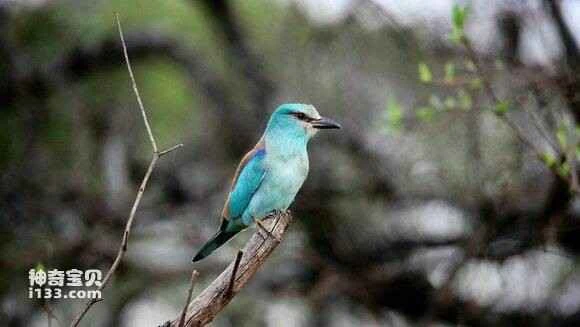
Blue-breasted drakes are often found alone or in pairs. They hunt mostly in the air, but also on the ground. When resting, they often perch on dead branches or power lines. They feed on invertebrates such as beetles, crickets, locusts, caterpillars, flies, and spiders, but also eat a few larger animals, such as frogs, rodents, lizards, snakes, and small, slender birds. They are accustomed to standing for long periods on tree trunks or power lines, searching diligently for potential prey on the ground, and often follow plows that turn up the soil to feast on their meal.
The Blue-breasted Roller's call is a harsh, chack-ack sound, stressed on the first syllable, resembling that of a raven or magpie. It can also be pronounced like a jay's rrak-rrak or rrak-rehhh. It is a summer migratory bird, capable of long-distance migrations between continents, flying over 10,000 kilometers from its breeding grounds in Eurasia to sub-Saharan Africa, repeating the journey in spring. In early April, a particularly spectacular bird migration can be observed in Africa, with countless Blue-breasted Rollers flying north along the narrow coastline from Tanzania to Somalia.

The breeding season for the Blue-breasted Roller is from May to July. Pairs help each other defend their shared breeding territory, typically nesting on steep riverbanks, in valleys, and in cliff cavities within their territory. They also nest in forest areas and tree cavities at forest edges, and even in cracks in houses. They often breed in small groups. The nest has no lining; eggs are laid directly on the ground. A clutch contains 1-7 eggs, with 4 or 5 being most common. The eggs are white, oval, and measure 33.3-39.0 mm × 26-30 mm, with an average of 35.9 mm × 28.0 mm. Both parents take turns incubating the eggs (primarily the female), with an incubation period of 17-19 days. The chicks are altricial; they cannot see immediately after hatching but develop rapidly, fluttering and able to fly after 25-30 days; however, they are still fed by their parents for three weeks or longer.
The blue-breasted roller became extinct in Germany, Denmark, Sweden, and Finland in the 20th century, likely due to habitat loss caused by intensive agriculture in these regions. Populations in the Middle East and Central Asia have not yet shown a significant decline. Globally, the total population may have decreased by 20%–30% over the past decade (1995–2005).

In August 2022, the Qinghai Provincial Forestry and Grassland Bureau announced at a press conference on bird protection and management that the Blue-breasted Buddha-monk, a protected animal in Qinghai, is a rare bird species that has been recorded in Qinghai but has no photographic record.
Listed in Appendix II of the Convention on the Protection of Migratory Wildlife Species (CMS).
Listed as Least Concern (LC) on the IUCN Red List of Threatened Species, 2015 assessment.
Listed in the "List of Terrestrial Wild Animals of National Protection that are Beneficial or of Important Economic and Scientific Research Value" issued by the State Forestry Administration of China on August 1, 2000. (Note: Item 275 of the class Aves, Blue-breasted Cracker)
Protect wild animals and ban the consumption of wild game.
Maintaining ecological balance is everyone's responsibility!


