
Basic Information
Scientific classification
- Chinese name: Spotted-tailed African Trogon
- Scientific name: Apaloderma vittatum, Bar-tailed Trogon
- Classification: Climbing birds
- Family and genus: Trogonales, Trogonidae, Trogon
Vital signs data
- Body length: Approximately 28 centimeters
- Weight: No verification information available.
- Lifespan: No verification data available.
Significant features
The tail is long and broad, with fine black and white markings on the underside.
Distribution and Habitat
It is distributed in Angola, Burundi, Cameroon, Congo, Democratic Republic of Congo, Equatorial Guinea, Kenya, Malawi, Mozambique, Nigeria, Rwanda, United Republic of Tanzania, Uganda, and Zambia.
They inhabit forests and prefer altitudes of around 1600 meters, which is higher than the Green-cheeked Quetzal, but there is some overlap in their habitats.
Appearance
The Spotted-tailed Trogon is about 28 cm in length. Its beak and legs are yellow, and its tail is long and broad with small black and white markings on the underside. The male has a bluish-black head with a coppery-red sheen. Below the eyes are two small, bare yellow or orange patches, and the eyes themselves have yellow or gray spots. The upper breast is purple to bluish-green, while the rest of the underparts are red. The back is green, and the top of the tail is bluish-black or purplish-black. The female has a brown head, a cinnamon-colored throat and breast, and otherwise resembles the male. Juveniles resemble females but have white bellies and pale spots on their wings.
Compared to other non-passerine birds, it is small in size, with gorgeous plumage, dense and soft feathers, and well-developed secondary feathers; the preen gland is bare; the back feathers are distinct, extending from the neck to the preen gland, but without branching; males and females are dimorphic. The bill is broad and short, with a hook and dentate tip, and the base of the bill and nostrils are covered by bristles; the head is large and the neck is short; the wings are short and rounded, with 10 primary flight feathers and no median coverts; the tail is long and broad, flat or convex, with 12 tail feathers; the legs are short and weak, the tarsi are feathered, and the toes are heterodactylous, with the 3rd and 4th toes pointing forward and mostly connected, while the 1st and 2nd toes point backward and are connected at the base. The skull is cleft palate type, with basal pterygoid processes present; the posterior margin of the sternum has 4 notches, and the xiphoid process is long and forked at the end; the coracoid bones are in contact. The flexor hallucis longus muscle extends to the 1st and 2nd toes; the flexor digitorum profundus muscle extends to the 3rd and 4th toes, and the two muscles are connected by ligaments; the perching muscles are absent. Blind sacs exist, but are short.
Detailed introduction
The Bar-tailed Trogon (scientific name: Apaloderma vittatum) is a small climbing bird.
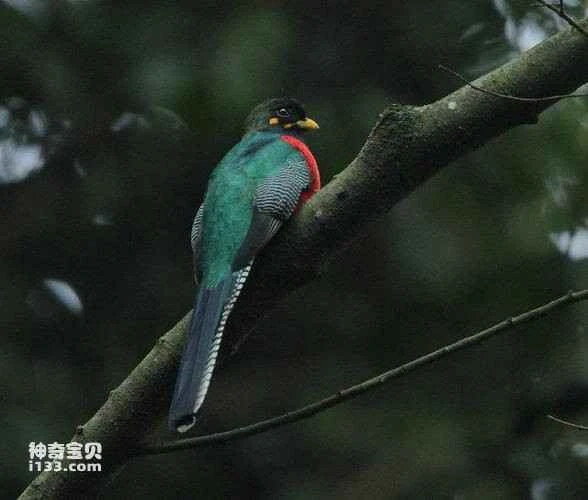
The African trogon is arboreal, often found singly or in pairs, and dislikes flocking. It is a skilled climber but not a strong walker or jumper; its flight is weak, fast but short-range, with unpredictable flight paths. It is most active in the middle and upper parts of trees, but also frequently roams the ground. When flying through the forest, its flight pattern is often undulating and rapid, but the distance is not very far. It is timid and solitary, preferring quiet environments and rarely making calls. When resting, it often hides in shady places. It feeds both in the air and on the ground, primarily on various insects such as locusts, mantises, moths, butterflies, and bees, as well as their larvae. It also sometimes eats small invertebrates such as snails, and the fruits, berries, and seeds of plants. Its call is monotonous and it rarely sings.
The African trogon breeds in natural burrows in decaying trees or in ant nests and bee hives in the forest, without building its own nest. It lays 2-4 eggs per clutch. The chicks are altricial. Incubation and chick raising are shared by both parents.
Listed as Least Concern (LC) on the IUCN Red List of Threatened Species 2012 ver 3.1.
Protect wild animals and ban the consumption of wild game.
Maintaining ecological balance is everyone's responsibility!


