Basic Information
Scientific classification
- Chinese name: Forked-tailed Hummingbird
- Scientific name: Marvellous Spatuletail (Loddigesia mirabilis)
- Classification: Climbing birds
- Family and genus: Apodiformes, Hummingbird family, Forked-tailed Hummingbird
Vital signs data
- Body length: 10-15 cm
- Weight: No verification information available.
- Lifespan: No verification data available.
Significant features
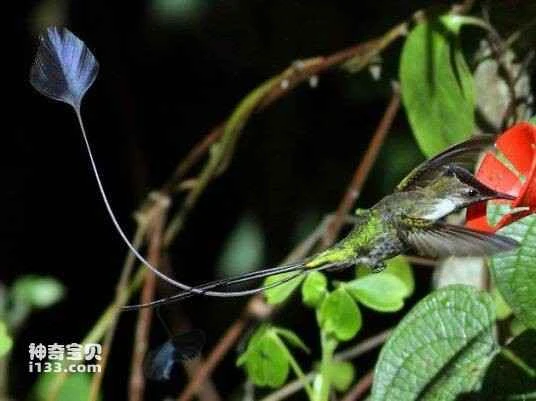
The male bird has two long, fan-shaped or racket-shaped tail feathers on the outer side of its tail.
Distribution and Habitat
The Forked-tailed Hummingbird is a bird endemic to Peru. It is found on the forest edges of the Río Utcubamba region. It was first reported to George Loddiges in 1835 by bird collector Andrew Matthews. It inhabits forests of alder and mixed scrubland, ranging in altitude from 2100-2900 meters, occasionally descending to 1700-3700 meters.
Appearance
The Forked Fantail Hummingbird is a medium-sized hummingbird, measuring 10-15 cm in length. It possesses tricolored plumage of white, green, and bronze. The male has a blue crest, bright turquoise markings on its neck, and a black stripe along its white belly; it is the only monotypic genus of hummingbirds. This hummingbird has a very distinctive appearance, with an exceptionally long, horizontal tail feather, consisting of only four feathers at the base. The most striking feature is the two long, fan-shaped or racket-shaped tail feathers on the outer side of the male's tail. These two tail feathers cross each other and end in a large, bluish-purple disc or spatula (described in French as "spatules," meaning spatula or medicine knife, etc.); the male can move each of the two feathers separately, a behavior that changes with age.
The female has a white throat, lacks black on her abdomen, and has a much shorter tail that protrudes in a teardrop shape resembling a racket. The fantail hummingbird's tail is very heavy, so it can only fly for a few seconds at a time.
Detailed introduction
The Marvelous Spatuletail (scientific name: *Loddigesia mirabilis*) is a medium-sized hummingbird. When flying, it flaps its wings rapidly, powerfully, and persistently, at a frequency exceeding 50 times per second. Its primary food source is red lilies, and it has been observed to consume at least five different flowering plants.
The Forked-tailed Hummingbird is confined to two regions in northern Shandong Province, both of which face the threat of forest degradation. Due to habitat shrinkage and destruction, the bird's small population size, and extremely limited suitable habitat, the Bird Preservation Society of America listed the Forked-tailed Hummingbird as a protected species in 2006. The Society has begun implementing methods such as afforestation to improve the bird's living environment. The Forked-tailed Hummingbird has been featured on the television program *Nature*.
Listed as Endangered (EN) on the IUCN Red List of Threatened Species 2012 ver 3.1.
Protect wild animals and ban the consumption of wild game.
Maintaining ecological balance is everyone's responsibility!