Basic Information
Scientific classification
- Chinese name: Horned Hummingbird
- Scientific name: Unicorn Hummingbird, Heliactin bilophus, horned sungem
- Classification: Climbing birds
- Family and genus: Apodiformes, Hummingbird family, Horned Hummingbird
Vital signs data
- Body length: 9.5-11 cm
- Weight: 1.8-2.8g
- Lifespan: No verification data available.
Significant features
Distribution and Habitat
Country of origin: Bolivia, Brazil, Suriname.
It is mainly distributed in the border region between central and eastern Brazil and Bolivia. Isolated populations exist in northern Brazil and southern Suriname.
They inhabit woodlands, tropical sparse grasslands, steppes, and long corridor forests.
Appearance
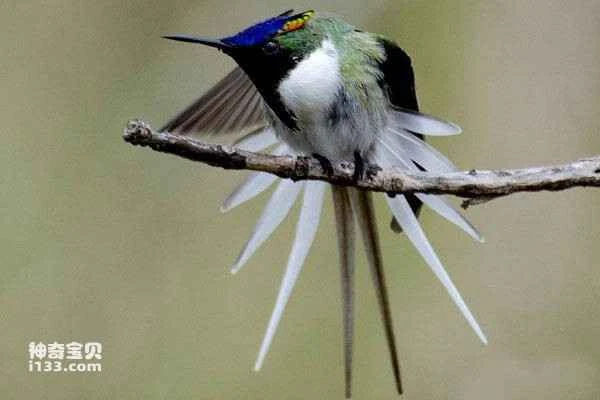
The male has a short, straight, black beak. Its crest is deep blue and glossy, with several tufts of red, blue, and yellow feathers standing upright on either side. The underparts are mostly white. The upperparts are bronze, with a black throat and breast, and a white belly and sides of the neck. The tail feathers are long and pointed, forming a dark "V" shape on a white background when viewed from below in flight.
The female is similar to the male, but lacks a crest and its throat is not black.
Size measurements: body length 9.5~11cm; weight 1.8~2.8g.
Detailed introduction
The horned hummingbird (scientific name: Heliactin bilophus), also known as the horned sungem, has no subspecies.
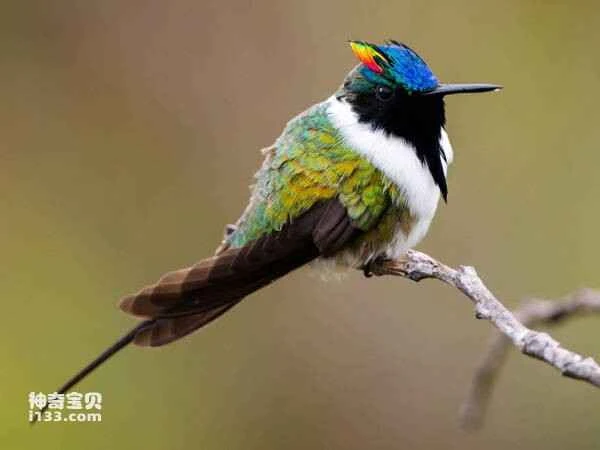
Horned hummingbirds primarily feed on the nectar of flowers in shrubs and trees, but also prey on small insects.
The horned hummingbird's nest is typically built in a cup-shaped structure on a shrub branch about 1 meter above the ground, constructed from soft plant fibers and spider silk. It lays two eggs per clutch, with the female incubating alone for approximately 13 days. The chicks develop feathers 20-23 days after hatching and can reproduce in their second year of adulthood.
The global population of the Horned Hummingbird is unquantified, but it is a rare species in its native range (Stotz et al. 1996). This bird readily adapts to artificial habitats, such as gardens and other cultivated areas, suggesting that its population may be growing. Due to deforestation, its habitat has expanded to other parts of Brazil, including the state of Espírito Santo (del Hoyo et al. 1999).
Listed as Least Concern (LC) on the IUCN Red List of Threatened Species, 2012 assessment.
Protect wild animals and ban the consumption of wild game.
Maintaining ecological balance is everyone's responsibility!