Basic Information
Scientific classification
- Chinese name: Round-tailed Shepherd
- Scientific name: White-fronted Round-tailed Shepherd, Spotted Round-tailed Shepherd, White-bellied Burrower, *Pterodroma hypoleuca*, Bonin Petrel
- Classification: Waterfowl
- Family and genus: Procellariiformes, Procellariiidae, *Rhynchus*
Vital signs data
- Body length: 30-33 cm
- Weight: About 182g
- Lifespan: No verification data available.
Significant features
White forehead, black crown to nape, greyish upper body, and black tips on tail feathers.
Distribution and Habitat
Origin: China, Japan, Marshall Islands, Northern Mariana Islands, Philippines, Russian Federation (East Asia), United States (Hawaii Island).
Origin uncertain: South Korea, Federated States of Micronesia, small islands off the continental United States.
Outside of the breeding season, they wander into the North Pacific Ocean, passing along the coast of Taiwan, the Ryukyu Islands, the Izu Islands, and then north to Sakhalin Island.
The round-tailed petrel is a typical marine bird, inhabiting temperate oceans. During the breeding season, it inhabits the coast and coastal islands and the surrounding sea, while outside the breeding season, it lives entirely at sea.
Appearance
The Round-tailed Shearling is 30-33 cm in length, with a wingspan of 63-71 cm and a weight of 182 grams. It is a medium-sized seabird. It has a short bill and neck; long, pointed wings; a rounded tail; a spindle-shaped body; a white forehead extending from below the eye to the throat, with white spots on the forehead; and a black crown to the nape. The back, shoulders, rump, and upper tail coverts are mouse-grey; the tail is also mouse-grey, but with a broad black tip; the black on the nape extends downwards to the sides of the neck, forming a broken collar at the throat; the underparts are white, extending from the throat to the back, forming a distinct black-and-white demarcation line below the eye to the forehead; the wings are black, with grey tinges on the upper wing coverts and secondary flight feathers, creating a subtle "M" shaped patch on the wings; the underwings are white, with black tips on the flight feathers forming a black outer edge, and two thick black lines running diagonally under the white wings are very conspicuous.
Brown iris, black beak, flesh-colored tarsus. Partially black webbed feet and outer toe.
Detailed introduction
The round-tailed petrel, scientifically known as *Pterodroma hypoleuca*, is also called Bonin Petrel and has no subspecies.

Round-tailed petrels typically live in flocks over the ocean, being active both day and night except during the breeding season when they are nocturnal. They are excellent fliers, capable of both flapping their wings and gliding sideways for extended periods over the ocean. They can also perform rapid, vertical descents from the air. They generally do not follow ships. Their diet consists mainly of various small fish, shrimp, mollusks, crustaceans, and other small marine animals.
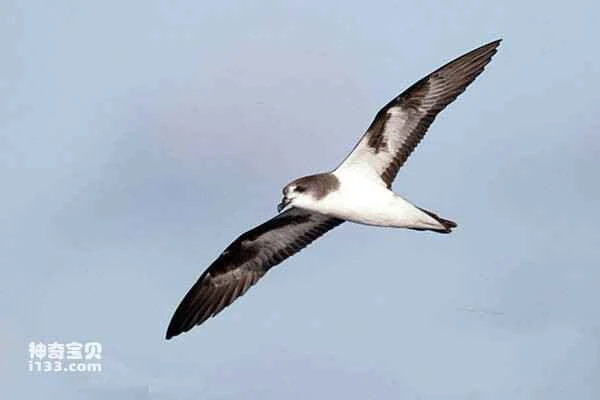
Round-tailed petrels breed on islands in temperate oceans, nesting and breeding in groups from October to April of the following year. They usually arrive at their breeding grounds at night, already paired. They nest in the ground within palm groves, but also at forest edges and under exposed pebbles by the sea. Nests are typically placed in rock piles, rock caves, or crevices, but they may also nest in fallen tree hollows or directly in the ground. The nests are extremely simple, containing only a few dry leaves and grass. They usually arrive at their breeding islands in pairs at dusk, flying quite high and chasing each other in the sky above the tall palm groves. They can move between trees by flapping their wings and leaving the forest through gaps in the canopy, or they can climb tree trunks to leave the ground. When entering a nesting site, they usually swoop down through gaps in the trees. Upon arrival, they immediately begin repairing their old nest or building a new one. They begin laying eggs in late November or early December, laying one egg per clutch. The egg is white and measures 47-50.1 mm × 36.5-37.1 mm, with an average size of 50 mm × 37 mm. Chicks hatch in January and are able to leave the nest and fly by April.

Listed as Least Concern (LC) in the IUCN Red List of Threatened Species 2018 ver 3.1.
Protect wild animals and ban the consumption of wild game.
Maintaining ecological balance is everyone's responsibility!