Basic Information
Scientific classification
- Chinese name: Yellow-billed Chestnut Woodpecker
- Scientific name: Blythipicus pyrrhotis, Bay woodpecker
- Classification: Climbing birds
- Classification: Order Vulpecula, Family Woodpeckers, Genus *Ixora*
Vital signs data
- Body length: Approximately 30 centimeters
- Weight: 102-160g
- Lifespan: No verification data available.
Significant features
Its body feathers are reddish-brown with black spots, and its long, pale yellow beak is...
Distribution and Habitat
The Yellow-billed Chestnut Woodpecker is found in Bangladesh, Bhutan, Cambodia, China, India, Lao People's Democratic Republic, Malaysia, Myanmar, Nepal, Thailand, and Vietnam.
Migratory bird: Hong Kong, China.
It is found in Sichuan, Yunnan, Guizhou, Guangxi, Hunan, Guangdong, Fujian, and Hainan in China.
They are generally rare, mainly inhabiting evergreen broad-leaved forests in mountainous areas at altitudes of 500-2200 meters. In winter, they often venture to the plains at the foot of mountains and the forest edges to forage.
Appearance
The Yellow-billed Chestnut Woodpecker is about 30 cm long, a slightly larger woodpecker. Distinguishing features include reddish-brown plumage with black spots and a long, pale yellow bill. It differs from the Bamboo Woodpecker in that its plumage has black horizontal bars. The male has scarlet patches on the sides of its neck and nape. The bill is yellow with a truncated tip. The plumage is mostly chestnut, with horizontal bars on both the upper and lower body. The upperparts are mostly brownish-gray, dark brown below the back; a large reddish-brown patch extends from under the nape to the sides of the neck and behind the ear coverts; the crown feathers have pale shaft streaks; the back, tail, and wings have black horizontal bars. The underparts are dark brown, with pale chestnut fine shaft streaks on the breast. The female lacks red spots on the neck and sides. Juveniles have coarser shaft streaks on their head feathers and a darker brown underparts. The bill is long and stout, with exposed nostrils. The wings are rounded, with the primary flight feathers slightly longer than the secondary flight feathers. The hind toes are fully developed, with the fourth toe slightly longer than the fifth.
The male has a brownish-red iris, while the female has a grayish-brown iris; the bill is yellow with a greenish base; the tarsi and toes are pale brownish-black, and the claws are green.
Size measurements: Weight: ♂ 120-160 g, ♀ 102 g; Body length: ♂ 252-319 mm, ♀ 256 mm; Bill length: ♂ 39-43 mm, ♀ 38-42 mm; Wing length: ♂ 140-156 mm, ♀ 130-156 mm; Tail length: ♂ 80-114 mm, ♀ 87-100 mm; Tarsus length: ♂ 24-29 mm, ♀ 24 mm. (Note: ♂ male; ♀ female)
Detailed introduction
The Yellow-billed Chestnut Woodpecker, scientifically known as *Blythipicus pyrrhotis*, has five subspecies.
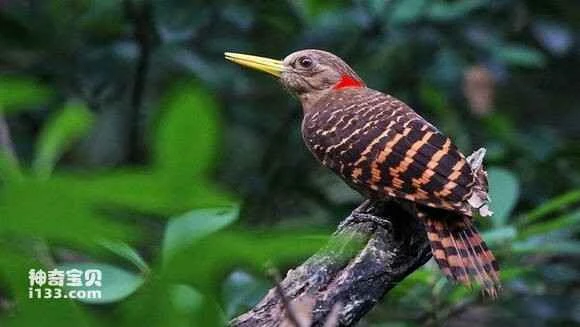
The nominate subspecies of the Yellow-billed Chestnut Woodpecker is a resident bird in the subtropical regions of Yunnan and southeastern Tibet, China. Its call is a hoarse, cawing sound. It is usually found alone or in pairs. During the breeding season, its call becomes harsh and noisy. It mostly perches and forages in the upper parts of trees, sometimes also foraging for ants on the ground and fallen logs. Its diet consists mainly of insects, but it also eats worms and other small invertebrates. Its loud call, "keek, keek-keek-keek, keek, keek," has a steady pitch but a falling interval, resembling that of a cuckoo.
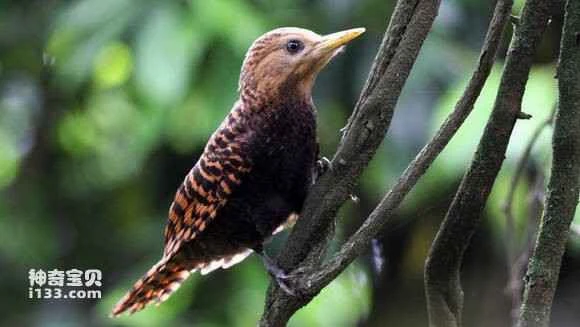
The breeding season for the Yellow-billed Chestnut Woodpecker is from May to June. They typically nest in trees within forests. The parents peck and build the nest themselves. Nests are usually chosen on the inside of decaying, easily peckable surfaces of living or dead trees. Each clutch contains 2-4 eggs. The eggs are white and measure 27-33 × 19-23 mm.
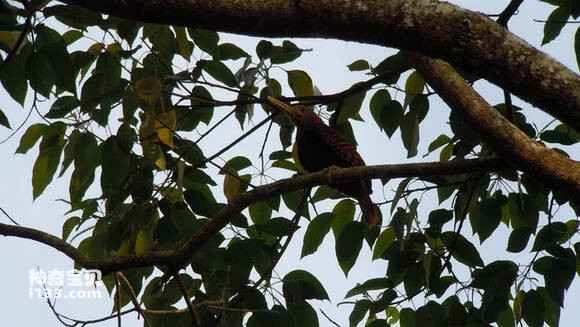
Listed as Least Concern (LC) on the IUCN Red List of Threatened Species 2012 ver3.1.
It is listed in the "List of Terrestrial Wild Animals of Beneficial or Important Economic and Scientific Research Value under State Protection" issued by the State Forestry Administration of China on August 1, 2000.
Protect wild animals and ban the consumption of wild game.
Maintaining ecological balance is everyone's responsibility!