Basic Information
Scientific classification
- Chinese name: Bamboo Woodpecker
- Scientific name: Gecinulus viridis, Bamboo woodpecker
- Classification: Climbing birds
- Family and genus: Order Vulpecula, Family Woodpeckers, Genus *Bambusa*
Vital signs data
- Body length: 23-25 cm
- Weight: Approximately 76g
- Lifespan: No verification data available.
Significant features
Distribution and Habitat
The bamboo woodpecker is distributed in western and southern Yunnan, Guangdong and Fujian within China; outside of China, it is distributed in India, Nepal, Myanmar, Thailand, Bangladesh, Bhutan, Laos and Vietnam.
Bamboo woodpeckers mainly inhabit low-mountain bamboo forests or mixed forests, shrublands and secondary forests with bamboo forests below 1000 meters above sea level.
Appearance
The male bamboo woodpecker has a pale buff-yellow or golden-brown olive-brown forehead, eye area, lores, base of the bill, and cheeks; olive-yellow sides of the neck, nape, and hindneck; and a large pink or bright red patch on the crown. The rest of the upperparts are chestnut-red or pale yellowish-olive-green. The wings are dark brown, with discontinuous brownish-yellow or buff-yellow bars on the primary flight feathers, the inner edges of which are red, gradually increasing in color towards the back, until the secondary flight feathers are completely the same color as the back. The tail is dark brown with brown bars at the base, and chestnut-red or red edges on the outer feathers. Alternatively, the tail may be reddish-brown with five pale chestnut bars. The chin and throat are pale olive-green, and the rest of the underparts are dark olive-green or olive-brown. The female is similar to the male, but the crown and nape are pale yellowish-green instead of red. The iris is dark red or brownish-red, the bill is pale bluish-grey or lead-blue with a pale horn-yellow tip, the legs are lead-green, and the claws are pale greenish-yellow. It has only three toes.
The Yunnan subspecies of the Bamboo Woodpecker has an olive-golden head, olive-yellow upperparts, a black tail with an olive base, and olive-brown underparts. The male has a scarlet crown and nape. The Southeast Asian subspecies has a pale buff head, olive-green upperparts tinged with red, a scarlet-brown tail with light chestnut horizontal bars, and dark olive-green underparts. The male has a rose-red crown and nape tinged with orange-yellow.
Size measurements: males weigh 76 grams, body length 230-251 mm, bill length 21-24 mm for males and 20-21 mm for females, wings 125-140 mm for males and 135-138 mm for females; tail length 92-102 mm for males and 94-103 mm for females; tarsus length 20-22 mm for males and 21 mm for females.
Detailed introduction
The bamboo woodpecker, scientifically known as Gecinulus viridis, has four subspecies.
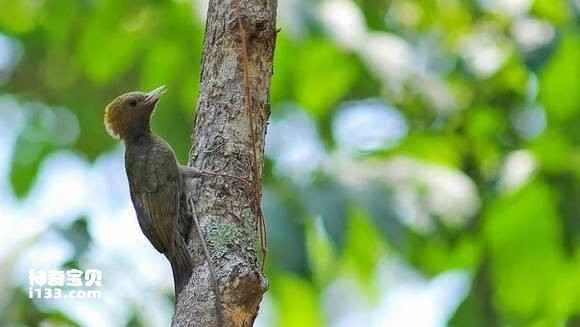
The bamboo woodpecker is a resident bird, found alone or in pairs. It is timid and mostly forages on tree trunks and bamboo, but also frequently forages on fallen logs on the ground. Its diet consists mainly of ants and insects. Its calls are quite noisy, consisting of a repetitive, nasal contact call "chaik-chaik-chaik" and a harsh, hoarse call "cheereker-chereker-chereker" that resembles that of a jay.
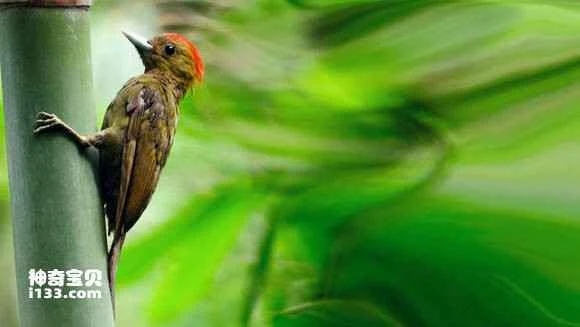
The bamboo woodpecker's breeding season is from April to July. They nest in tree cavities, primarily in broad-leaved forests and secondary forests mixed with bamboo, but also in trees near farmland. Nesting sites are often dead or decaying upright tree trunks. The nests are typically 1.5-6 meters above the ground. Each clutch contains three eggs. The eggs are white, measuring 22-28 × 18-20 mm, with an average of 25-19 mm.
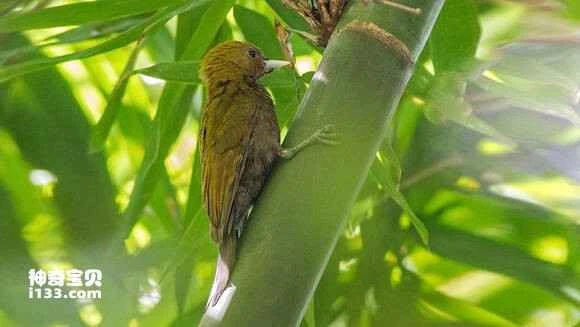
The bamboo woodpecker is listed as Least Concern (LC) on the IUCN Red List of Threatened Species 2012 ver 3.1.
The bamboo woodpecker has been included in the "List of Terrestrial Wild Animals of Beneficial or Important Economic and Scientific Research Value under State Protection" issued by the State Forestry Administration of China on August 1, 2000.
Protect wild animals and ban the consumption of wild game.
Maintaining ecological balance is everyone's responsibility!