
Basic Information
Scientific classification
- Chinese name: Little Spotted Kiwi
- Scientific name: Little Spotted Kiwi (Apteryx owenii)
- Classification: Landfowl
- Family and genus: Order Aptrimales, Family Aptrimales, Genus Aptrimales
Vital signs data
- Body length: 46-50 cm
- Weight: 2.125-4kg
- Lifespan: Approximately 30 years
Significant features
New Zealand's national bird
Distribution and Habitat
The little spotted kiwi is found on the southwest coast of New Zealand's South and North Islands, primarily on Kapiti Island.
Little spotted kiwis live in burrows, and the burrows are left to stand for several weeks before being used, allowing moss and natural vegetation to regrow and providing camouflage.
Appearance
The Little Spotted Kiwi is the smallest bird in the order Anoptera, measuring approximately 35-45 cm in length and weighing about 1.2-2.5 kg. It has a small head, a pear-shaped body, and is covered in fluffy, fine feathers that are soft and lack tufts. Its vestigial wings are covered by feathers, and it lacks tail feathers, making it unable to fly. Its legs are short, thick, and powerful, allowing it to run at speeds up to 10 miles per hour. The kiwi has a pointed, slender beak about 10 cm long, with cat-like whiskers at the base. Its nostrils are located on the long, flexible tip of its beak, not at the base. Its eyes are small, and its daytime vision is poor. Its ear openings are large and well-developed, and it has long whiskers at the base of its beak (possibly for tactile sensation). It has a short neck, highly sensitive and well-developed ears, and mottled dark brown feathers, with a pale belly featuring black stripes.
Sexual dimorphism is observed, with females being significantly larger, differing by more than 1 kilogram. Unlike most other birds, they are flightless and can only walk on the ground. Their legs are located at the rear of their bodies, short and stout, strong and muscular; all four toes have large claws. They possess powerful tarsi, with hexagonal horny scales along the anterior and posterior edges. Each foot has four small, flat toes, three pointing forward and one backward, all equipped with sharp claws for digging and searching for food.
Detailed introduction
The Little Spotted Kiwi, scientifically known as Apteryx owenii, has no subspecies.
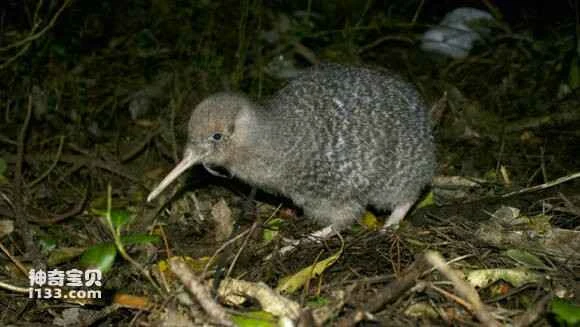
A pair of spotted kiwis may dig up to 100 burrows in their territory as refuges, typically changing their habitat daily. They do not leave their burrows during the day unless in danger, generally emerging at night. Foraging begins about 30 minutes after sunset. Their diet consists mainly of insects, snails, spiders, worms, and shrimp; they will even eat small lizards and mice, as well as fallen fruit and berries. Unlike thrushes or swallows, kiwis do not have their nostrils located at the base of their beaks, but rather at the tip. Their sense of smell is exceptional, allowing them to detect insects several centimeters underground, which they then dig out and eat using their claws or beak. Furthermore, their beak has an unexpected function—when they need to rest, it can act as a third leg, supporting their body like a tripod, providing ease and stability.
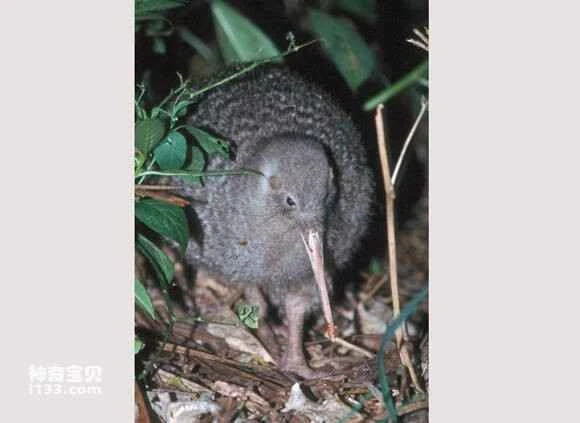
The little spotted kiwi is a strictly monogamous bird. A pair stays together for at least two or three breeding seasons. The breeding season is in late autumn, and the egg's gestation period in the female's body lasts up to a month. During this time, the female must store enough fat to produce a well-nutritious egg. Because they cannot fly, kiwis often nest in tree cavities at the base of trees, sometimes even on the ground. Kiwis are not very prolific; females typically lay only one or two eggs per year. Although kiwis are not large birds, their eggs are quite large, equivalent to one-quarter, or even one-third, of the female's body weight. The eggs are white or pale green, and the incubation process takes 70-74 days, entirely managed by the male. After hatching, the chick continues to consume the remaining yolk for nutrition for a week before beginning to learn foraging and other survival skills from the male. The chicks take a long time to mature, approximately four years.
Listed as Near Threatened (NT) in the IUCN Red List of Threatened Species, 2012 version 3.1.
Listed in Appendix II of the Washington Convention: Class I protected animal.
Protect wild animals and ban the consumption of wild game.
Maintaining ecological balance is everyone's responsibility!


