Basic Information
Scientific classification
- Chinese name: Yellow-fronted Woodpecker
- Scientific name: Melanerpes flavifrons, Yellow-fronted woodpecker
- Classification: Climbing birds
- Family and genus: Order Piliformes, Family Pilidae, Genus *Pterygota*
Vital signs data
- Body length: No verification information available.
- Weight: No verification information available.
- Lifespan: No verification data available.
Significant features
Distribution and Habitat
The Yellow-fronted Woodpecker is found in South America, including Colombia, Venezuela, Guyana, Suriname, Ecuador, Peru, Bolivia, Paraguay, Brazil, Chile, Argentina, Uruguay, and the Falkland Islands (also known as the Malvinas Islands).
The yellow-fronted woodpecker is found in forests, open woodlands, and forests where only a few scattered trees remain after logging; it is quite common within its habitat.
Appearance
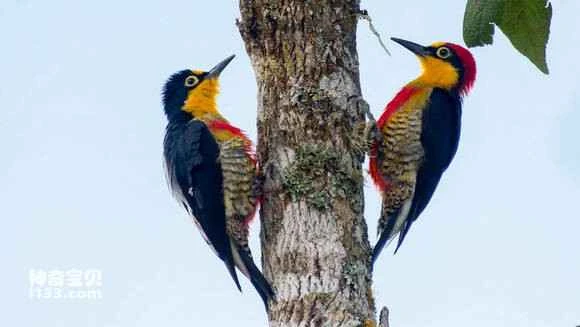
The Yellow-fronted Woodpecker is about 22 centimeters long. It has a bright yellow throat, white stripes on its back, white horizontal bars on its tail feathers, and sharp tail feathers that support its body.
Detailed introduction
The Yellow-fronted Woodpecker, scientifically known as Melanerpes flavifrons, is also called Yellow-fronted Woodpecker.
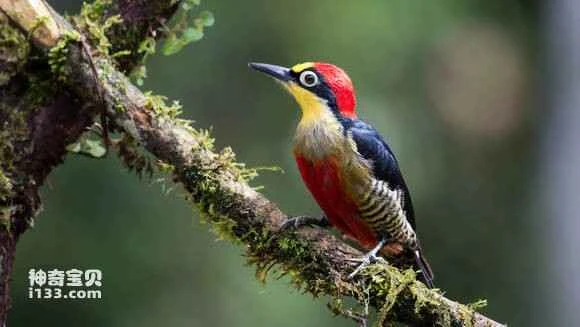
Yellow-fronted woodpeckers are highly gregarious, foraging for fruit in the bushes in flocks. They often perch on branches, sometimes hopping down from high herbaceous plants to eat berries. Captive individuals also eat insects and enjoy nectar, indicating that wild species can also reach into flowers to suck nectar. When courting or intimidating enemies, they will constantly shake their heads up, down, left, and right to display their yellow eye rings and bright red crown.
Listed in the IUCN Red List of Birds, version 3.1, 2009.
Protect wild animals and ban the consumption of wild game.
Maintaining ecological balance is everyone's responsibility!