
Basic Information
Scientific classification
- Chinese name: Yellow-striped Woodpecker
- Scientific name: Hainan Green Woodpecker, Black-naped Green Woodpecker, Yellow-eared Woodpecker, Yellow Woodpecker, Fire Crow, Green-eared Woodpecker, Megalaima faiostricta, Psilopogon faiostrictus, Green-eared Barbet
- Classification: Climbing birds
- Family and genus: Entomomorpha, Pterygomorphaceae, Pterygomorpha
Vital signs data
- Body length: Approximately 24 centimeters
- Weight: No verification information available.
- Lifespan: No verification data available.
Significant features
Distribution and Habitat
Country of origin: Cambodia, China, Thailand and Vietnam.
Breeding grounds: Lao People's Democratic Republic.
The Yellow-striped Woodpecker mainly inhabits broad-leaved forests in low mountains and plains below 1,000 meters above sea level, and also appears in sparse forests and secondary forests at forest edges.
Appearance
The Yellow-striped Woodpecker has a dark brown crown with white feather edges, forming prominent dark brown longitudinal stripes on the crown. The lower eye and ear coverts are yellowish-green, the nape is brown with yellowish-green feather edges, and the upperparts gradually turn bright grass-green from the nape onwards. The back, shoulders, and lesser and median wing coverts are tinged with copper-green. The central tail feathers are green, with the outer webs of the outer tail feathers green and the inner webs more brown. The primary flight feathers are brown with green inner webs, the outer secondary flight feathers have green outer webs and brown inner webs, with a yellowish-brown spot in the center and white feather edges, and the inner secondary flight feathers are entirely green. The lower edge of the cheek, chin, throat, and upper part of the foreneck are pale yellowish-brown; the rest of the underparts are bright grass-green. The breast and flanks have broad brown longitudinal stripes.
The iris is deep red, the mouth is grayish-yellow, and the tip of the mouth and the area around the nostrils are brown. The feet and toes are grayish-green.
Size measurements: body length 24 cm, bill 3 cm, wings 11.8 cm, tail 8 cm, tarsus 27 cm.
Detailed introduction
The Green-eared Barbet, scientifically known as Megalaima faiostricta or Psilopogon faiostrictus, has two subspecies.
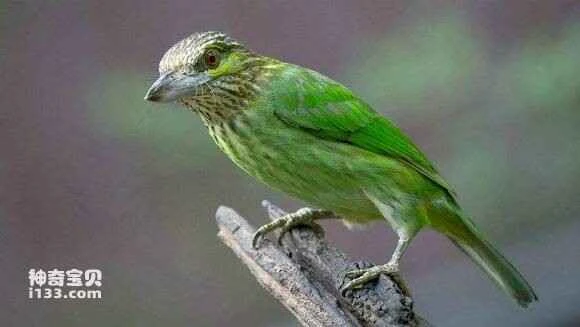
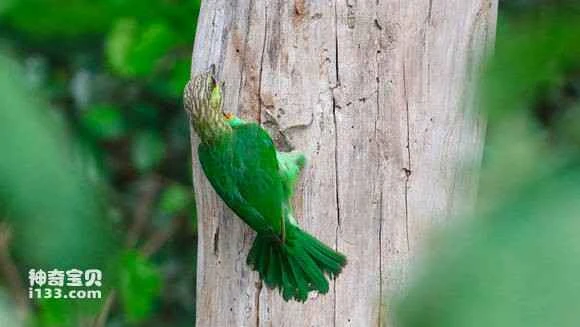
The Yellow-striped Barbet is a resident bird, sharing similar habits with other barbets in its genus. It is usually found alone or in pairs, and the flocking of adults and chicks after the breeding chicks leave the nest is short-lived. It can nimbly leap between tree trunks and branches with astonishing speed and stands firmly on vertical branches. It often hides in the dense foliage of tall trees and calls with a clear, resonant voice. It can produce a guttural "per-roo-roo-rook" and a rounded, flute-like rising "pooouk" call. Its diet consists mainly of plant fruits, seeds, and insects.
Listed as Least Concern (LC) in the IUCN Red List of Threatened Species 2018 ver 3.1.
Protect wild animals and ban the consumption of wild game.
Maintaining ecological balance is everyone's responsibility!


