
Basic Information
Scientific classification
- Chinese name: Great Barbet
- Scientific name: Psilopogon virens, Great Barbet
- Classification: Climbing birds
- Family and genus: Entomomorpha, Pterygomorphaceae, Pterygomorpha
Vital signs data
- Body length: 30-34 cm
- Weight: 150-230g
- Lifespan: No verification data available.
Significant features
Its call is monotonous and loud, consisting of a continuous, repetitive 'go-o, go-o' call.
Distribution and Habitat
Global distribution: Found in countries in the Himalayas, Myanmar, Thailand, and the Indochina Peninsula.
Distribution in China: Found in Yunnan, Guizhou, Sichuan, Anhui, Zhejiang, Fujian, Guangdong and southern Tibet.
The Great Barbet inhabits low and mid-mountain evergreen broad-leaved forests below 1500 meters in altitude, and is also found in mixed coniferous and broad-leaved forests. Its highest distribution altitude can reach 2500 meters.
Appearance
The Great Barbet is 30-34 cm in length. It has a large, thick bill, ivory or pale yellow; the entire head, neck, and throat are dark blue or purplish-blue; the upper breast is dark brown; the lower breast and belly are pale yellow with broad green or blue-green longitudinal stripes; the undertail coverts are red. The back and shoulders are dark greenish-brown, the rest of the upperparts are grass-green. The head and neck are blue or blue-green, with dark brown or black feather bases. The upper back and shoulders are dark greenish-brown, or tinged with dark red. The lower back, rump, upper tail coverts, and tail feathers are bright grass-green. The tail feather shafts are blackish-brown. The inner lesser and middle coverts are the same color as the back; the inner greater coverts are grass-green with chestnut-brown tips; the flight feathers are blackish-brown, the inner flight feathers are copper-green or grass-green; the outer webs of the inner primaries have grey or greyish-white tips. The upper breast is dark brown; the lower breast and central belly are green or blue-green with creamy yellow tinges; the flanks are yellow with brownish-green longitudinal stripes; the undertail coverts are red; the leg feathers are yellowish-green. Axillary feathers and underwing coverts yellowish-white. Iris brown or brownish-gray. Bill thick, ivory or pale yellow, with a lead-brown or dark brown tip on the upper mandible. Tarsus and toes lead-brown or greenish-brown, claws brown.
Size measurements: Weight ♂ 150-197 g, ♀ 173-230 g; Body length ♂ 300-325 mm, ♀ 303-335 mm; Bill length ♂ 38-43 mm, ♀ 37-44 mm; Wing length ♂ 139-144 mm, ♀ 138-151 mm; Tarsus length ♂ 32-34 mm, ♀ 30-35 mm.
Detailed introduction
The Great Barbet (Psilopogon virens) has four subspecies: 1. *Megalaima virens clamator*, found in Yunnan and other parts of mainland China. Its type locality is Yunnan. 2. *Megalaima virens magnifica*, found in Yunnan and other parts of mainland China. Its type locality is India. 3. *Megalaima virens marshallorum*, found in Tibet and other parts of mainland China. Its type locality is the Himalayas. 4. *Megalaima virens virens*, found in Sichuan, Yunnan, and extending eastward to Anhui, Zhejiang, and Fujian provinces. Its type locality is China.
).
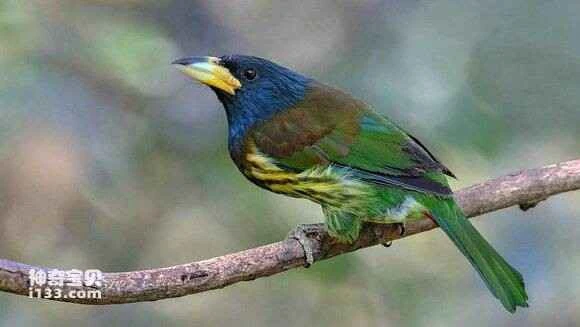
The Great Barbet is usually solitary or in pairs, but sometimes forms small flocks in areas with abundant food. It typically perches at the top of tall trees and can move from branch to branch like a parrot. Its call is monotonous and loud, consisting of a continuous repetition of 'go-o, go-o'.
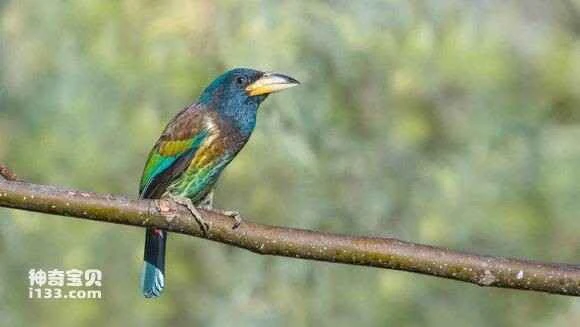
The Great Barbet's diet consists mainly of flowers, fruits, and seeds of plants such as privet, Araliaceae, and others. It also eats various insects, especially during the breeding season.
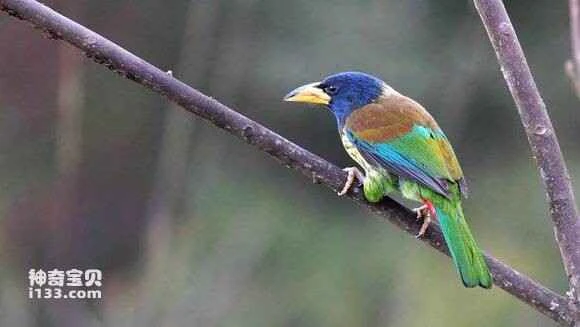
The Great Barbet's breeding season is from April to August. They nest and breed in pairs. They typically nest in trees in mountain forests at altitudes of 300-2500 meters, often carving their own nests into tree trunks, but sometimes utilizing natural tree cavities. The nest entrance is usually 3-18 meters above the ground, with a diameter of about 7 cm and a depth of 17 cm. Each clutch contains 2-5 eggs, mostly 3-4. The eggs are white, oval, and measure 30-39 mm × 22-29 mm. Both parents take turns incubating the eggs. The chicks are altricial.
It is listed in the "List of Terrestrial Wild Animals of Beneficial or Important Economic and Scientific Research Value under State Protection" issued by the State Forestry Administration of China on August 1, 2000.
Listed as Least Concern (LC) on the IUCN Red List of Threatened Species 2012 ver 3.1.
Protect wild animals and ban the consumption of wild game.
Maintaining ecological balance is everyone's responsibility!


