Basic Information
Scientific classification
- Chinese name: Brae's hummingbird
- Scientific name: Brace's Emerald Hummingbird (Chlorostilbon bracei)
- Classification: Climbing birds
- Family and genus: Apodiformes, Hummingbird family, Kingfisher genus
Vital signs data
- Body length: 9.5 cm
- Weight: No verification information available.
- Lifespan: No verification data available.
Significant features
It is an extinct hummingbird endemic to New Providence Island in the Bahamas.
Distribution and Habitat
New Providence Island, Bahamas.
Appearance
Bryce's hummingbird measures approximately 9.5 cm in length, with a wingspan of 11.4 cm and a tail length of 2.7 cm. Its beak is black, slightly curved downwards, and conical at the tip. Its legs are black. The back is copper-green with a golden sheen. The head is similar in color to the back but lacks the golden sheen. There are white spots behind the eyes. The throat is bluish-black, and the belly feathers are green with grey tips. The wings are purple. The flight feathers are green, and the vent feathers are grey with pale laurel edges.
Detailed introduction
The scientific name of the Brace's Emerald is Chlorostilbon bracei, and its specific habits are unknown.
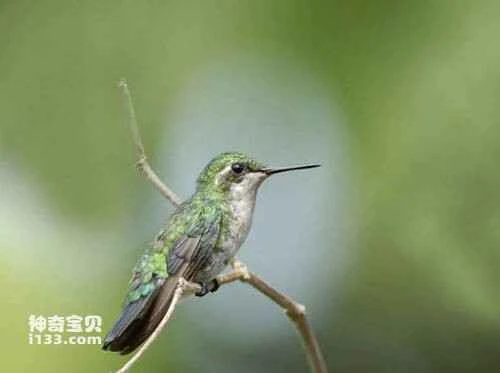
In 1877, a specimen of a male Blaine's hummingbird was discovered 4.8 kilometers outside Naso, Bahamas. The specimen's throat was unfortunately severely injured, and it was deposited at the Smithsonian Institution in Washington, D.C. However, this specimen went unnoticed until 1880 when it was listed as a synonym of the Cuban hummingbird. It wasn't until the 1930s that the differences between Blaine's hummingbird and the Cuban hummingbird were compared, and in 1945, Blaine's hummingbird was classified as a subspecies of the Cuban hummingbird. Blaine's hummingbird is smaller than the Cuban hummingbird, has a longer beak, and its plumage coloration differs.
In 1982, fossil remains of three Pleistocene hummingbirds were discovered in a cave on New Providence Island, including the Bahamal's star hummingbird, the Cuban kingfisher hummingbird, and the later confirmed Bryde's kingfisher hummingbird. This proved that Bryde's kingfisher hummingbird was a new species that had lived on New Providence Island since the Pleistocene. They likely lost their habitat due to human disturbance, such as the discovery of agriculture, and eventually became extinct at the end of the 19th century.
Protect wild animals and ban the consumption of wild game.
Maintaining ecological balance is everyone's responsibility!