Basic Information
Scientific classification
- Chinese name: Black-backed Albatross
- Scientific name: Phoebastria immutabilis, Laysan albatross
- Classification: Waterfowl
- Family and genus: Procellariiformes, Albatrossidae, Albatross
Vital signs data
- Body length: Approximately 81 cm
- Weight: 2.21-2.8kg
- Lifespan: 12-62 years
Significant features
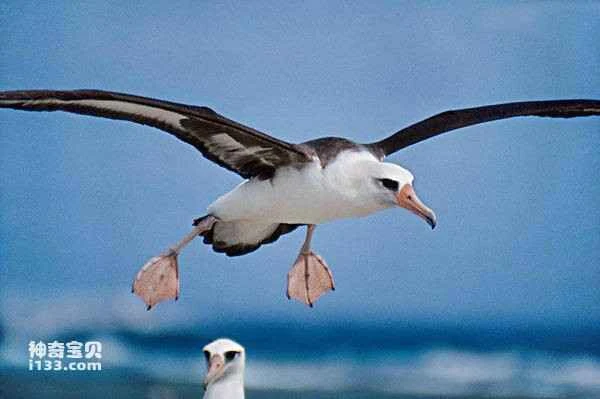
The body is entirely white from chin to rump, but darker on the upper wings and back, and predominantly white underwings with dark edges. The coverts have nearly black longitudinal stripes.
Distribution and Habitat
Origin: Canada, Japan, Marshall Islands, Mexico, Federated States of Micronesia, Northern Mariana Islands, Russian Federation, United States (Hawaii) and surrounding islands and outlying islands.
Wandering: New Zealand, Norfolk Island.
Uncertain distribution: Taiwan, China; South Korea.
They primarily inhabit small islands and surrounding waters in the open ocean. Outside of the breeding season, they mainly live and inhabit open ocean and bay areas, and do not live on land except during the breeding season. They spend their days flying over the vast ocean, sometimes soaring high in the sky, sometimes skimming close to the sea surface.
Appearance
The Black-backed Albatross is a medium-sized albatross, measuring 81 cm in length, with a wingspan of 195-215 cm and a weight of 2210-2800 grams. Its lifespan is 12 to 51 years (as of 2013, a Black-backed Albatross named "Wisdom" lived to be 62 years old). It is a large bird with extremely long wings. Males are slightly larger. Its distinguishing feature is a completely white plumage from the chin to the rump, but darker on the upper wings and back. The underwings are primarily white with dark edges, and the coverts have nearly black longitudinal stripes. The eyes and surrounding area are dark. In flight, the legs extend slightly beyond the tail. Juveniles resemble adults but have a heavier grey bill.
The iris is dark brown, the beak is yellow with a dark tip, and the feet are pinkish-grey.
Detailed introduction
The black-backed albatross (scientific name: Phoebastria immutabilis, also known as Laysan albatross) is a medium-sized albatross with no subspecies.
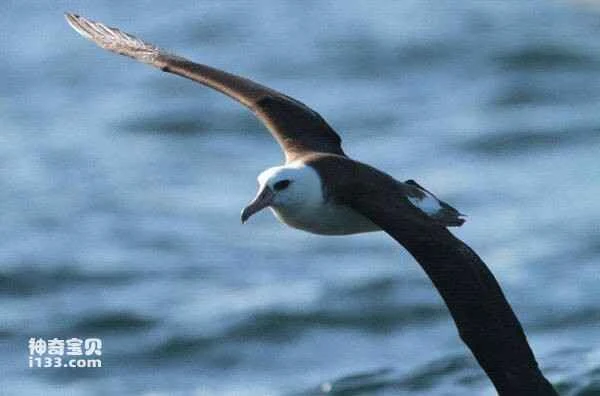
The black-backed albatross is renowned for its effortless flight—it can glide alongside ships for hours with almost no wing flapping. One adaptation to reduce the energy expenditure of muscles during gliding is a special tendon that holds the outstretched wing in place. Another is its remarkably long wingspan; compared to other families of proboscis, the albatross's forearm bones and phalanges are exceptionally long, and its wings are covered with 25-34 secondary flight feathers, compared to only 10-12 for petrels. Thus, the black-backed albatross's wings function like highly efficient aircraft wings; the high aspect ratio (wing length to width) allows them to glide rapidly forward with a very low probability of sinking. This adaptation to fast, long-distance flight allows the black-backed albatross to take off from its breeding grounds on islands and soar over the vast ocean.
As evidenced by their habit of following ships, black-backed albatrosses are well-known scavengers, preferring to feed on waste discarded from vessels. Their diet is broad, but detailed analysis of their stomach contents reveals that fish, squid, and crustaceans constitute their primary food source. They mainly hunt these prey at the surface, but occasionally dive into the water like gannets, reaching depths of 6-12 meters. Black-backed albatrosses sometimes forage at night, as much marine organic matter rises to the surface then. Detailed information about the ratio of daytime to nighttime feeding can be obtained by persuading them to swallow a sensor. Located in their stomach, the sensor records the immediate drop in body temperature when an albatross ingests a fish caught in the cold waters of the Southern Ocean. The proportions of ingested food components vary depending on the species, and this has a significant impact on the reproductive biology of albatrosses.
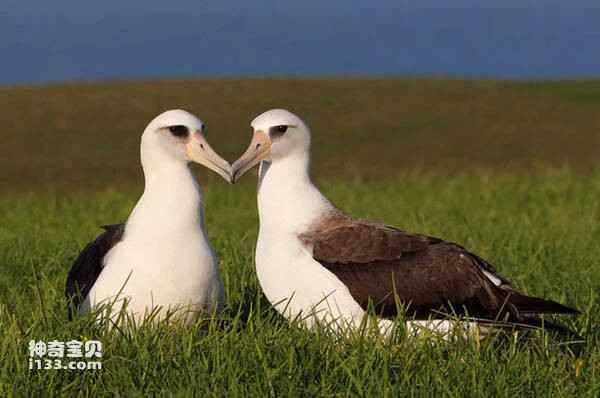
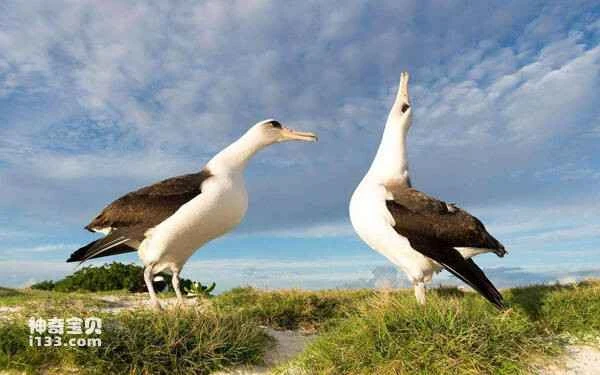
Black-backed albatrosses have a relatively long lifespan, averaging 30 years. However, they breed relatively late. Although they are physiologically capable of reproduction at 3-4 years old, they do not actually begin breeding for several years afterward, some even not until they are 15 years old. After reaching sexual maturity at 8-9 years old, black-backed albatrosses migrate from the sea to their permanent habitat, returning to land. Males arrive at the gregarious colony at the start of the breeding season and mate after the female joins. During courtship, black-backed albatrosses continuously sing "coo-coo" songs while bowing gracefully to their mates. They especially like to extend their beaks into the air to display their graceful curves to their lovers. It takes nearly 10 months, almost a year, to raise a chick. The first breeder engages in a carefully designed courtship display, establishing a partnership that will last for 40 years.
Most black-backed albatrosses nest in large groups, sometimes with thousands of pairs building nests in one large mound of earth and plant material. The male and female construct a shallow nest in an open area surrounded by tall vegetation within their habitat. The female lays only one egg. Incubation is shared by both parents, who typically rotate every few days. The entire incubation period is approximately nine weeks. Initially, the parents primarily feed the chicks, later focusing on care. The chicks are fed by both parents, who take turns bringing back food and begin taking turns flying over the sea to forage for several days at a time. During the brooding period, both parents take turns foraging in distant hunting areas for periods ranging from 1-3 days to over 5 days. Upon returning, they reflux stomach oil and partially digested stomach contents to feed the chicks.
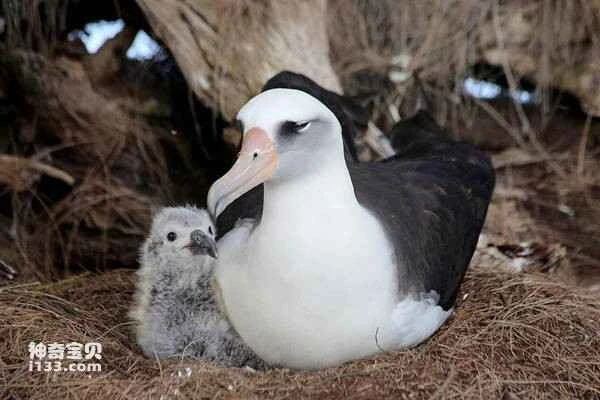
After 20 days, the caretaker period ends, and the adults then only periodically return to land to feed the chicks. During the day, the chicks often pace around 30 meters from the nest, searching for shady spots, but they immediately rush back to the nest as soon as their parents arrive with food. The adults will linger on land long enough to identify the chicks, feeding them undigested marine animal meat and the lipid-rich oils produced from their prey. It takes 120 days for the black-backed albatross to develop its full flight feathers. At the end of the breeding season in July, most birds fly northwest towards Japan, then northeast towards the Aleutian Islands off the coast of Alaska. They then migrate south to Hawaii for the next breeding season.
Once fully mature, young birds will appear at their breeding grounds near the end of the breeding season, but only for a short time; they will spend more and more time ashore in the following years seeking a mate. Once a pair bond is established, they usually live together until one dies. "Divorce" only occurs after several breeding failures and is very costly, as they will not breed for several years afterward. In fact, for wandering black-backed albatrosses, a single divorce can permanently reduce their reproductive success rate by 10%-20%.
The breeding colonies of the Black-backed Albatross, situated on isolated islands with no natural predators, had long been well-protected. However, after being discovered by sailors, they suffered immense losses: eggs were stolen, and adult birds were killed. Their plumage was further exploited in the manufacture of clothing and bedding. The species survived because the juveniles, not initially at their breeding colonies, were relatively safe at sea and later returned along their usual routes, thus "saving" the entire species. Since resuming breeding in 1954, the number of Short-tailed Albatrosses on Minami-Torishima Island, Japan, has slowly recovered, with one major breeding colony now numbering approximately 200 pairs. The Black-backed Albatross, on the other hand, has been severely threatened by the establishment of a U.S. Air Force base on Midway Island in the North Pacific. Nesting around military bases and airport runways, many birds have died after colliding with antennas and aircraft.
Black-backed albatrosses face even more hidden dangers at sea. Besides the hazards of oil spills and chemical pollutants, the more imminent threat comes from human fishing activities. Although gillnets are now prohibited in the high seas, the so-called "longline method" is widely used to catch seabed fish such as Chilean bass and mid-water fish such as tuna. A single longline for tuna fishing can be as long as 100 kilometers. After the longline is set, the bait is spread out from the bow of the fishing boat. Albatrosses find this temptation irresistible. They swallow the bait, get hooked, and are then dragged into the water by the longline, eventually being pulled ashore by fishermen along with other prey hours later. Up to 44,000 albatrosses perish in this way each year, leading to a decline in the populations of some species in the southern ocean.
Several practical measures can effectively reduce this threat, such as laying ropes at night. Meanwhile, international organizations are actively persuading relevant countries and fishing fleets to adopt fishing methods that are harmless to black-backed albatrosses. However, as fishing fleets worldwide further develop the southern waters, a new threat has emerged: humans may directly compete with albatrosses and other animals for krill, squid, and other marine life resources, which will inevitably affect their survival.
Listed as Near Threatened (NT) on the IUCN Red List of Threatened Species 2016 ver 3.1.
Protect wild animals and ban the consumption of wild game.
Maintaining ecological balance is everyone's responsibility!