Basic Information
Scientific classification
- Chinese name: Black-browed Albatross
- Scientific name: Thalassarche melanophrys, Black-browed Albatross
- Classification: Waterfowl
- Family and genus: Procellariiformes, Albatrossidae, Albatross
Vital signs data
- Body length: 80-95 cm
- Weight: 2.9-4.7kg
- Lifespan: Approximately 70 years
Significant features
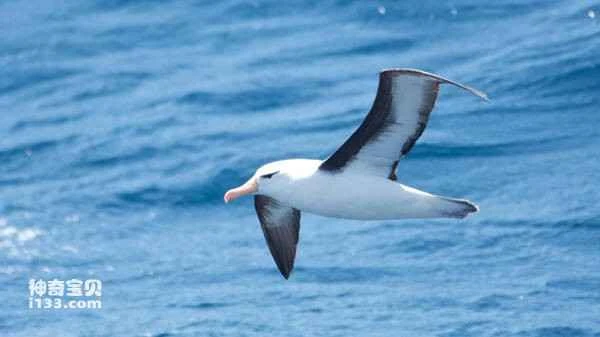
Black eyebrows, yellow-orange beak with a reddish-orange tip.
Distribution and Habitat
After migrating from the Falkland Islands to South Africa for the winter, black-browed albatrosses reunite with their mating partners in the nests they occupied in previous years.
Black-browed albatrosses are distributed in the oceans surrounding Antarctica, breeding on 12 islands. In the Atlantic Ocean, they are found in the Falkland Islands, the Diego Ramírez Islands, and South Georgia. In the Pacific Ocean, they are found on Campbell Island, the Antipodes Islands, the Snells Islands, and Macquarie Island. In the Indian Ocean, they are found in the Crozier Islands, the Kerguelen Islands, Heard Island, and the McDonald Islands.
Appearance
The Black-browed Albatross is a medium-sized bird, measuring approximately 80–95 cm in length, with a wingspan of 2–2.4 meters and an average weight of 2.9–4.7 kg. They can live to over 70 years old. Their wings and back are bright pink, while their abdomen and rump are orange. The wing base is primarily white with irregular black edges. They have black eyebrows and a yellowish-orange beak with a reddish-orange tip.
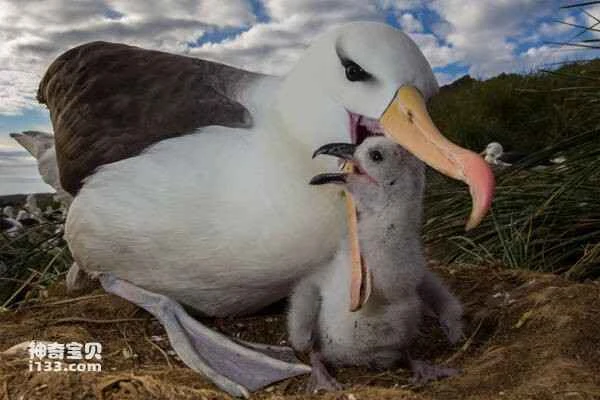
The chicks have dark red beaks, gray heads and necks, and dark undersides of their wings.
Detailed introduction
The Black-browed Albatross (Thalassarche melanophrys) is a large, widespread, and common albatross. It is named for its black brow, which is visible behind its eye. The Black-browed Albatross was first described by Conrad Jacob Temminck in 1828 based on specimens found at the Cape of Good Hope and was classified within the genus *Thalassarche*.
Black-browed albatross colonies are very noisy, frequently marking their territory with vocalizations. They use their tails to express affection. Black-browed albatrosses typically nest on grassy slopes or cliffs. However, in the Falkland Islands, they nest on grassy shores. They breed only once a year, between September and November, laying only one egg at a time. Both parents assist in incubation, which takes about 68-71 days. The chicks molt 120-130 days after hatching. Young birds return to the colony at 2-3 years old, primarily for courtship, and are ready to breed at around 10 years old.
The International Union for Conservation of Nature (IUCN) has listed the Black-browed Albatross as endangered based on a dramatic decline in its population. On Bird Island near South Georgia, breeding pairs are decreasing by 4% annually, while in the Kerguelen Islands, the population declined by 17% between 1979 and 1995. Populations in the Diego Ramirez Islands have been declining since the 1980s, but saw an increase in the Falkland Islands during the same period, possibly due to large amounts of fishery waste. Their numbers have declined dramatically by 67% over 64 years.
The increased use of longline fishing in the southern oceans is a major cause of the decline in the black-browed albatross population. In fact, black-browed albatrosses are among the most vulnerable to being killed by fisheries. Additionally, trawling has also reduced their numbers, particularly in the Patagonian shelf and near South Africa. Black-browed albatrosses are protected under the Bonn Convention and the Convention on the Conservation of Albatrosses and Petrels, their populations are monitored, and their breeding grounds are protected. Heard Island, the McDonald Islands, Macquarie Island, and New Zealand are among the sites protected as World Heritage Sites.
Protect wild animals and ban the consumption of wild game.
Maintaining ecological balance is everyone's responsibility!