
Basic Information
Scientific classification
- Chinese name: Oriental Great Hornbill
- Scientific name: Anthracoceros albirostris, Oriental pied hornbill, Pied hornbill
- Classification: Climbing birds
- Classification and genus: Order Coraciiformes, Family Hornbills, Genus *Bruguiera*
Vital signs data
- Body length: Approximately 80 centimeters
- Weight: No verification information available.
- Lifespan: Approximately 40 years
Significant features
Distribution and Habitat
The Oriental Great Hornbill is native to Xishuangbanna in China, and lives in tropical rainforests.
The Eastern Great Hornbill typically inhabits giant trees in dry forests and nests in tree cavities.
Appearance
The Oriental Great Hornbill measures 75-80 cm in length. Its back feathers are pure black with a green metallic sheen. The wing edges, flight feathers, and tail feather tips are white. The bony casque at the base of the bill is very well-developed, occupying almost one-third of its body length. The male has a large, downward-curving bill, about 15 cm long, with a tall, light, and sturdy casque at the base of the upper part of the bill. The bill and casque are filled with loose bony fibers, making them light, strong, and agile. Long eyelashes adorn the eyelid margins.
Detailed introduction
The Oriental Pied Hornbill, scientifically known as *Anthracoceros albirostris*, is a slow-flying bird. Its wings make a loud noise when in flight, like an airplane overhead. When it lands on a treetop, it emits a loud, harsh call that travels far, sounding like a horse neighing.
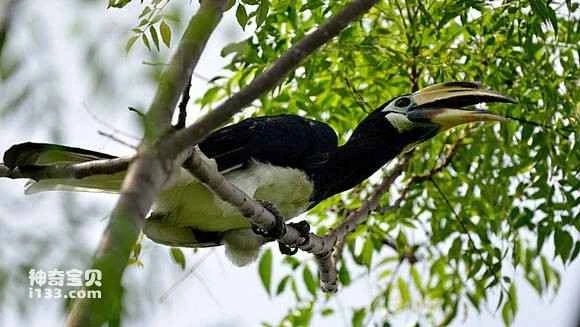
The Oriental Great Hornbill is a unique and precious large bird. Its broad, flat toes are perfectly suited for climbing trees, and it has large eyes with long, thick eyelashes. It remains faithful to its mate throughout its life, raising its offspring together in a unique way. It is an important ecological link in the tropical rainforest, contributing to a healthier forest environment.
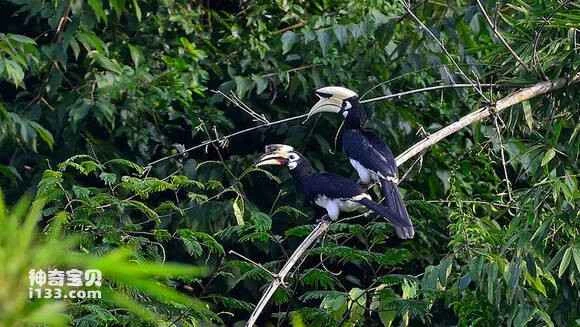
The Oriental Great Hornbill was once very common in the region, but now it is on the verge of extinction in my country. It is a Class II protected wild animal in my country.
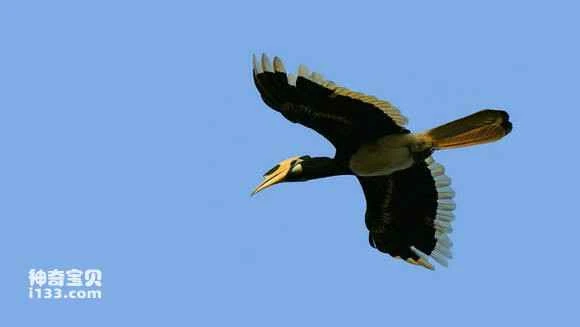
Protect wild animals and ban the consumption of wild game.
Maintaining ecological balance is everyone's responsibility!


