
Basic Information
Scientific classification
- Chinese name: Kingfisher
- Scientific name: Corythornis cristatus, Malachite Kingfisher
- Classification: Climbing birds
- Classification and genus: Order Coraciiformes, Family Kingfisher, Genus Kingfisher
Vital signs data
- Body length: Approximately 13 centimeters
- Weight: 12-18g
- Lifespan: No verification data available.
Significant features
The crested kingfisher is one of the most common kingfishers in Africa.
Distribution and Habitat
The crested kingfisher is native to: Angola, Benin, Botswana, Burkina Faso, Burundi, Cameroon, Central African Republic, Chad, Congo, Democratic Republic of Congo, Ivory Coast, Djibouti, Equatorial Guinea, Eritrea, Ethiopia, Gabon, Gambia, Ghana, Guinea, Guinea-Bissau, Kenya, Lesotho, Liberia, Malawi, Mali, Mauritania, Mozambique, Namibia, Niger, Nigeria, Rwanda, Senegal, Sierra Leone, Somalia, South Africa, South Sudan, Sudan, Swaziland, United Republic of Tanzania, Togo, Uganda, Yemen, Zambia, and Zimbabwe.
Migratory bird: Oman.
The crested kingfisher inhabits bodies of water such as streams, creeks, lakes, and irrigation canals with thickets or sparse forests and clear, slow-flowing water. Sometimes it also perches on rocks along the coast.
Appearance
The crested kingfisher is 13 cm long and weighs 12-18 grams. It is widely distributed south of the Sahara Desert in Africa. The crested kingfisher resembles the common kingfisher, but is slightly smaller, has a red beak instead of black, and its head feathers can be raised into a crest, hence its name. The crest feathers are black and pale blue or blue-green, interspersed with white spots. The cheeks and throat are red, with white patches on the chin and throat leading to the neck. The rest of the upper neck is bright ultramarine blue. The breast, wings, lower abdomen, and tail are a very deep red. It has a red beak, dark brown iris, and reddish-orange legs.
Males and females are similar. Young birds have darker plumage, a black beak, and more extensive and shorter feathers on the forehead and tip. The black beak begins to turn red after about 3 months.
The beak is thick, straight, long, and strong, with a rounded ridge; the nasal groove is indistinct; the wingtips are long, with the first primary flight feather slightly shorter and the third and fourth longest; the tail is short and rounded; the body plumage is bright and glossy, often with blue or green hues. The head is large, the neck short, the wings short and rounded, and the tail mostly short as well; the beak is large and pointed with a blunt culmen; the legs are very short, the toes slender and weak, the fourth toe mostly fused with the third, and only fused with the second toe at the base. The preen gland is covered with (unidentified feathers). Coracoid bones are present on both sides, and there are four notches on the posterior margin of the sternum; the manubrium of the sternum is simply formed by external spines.
Note: Many places online confuse the crested kingfisher (Alcedo cristata) and the crested kingfisher (Megaceryle lugubris) as one species. However, according to their Latin scientific names, they are two different species of kingfishers. The former belongs to the genus Alcedo cristata in the family Alcedoidae, while the latter belongs to the genus Megaceryle in the family Alcedoidae.
Detailed introduction
The crested kingfisher, scientifically known as *Corythornis cristatus*, also called Malachite Kingfisher or *Alcedo cristata*, has three subspecies: (1. *Alcedo cristata galerita*, found in Senegal and Ghana; (2. *Alcedo cristata cristata*, the nominate subspecies found in Nigeria, Sudan, Uganda, Angola, Namibia, Botswana, Zimbabwe, South Africa, and Kenya; and (3. *Alcedo cristata stuartkeithi*, the Sudanese subspecies found in Sudan, Ethiopia, Somalia, and Yemen.)
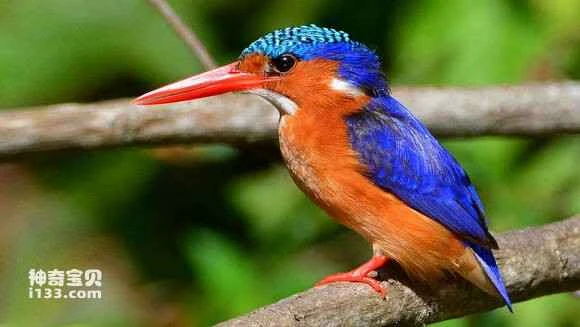
The kingfisher is highly territorial. Solitary by nature, it usually perches alone on branches or rocks near water, waiting to hunt. Its diet consists mainly of small fish, supplemented by crustaceans, various aquatic insects and their larvae, as well as small frogs and a small amount of aquatic plants. Even when submerged, the kingfisher maintains excellent vision because its eyes can quickly adjust to the visual contrast caused by light underwater. Therefore, it is highly skilled at catching fish.
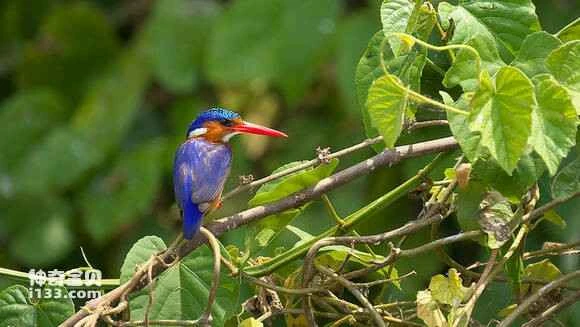
Crested kingfishers typically nest on earthen cliffs, or on the banks of fields and streams, digging tunnel-like burrows with their beaks. These burrows are usually unlined. Eggs are laid directly on the ground inside the nest. Each clutch contains 6-7 eggs. The eggs are pure white, glossy, and slightly spotted, measuring approximately 28 mm x 18 mm. There are 1-2 clutches per year; the incubation period is about 21 days. Both parents incubate the eggs, but only the female feeds the chicks. The chicks are fed larvae and aquatic insects, small crabs, shrimp, tadpoles, small fish, frogs, beetles, crickets, and small reptiles (mainly lizards). The female feeds the five chicks approximately 60-70 times a day.
Listed as Least Concern (LC) on the IUCN Red List of Threatened Species 2013 ver 3.1.
Protect wild animals and ban the consumption of wild game.
Maintaining ecological balance is everyone's responsibility!


