Basic Information
Scientific classification
- Chinese name: Emerald of Mark Island
- Scientific name: Todirhamphus godeffroyi, Halcyon godeffroyi, Marquenan Kingfisher
- Classification: Climbing birds
- Genus and species: Order Coraciiformes, Family Kingfisher, Genus Aldebaran
Vital signs data
- Body length: Approximately 22 centimeters
- Weight: No verification information available.
- Lifespan: No verification data available.
Significant features
It is a bird endemic to French Polynesia
Distribution and Habitat
Marquesas emeralds are found on the island of Marquesas in French Polynesia.
Mark Island emeralds typically inhabit dense forests and riverbanks near water.
Appearance
The Mark Island Emerald is 22 cm long. It has a pale yellow triangle on its upper back, a white crest, and blue markings on its forehead, wattles, cloak, and the center of its upper back. It has blue eye markings, a white belly, and turquoise rump, tail, and wings.
The beak is thick and long, resembling a chisel, with a relatively wide base, a straight beak peak, a rounded ridge, and no nasal grooves on either side; the wings are rounded, with the first primary flight feather being the same length as or slightly shorter than the seventh primary flight feather, and the second, third, and fourth primary flight feathers being nearly the same length; the base of the primary flight feathers has white spots; the tail is rounded.
Detailed introduction
The scientific name of the Marques Island jadeite is *Todirhamphus godeffroyi*, *Halcyon godeffroyi*, and *Marquenan Kingfisher*. It has no subspecies.
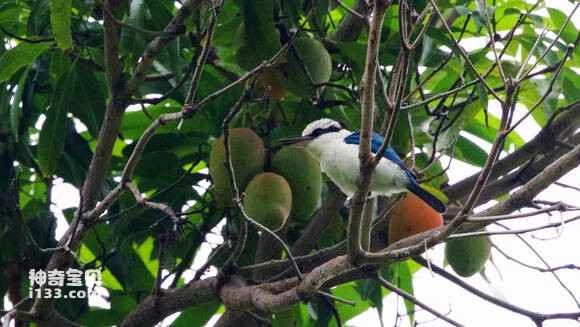
Mark Island kingfishers typically hunt alone or in pairs. Like most forest kingfishers, they are entirely carnivorous, often searching for prey in leaves or soil. Their main diet consists of invertebrates such as crickets, spiders, scorpions, and snails. They also eat small vertebrates such as small fish, snakes, and lizards.
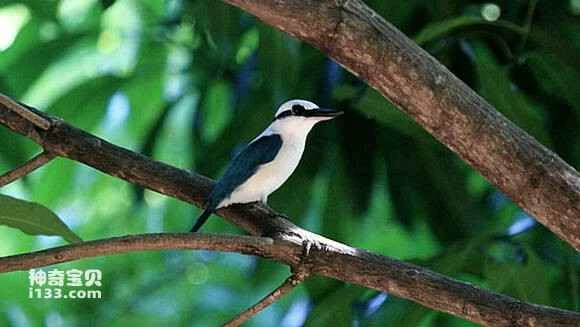
Mark Island emeralds nest in burrows in tree trunks. The eggs are nearly round, pure white, and approximately 29.4 × 26.2 mm in size.
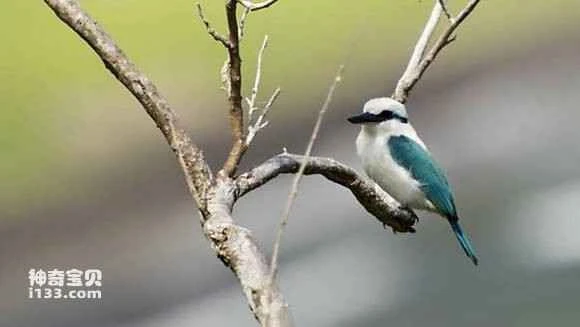
Currently listed as critically endangered, there are only about 350 mature individuals remaining in the wild, according to an estimate in 2014.
Listed as Critically Endangered in the IUCN Red List of Threatened Species (ver 3.1, 2008).
Protect wild animals and ban the consumption of wild game.
Maintaining ecological balance is everyone's responsibility!