
Basic Information
Scientific classification
- Chinese name: Red-backed jadeite
- Scientific name: Todirhamphus pyrrhopygia, Red-backed Kingfisher
- Classification: Climbing birds
- Genus and species: Order Coraciiformes, Family Kingfisher, Genus Aldebaran
Vital signs data
- Body length: Approximately 22 centimeters
- Weight: 41-48g
- Lifespan: No verification data available.
Significant features
The front is white with green striped caps, and the upper back is bright red from the waist to the tail.
Distribution and Habitat
Distributed in Australia and New Zealand (including Australia, New Zealand, Tasmania and nearby islands).
It typically inhabits arid or semi-arid regions. It is also found in eucalyptus shrublands, the Gibson Desert, the Greater Victorian Desert, and areas up to 100 km from the New South Wales coast. Its range extends throughout Australia, except for the southwest.
Appearance
The Red-backed Kingfisher measures 22 cm in length; females weigh 45-48g, and males 41-62g. This kingfisher is white on the front with a green-mottled cap. It has a sketch-like white eyebrow. A black eye stripe covers the lores and extends to the neck. The back of the neck, cheeks, chin, throat, and wingtip are largely white. There is a green tinge on the shoulders and upper back, slightly darker near the white collar. Some feathers on the back have white stripes, giving this area a horizontal striped appearance. The upper back, from the rump to the tail, is bright red. The tail is pale reddish-yellow with some green feathers in the middle, turning dark blue towards the tip. The bill is greyish-black with a colored lower jaw. The legs are olive-grey.
The female differs from the male in that her wings are bluish-green, and the stripes on her forehead and crown are interspersed with mottled gray or brown. Her collar is white. Juveniles generally resemble females, but differ in that the sides of the upper neck at the back of the neck have a pale reddish tinge. The neck and chest areas are slightly darker.
The beak is thick and long, resembling a chisel, with a relatively wide base, a straight beak peak, a rounded ridge, and no nasal grooves on either side; the wings are rounded, with the first primary flight feather being the same length as or slightly shorter than the seventh primary flight feather, and the second, third, and fourth primary flight feathers being nearly the same length; the base of the primary flight feathers has white spots; the tail is rounded.
Detailed introduction
The Red-backed Kingfisher, scientifically known as *Todirhamphus pyrrhopygia*, is a bird belonging to the kingfisher family.
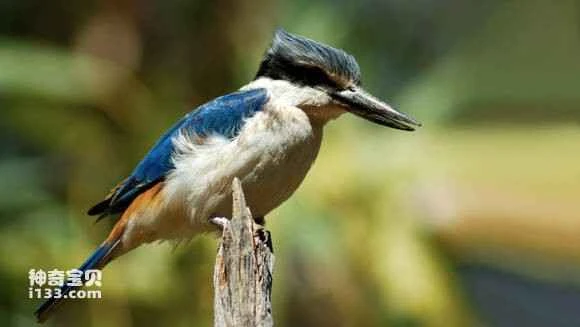
The redback eagle is both resident and migratory, spending August to April in northern Australia, primarily wintering on the Cape York Peninsula. From September to March, it moves to the extreme south. It undergoes a north-south movement.
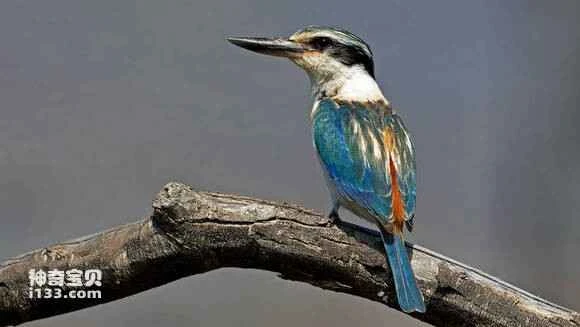
Like most kingfishers, the red-backed kingfisher is entirely carnivorous. It typically hunts for prey in leaves or mud. Its main diet consists of invertebrates such as spiders, centipedes, frogs, and tadpoles. It also eats small vertebrates such as small fish, snakes, lizards, mice, eggs, and fledglings.
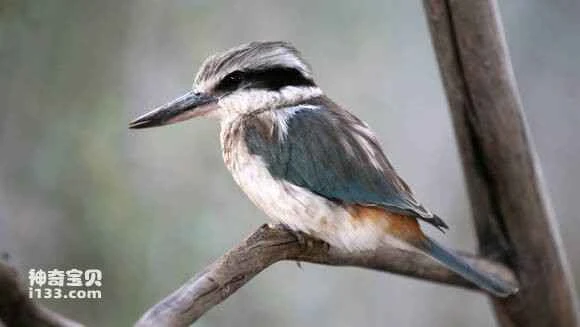
Red-backed kingfishers nest on earthen cliffs or riverbanks, digging tunnel-like burrows with their beaks. These burrows are generally unlined. Eggs are laid directly on the ground inside the burrow. They lay 4 to 6 eggs at a time. The egg-laying season varies depending on the region: from September to February in Queensland, from August to November in Western Australia, from November and September in South Australia, and from September to March in New South Wales.
Listed in the IUCN Red List of Birds, ver 3.1: 2008.
Protect wild animals and ban the consumption of wild game.
Maintaining ecological balance is everyone's responsibility!


