
Basic Information
Scientific classification
- Chinese name: Yellow-webbed sea swallow
- Scientific name: Oceanites oceanicus, Wilson's Storm Petrel
- Classification: Waterfowl
- Family and genus: Procellariiformes, Petrelidae, Petrel
Vital signs data
- Body length: Approximately 17 centimeters
- Weight: Approximately 40g
- Lifespan: No verification data available.
Significant features
It is one of the most widely distributed birds in the world.
Distribution and Habitat
The Yellow-webbed Petrel breeds on the coastline of Antarctica and nearby islands. Outside the breeding season, they live at sea, migrating north for the Southern Hemisphere winter. They are more common in the Atlantic Ocean than the Pacific. Outside of the breeding season, the Yellow-webbed Petrel is a typical pelagic bird, and given their breeding grounds in Antarctica, they are rarely seen on land.
It is one of the most widely distributed birds in the world, with an estimated population of over 50 million pairs worldwide.
Appearance
It is a small seabird with a body length of 17cm. It is brownish-black all over, with two prominent brownish-white spots on its wings, a white rump, and yellow webbed feet.
Detailed introduction
The yellow-webbed ocean petrel, scientifically known as Oceanites oceanicus, Wilson's Storm Petrel, is a species of petrel.
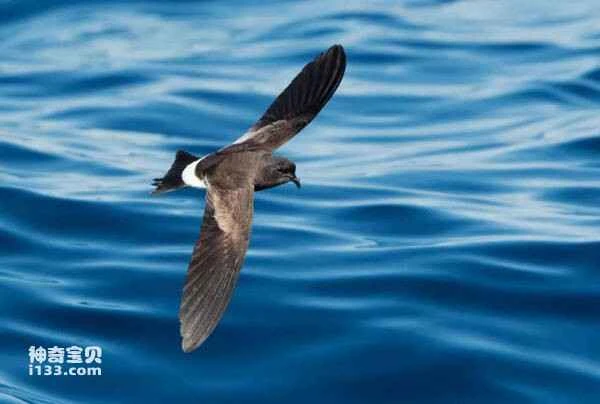
The Yellow-webbed Petrel is usually solitary or lives in small groups. Like many other petrels, it flies low close to the sea surface, its wings loosely flapping, occasionally gliding briefly, sometimes tilting or tumbling, to catch prey near the surface. Even in calm seas, they can use the breezes created by the waves to fly and use their long legs to help stabilize themselves. Yellow-webbed Petrels are highly gregarious animals and will also follow ships at sea. They make soft chirping sounds when foraging. They mainly feed on planktonic invertebrates on the surface of the sea and rarely jump into the water to catch prey. Sometimes they will also hunt small fish of 3-8 cm. When feeding, they hover in the air flapping their wings or slapping the water with their feet suspended.

The Yellow-webbed Petrel typically breeds from November to February of the following year, building its nest in rock crevices. The incubation period is 33-59 days, and the brooding period is 46-97 days.
Protect wild animals and ban the consumption of wild game.
Maintaining ecological balance is everyone's responsibility!


