
Basic Information
Scientific classification
- Chinese name: Black-footed Roundtail Shelduck
- Scientific name: Pterodroma cookii, Cook's Petrel, Fardela blanca de Cook, Fardela blanca de Más a Tierra, Fardela de Cook, Petrel de Cook
- Classification: Waterfowl
- Family and genus: Procellariiformes, Procellariiidae, *Rhynchus*
Vital signs data
- Body length: 25-30 cm
- Weight: Approximately 180g
- Lifespan: No verification data available.
Significant features
It is a greyish-white seabird with a white forehead that blends into a grey crown.
Distribution and Habitat
Resident birds: Peru and the United States.
Breeding grounds: New Zealand.
Non-breeding areas: American Samoa, Chile, Cook Islands, French Polynesia, Niue, Mexico, Norfolk Island, Pitcairn, Wallis and Futuna.
Wandering (non-breeding grounds): Canada.
Wandering: Australia and Kiribati.
Sources uncertain (seasonal uncertainty): Ecuador, French Southern Territories, New Caledonia, Samoa, Tokelau, Tonga, and Tuvalu.
The Black-footed Roundtail is endemic to New Zealand, primarily inhabiting areas between 34°S and 30°N, limited to three of New Zealand's islands. Its largest breeding ground is Little Barrier Island, while the bird is virtually nonexistent on the Great Barrier Reef islands, both in the north. However, the species also breeds on Cod Island off the south coast of Stewart Island. After breeding, it migrates to the eastern Pacific and appears off the west coast of America.
They typically nest under tall trees in forests at altitudes above 200 meters, but also in mature vegetation at lower altitudes. Nesting burrows are usually found between tree roots, under fallen trees, under rocks, or in soft soil.
This species breeds in caves on forest ridges and steep slopes at altitudes of 300-700 meters on Little Barrier Island and 4-350 meters on the Codfish Islands; the ideal breeding habitat is uncultivated forest near a ridge with low, open canopies and many large branches. It has previously bred in suitable habitats throughout New Zealand.
Appearance
The Black-footed Roundtail is 25-30 cm long, with a wingspan of 65-66 cm and a weight of 180 grams. It is a medium-sized bird, with similar sexes, but males are usually slightly larger than females. It has a distinctive upper beak structure, consisting of a tubular nose with a hooked tip; the nostrils are two openings above the beak. The head is grey with white spots and dark markings on the crown and forehead, a short, white brow ridge, and a dark area below the eyes. The black beak is 25-30 mm long. The eyes are dark brown; the legs are dark bluish-grey or dark pink; the webbed feet are yellow with black edges.
The plumage is greyish-white, with narrow wings. The grey underparts contrast with the distinct blackish-brown "M" pattern on the upper wings and rump. The tail is grey with a dark rectangular stripe in the center, the tip being the darkest, while the outer tail feathers are light grey, with the outermost paired feathers being white. The abdomen is mostly white, with only a dark patchy line forming the leading edge of the outer side of the underparts.
The tips of the upper feathers of young birds are lighter, contrasting with the dark wings and tail.
Detailed introduction
The Black-footed Round-tailed Shepherd (scientific name: Pterodroma cookii), also known as Cook's Petrel, Fardela blanca de Cook, Fardela blanca de Más a Tierra, Fardela de Cook, and Petrel de Cook, has no subspecies.
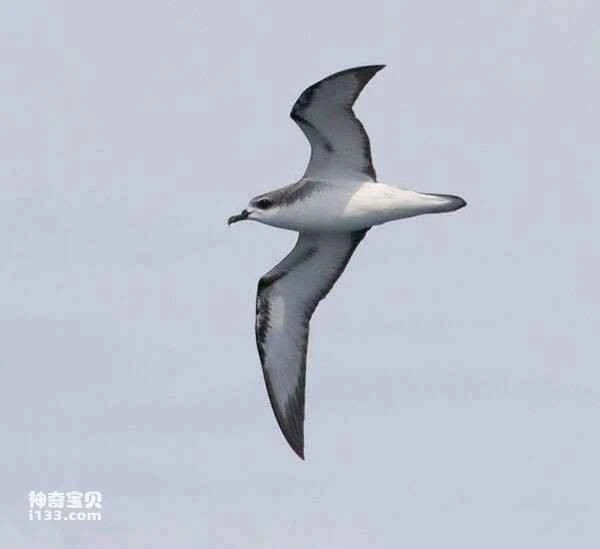
The Black-footed Roundtailed Shepherd migrates to the eastern Pacific Ocean between April and November after the breeding season. It migrates north to the Gulf of Alaska and south of the Aleutian Islands. The species can be found from the Aleutian Islands and northern Hawaii, to California and the west coast of South America, and even to southern Peru.
The Black-footed Roundtail is nocturnal at its breeding grounds. When the birds leave their breeding islands to forage after dark, their flight is rapid and unsteady, with rapid and urgent wingbeats. They possess many skillful and varied flight maneuvers, interspersed with soaring swoops. They are highly pelagic birds, only landing during the breeding season. They fly great distances when foraging at sea. They forage on the surface but can dive to depths of over 20 meters. They typically rely primarily on the surface for hunting, using their beaks to capture prey from the water's surface. The species' tubular nostrils, located on either side of its beak, provide a strong sense of smell, which is extremely helpful when foraging in the dark.
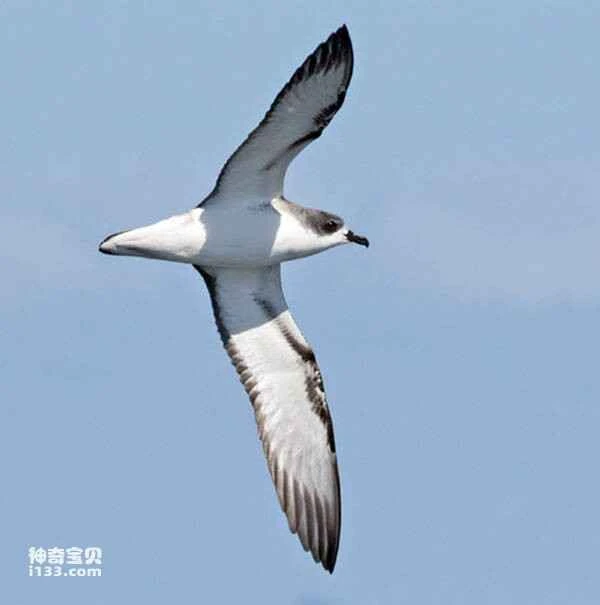
Like other petrels, the Black-footed Round-tailed Petrel has a very loud call. It makes a bleating sound, "kek-kek-kek," or a nasal sound, "nga-nga nga," sometimes during long flights. A low hissing sound or a loud snoring can also be heard. However, they can be quite quiet at sea. They generally forage at night, but during the breeding season, they will also forage during the day. They often fly low over the open sea, chasing the waves. They typically feed on invertebrates such as squid, small fish, cuttlefish, and crustaceans.
The breeding season for northern Black-footed Roundtails runs from September to April of the following year, but southern birds breed a month later. After their first visit to the nesting burrow, they will go to sea 25-27 days before laying eggs and hatching. The pair is monogamous, and their long-term pairing lasts for several seasons.
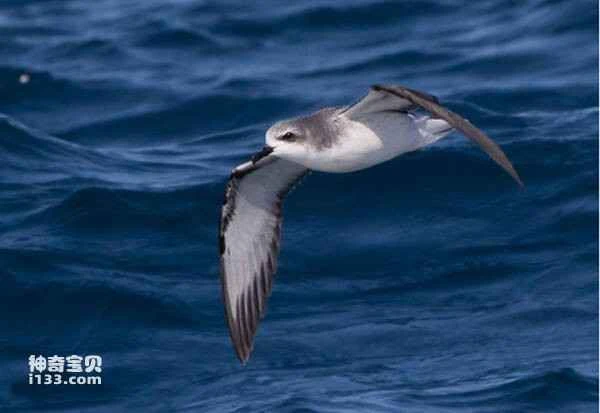
The Black-legged Roundtail Shearling nests in a long burrow, sometimes among tree roots on a slope. The nest is well-lined. The female lays a single white egg. Incubation lasts approximately 47 days, with a nursing period of 12-16 days. Newly hatched chicks are covered in light grey down on their upper bodies and mostly white on their underparts. They are cared for by two adults and become independent around 3 months old, usually in early March.
In January 2012, it was estimated that there were over 650,000 mature individuals on Little Barrier Island and approximately 15,000 mature individuals on Cod Island. Therefore, the total population estimate was rounded to approximately 670,000 mature individuals.
Listed as Vulnerable (VU) in the IUCN Red List of Threatened Species 2018 ver3.1.
Protect wild animals and ban the consumption of wild game.
Maintaining ecological balance is everyone's responsibility!


